
TransAct Technologies Updates Share Repurchase and Names New CFO Amid Q1 Operating Loss
The company reported an operating loss in Q1 2026 while initiating a $3 million share repurchase program and announcing a key CFO transition.
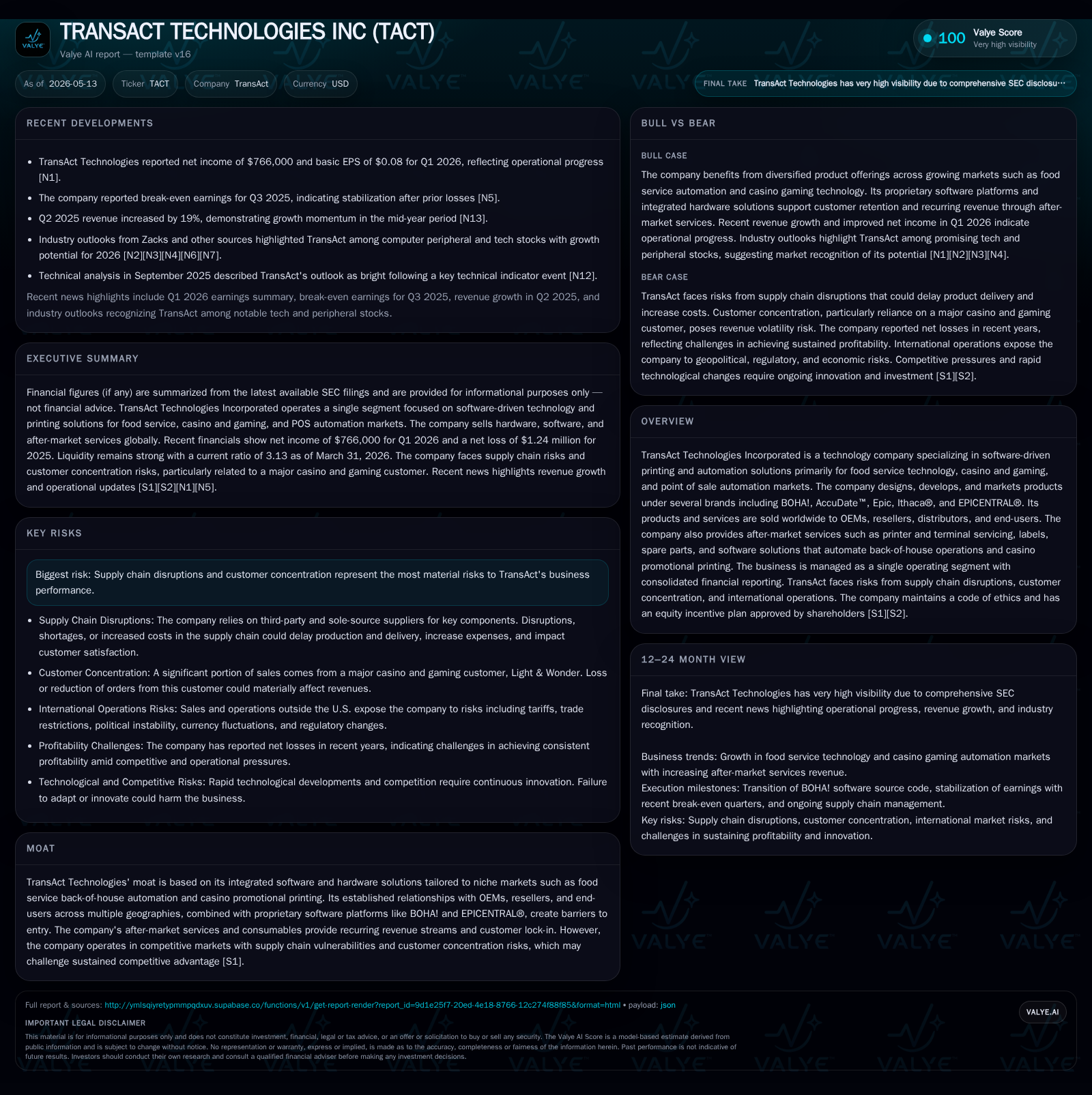
TransAct Technologies reported continued operating losses in its Q1 2026 filing but took strategic steps by authorizing a $3 million share repurchase plan and promoting Robert Campbell to CFO, ensuring leadership continuity. The business remains focused on its specialized software-driven printing and automation solutions serving food service back-of-house, casino gaming, and POS automation markets. Competitive positioning is supported by integrated hardware-software offerings and recurring after-market revenues, although risks from supply chain dependencies and customer concentration persist. Near-term growth hinges on recovery in casino orders, adoption of proprietary software platforms, and optimization of product mix.
Latest Quarterly Operating Update Reflects Challenging Market Conditions
In its latest Form 10-Q filed May 13, 2026, TransAct Technologies Incorporated reported an operating loss of $1.415 million for the first quarter, continuing results pressured by market softness especially in its casino gaming vertical where demand was subdued following inventory normalization after robust purchases in preceding years [S2]. The company disclosed no material changes in known risk factors since the prior annual report but announced several important corporate developments that impact near-term strategy. On May 12, it authorized a new $3 million share repurchase program to be executed through open market or negotiated transactions over the next twelve months, reflecting management's commitment to managing shareholder value amidst ongoing profitability challenges [S3]. Simultaneously, TransAct announced that Robert Campbell will succeed retiring CFO Steven DeMartino effective June 30. Having served as Controller since mid-2022 with over a quarter-century of financial leadership experience across manufacturing organizations, Campbell’s appointment signals continuity during a time of operational headwinds [S3].
These developments provide context to TransAct’s current environment where operating losses persist but capital allocation moves such as the buyback serve as tactical responses during cautious optimism for gradual market recovery.
Business Model Overview: Integrated Solutions for Targeted Automation Niches
TransAct’s consolidated operations focus on designing and marketing integrated software-driven printing and automation systems primarily targeted at niche sectors: food service technology (FST) back-of-house operations, casino and gaming promotional printing, and point-of-sale (POS) automation. The portfolio comprises several branded offerings including BOHA!, AccuDate™, Epic™, Ithaca®, and EPICENTRAL®, delivering hardware products paired with proprietary software platforms to streamline complex workflows [S1].
Revenue mechanics hinge on multiple streams: initial equipment sales primarily to OEMs, resellers, distributors, and direct end-users worldwide; recurring revenues from after-market services like printer repairs, labels, spare parts; and subscription or license fees linked to proprietary software enabling back-of-house operational automation or promotional print management in casinos [S1]. This integrated approach creates switching costs anchored by the harmonious interplay between hardware reliability and specialized software capabilities that often necessitate vendor lock-in.
Operationally managed as a single segment leveraging centralized R&D and supply chains underlies efficiency gains while addressing similar customer profiles globally. Recent capital expenditures focus on software development—particularly completion of a licensed BOHA! source code acquisition—to drive deeper penetration into FST markets via enhanced platform capabilities [S1].
Competitive Positioning Within Printing and Point-of-Sale Automation Industry
In the specialized markets served by TransAct—particularly FST back-of-house tech and casino promotional printing—the competitive landscape is characterized by a few key players contending over entrenched customer relationships supplemented by supply chain complexity. TransAct’s moat derives from its integrated product portfolio combining proprietary software platforms (BOHA!, EPICENTRAL®) tightly coupled with dedicated hardware devices (printers and terminals), creating technical barriers that inhibit easy substitution or entrant competition [S1].
However, competitive pressures remain from pricing dynamics influenced by global supply chain disruptions; notably assembly operations centralized in Thailand expose manufacturing throughput to geopolitical or logistical risks that can increase costs or delay deliveries [S1]. Moreover, customer concentration is pronounced: a handful of large casino operators represent significant revenue proportions—introducing volatility contingent on their investment cycles or inventory strategies [S4]. Pricing power is therefore somewhat constrained by customer bargaining leverage.
The offering differentiation accrues primarily through embedding advanced software functionalities tailored to regulatory compliance requirements in gaming venues or operational efficiency in food service environments—features less commoditized than generic POS equipment but requiring continuous innovation investment.
Drivers for Growth: Software Innovation, Recurring Revenue, and Market Recovery
Looking ahead, TransAct’s growth engines pivot on structural industry recoveries coupled with secular trends favoring digital transformation in hospitality-related sectors. Post-pandemic casino activity normalization underpins expected reacceleration in promotional printing demand following the inventory correction phase that dampened orders through late 2023 into early 2024 [S1].
Equally pivotal is broadening BOHA!’s footprint within food service technology back-of-house automation—a market exhibiting increasing appetite for process digitization to reduce labor costs and improve compliance auditing. The acquisition of BOHA! source code positions TransAct to deepen product innovation enabling enhanced integration with third-party POS ecosystems or mobile ordering platforms—a differentiator in winning OEM partnerships or direct customers.
The recurring revenue streams derived from consumables—printer labels, replacement parts—and service contracts add stability while improving gross margin profiles over time as installed base scales. Measures such as backlog volumes for consumables or subscription renewal rates could serve as leading KPIs to monitor traction in these more predictable revenue buckets.
Risks and Constraints: Supply Chain Exposure, Customer Concentration, Profitability Volatility
Despite upside levers, notable risks cloud the path forward. The company explicitly calls out supply chain dependencies concentrated on its Asian contract manufacturer base—disruptions or cost inflation materially affect manufacturing economics given limited alternative capacity [S1]. Inflationary pressures elevate raw material costs which may not be fully transferable to price-sensitive customers.
Customer concentration adds cyclicality; major gaming customers’ order behaviors directly impact quarterly results creating potential revenue volatility. Profitability continues to face headwinds as the company has recorded net losses several times over recent years including $1.24 million net loss for full year 2025 despite prior profitable intervals reflecting inconsistent margin management amid volatile sales patterns [S1][F1].
Additional challenges include evolving regulatory compliance demands within gambling jurisdictions requiring ongoing software updates; dependency on third-party hosting during transition phases for BOHA! software; potential goodwill impairment risks should expected growth not materialize; along with general macroeconomic uncertainties influencing discretionary spending within hospitality verticals [S1].
Upcoming Milestones and Performance Watchpoints
Critical near-term developments will hinge on observing Q2 performance metrics when next results are disclosed: signs of stabilizing or growing order volumes particularly from casinos will signal recovery validation post-inventory corrections. Uptake rates for new BOHA! versions rolled out following source code acquisition will indicate software market traction.
Execution effectiveness around the $3 million share repurchase under Rule 10b-18 guidelines starting May 12 will merit attention as a gauge for management confidence deployment of capital amidst earnings pressures. Furthermore, monitoring the transition period concluding June 30 when Robert Campbell officially assumes CFO duties can reveal impacts on financial stewardship amid ongoing cost controls.
Broader macro variables such as inflation trends affecting material inputs or global logistics capacity also remain external watchpoints influencing margin trajectories.
Brief Financial Snapshot Highlighting Liquidity and Capital Allocation Moves
Latest financial snapshot
| Metric | Value | Period |
|---|---|---|
| Cash & equivalents | $19mm | |
| 2026-03-31 | ||
| Current assets | $39mm | |
| 2026-03-31 | ||
| Current liabilities | $12mm | |
| 2026-03-31 | ||
| Current ratio | 3.13x | |
| 2026-03-31 |
Source: SEC companyfacts cache [F1].
As per the latest quarter ended March 31, 2026 ([F1],[S2]), TransAct maintains robust liquidity:
| Metric | Value (USD) | Date |
|---|---|---|
| Cash & Equivalents | 18,841,000 | |
| 2026-03-31 | ||
| Current Assets | 38,712,000 | |
| 2026-03-31 | ||
| Current Liabilities | 12,370,000 | |
| 2026-03-31 | ||
| Current Ratio | 3.13 | |
| 2026-03-31 |
This liquidity profile provides cushion supporting operational needs amid loss-making quarters while underwriting the newly authorized share repurchase program valued at up to $3 million over one year commencing May 12 [S3]. Capital expenditures remain modest relative to cash balances ensuring operational flexibility.
Disclaimer: This analysis is prepared solely for informational purposes based on publicly filed SEC documents and news sources without providing any investment advice or recommendations.
Disclaimer: This is research-only, informational analysis and not investment advice. It may include AI-generated interpretation and general industry context. Always verify important details using primary sources.

Comments