
Kadant Inc Advances Sustainable Processing Solutions with Strategic Acquisitions
Kadant’s strong Q1 performance and recent acquisitions bolster its position in engineered sustainable industrial processing solutions.
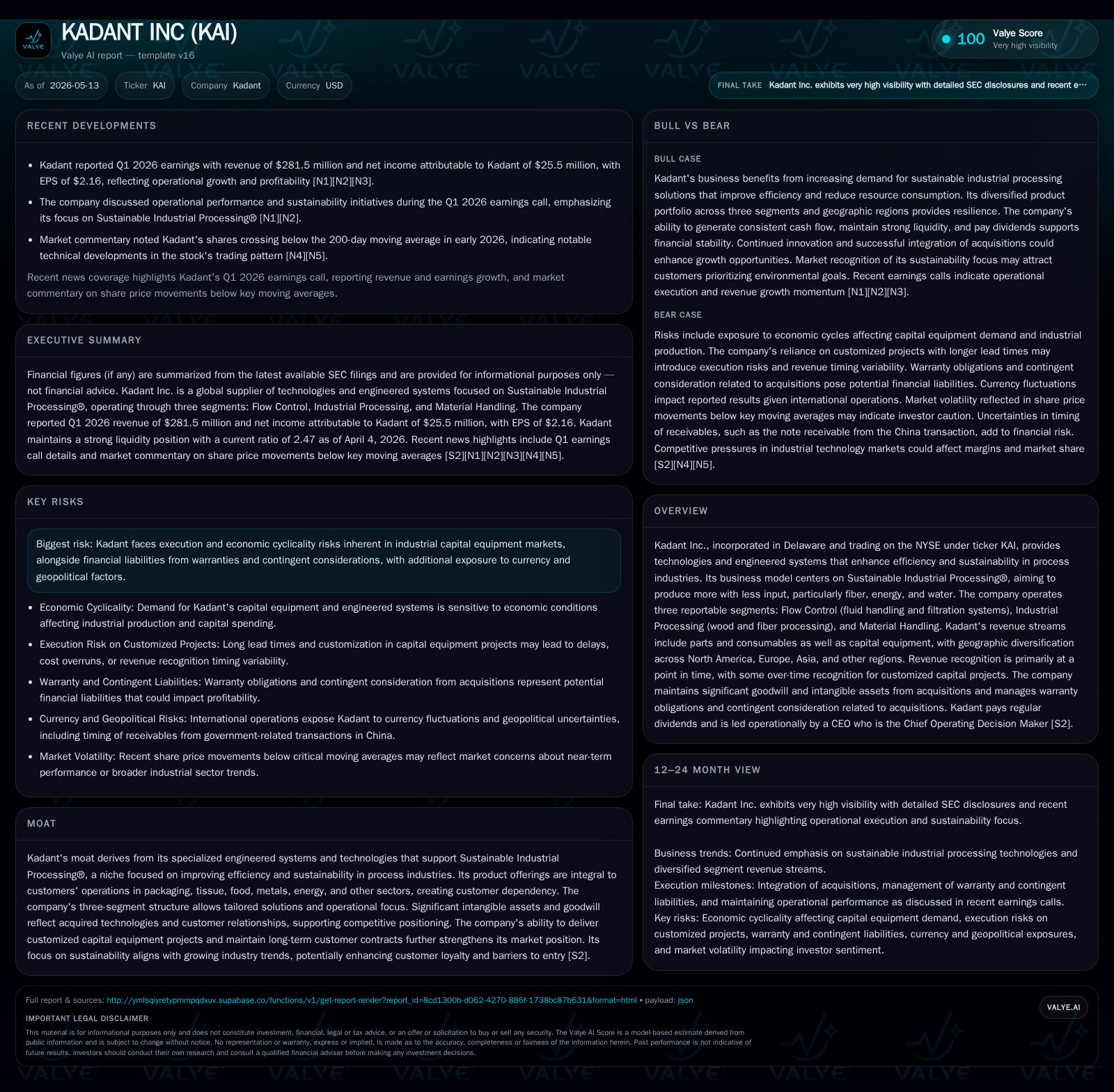
Kadant Inc delivered an 18% year-over-year revenue increase in Q1 2026, supported by integration gains from recent acquisitions such as Babbini and Clyde Industries. The company's core business model centers on its Sustainable Industrial Processing® platform, leveraging three specialized segments to provide capital equipment and consumables that drive efficiency and sustainability in fiber, energy, and water usage across process industries. Kadant’s competitive moat rests on proprietary engineered systems and long-term customer relationships reinforced by sustainability trends. Growth is fueled by geographic expansion, acquisition synergies, and ongoing R&D innovation, although execution risk, economic cyclicality, and leverage constraints merit close monitoring.
Latest Quarterly Operating Update: Momentum in Financials and Integrations
Kadant's first quarter of fiscal 2026 displayed notable operational momentum as the company reported revenue of $281.5 million, an approximately 18% increase compared to the prior year's corresponding period [$239.2 million] ([S2]). This top-line growth translated into operating income of $40.1 million, up from $35.6 million in Q1 2025, signaling effective cost management alongside expanding sales. Selling, general and administrative expenses rose commensurately with the expanded scale to support ongoing growth initiatives.
Significantly, measurement period adjustments related to the acquisitions of Babbini (July 2025) and Clyde Industries (October 2025), which integrate engineered dewatering, power transmission solutions, and boiler efficiency systems capabilities into Kadant's portfolio, contributed favorably to the operational footprint impacting reported results this quarter ([S8]). Additionally, Kadant announced completion of the voestalpine BÖHLER Profil acquisition at the end of April 2026 ([S24]), introducing capabilities in customized rolled profiles and industrial knife solutions into the Industrial Processing segment.
This series of acquisitions was strategically financed predominantly via borrowings under Kadant’s revolving credit facility ([S4],[S24]), with continued management emphasis on realizing synergy capture while sustaining strong operational performance during the integration phase.[N3]
Comprehensive Business Model: Sustainable Industrial Processing® at Core
At the heart of Kadant's enterprise is its Sustainable Industrial Processing® initiative—a proprietary approach targeted at enhancing efficiency for customers primarily in fiber-based and other process industries through innovative engineered systems rather than commodity products ([S1]).
The three reportable segments underpinning revenues are:
- Flow Control: Provides fluid handling and filtration systems essential for process optimization.
- Industrial Processing: Focuses on wood and fiber processing equipment, including highly engineered cutting-edge solutions bolstered by recent acquisitions.
- Material Handling: Delivers equipment facilitating efficient product flow within industrial operations.
Revenue arises from both capital equipment sales—largely recognized over time for extensive custom projects—and recurring parts and consumables recognized at a point in time when delivered ([S18]). This dual stream stabilizes revenues by coupling project-driven capital orders with steady aftermarket demand.
Customer retention benefits from system integrality where Kadant’s products are embedded deeply in critical manufacturing workflows (e.g., tissue production lines), establishing significant switching costs driven by customization and service contracts ([S1]). The company also leverages geographic diversity spanning North America, Europe, Asia, and other regions reducing dependency on any single market ([S18]).
Competitive Landscape and Industry Structure: Navigating Niche Engineering Systems
Kadant competes within a market niche defined by ever-more stringent sustainability mandates coupled with industrial customers’ relentless focus on process efficiency. Key competitive factors include proprietary filtration technologies, specialized fabrication methods (e.g., near-net-shape rolling acquired via Kadant Profil), extensive aftermarket support networks, and customized capital project execution capabilities ([S1],[S14]).
The industry’s structural barriers are enhanced by regulatory pressures emphasizing reduced resource consumption (fiber, energy, water) that elevate product differentiation based on demonstrable sustainability impact. Kadant's intellectual property portfolio combined with goodwill from acquisitions embeds technological know-how that competitors find challenging to replicate swiftly ([S2],[S14]).
Recurring consumables revenue engenders predictable cash flow streams while bespoke system sales create deeper client engagements fostering loyalty. Supply chain resilience remains critical amid global volatility; Kadant’s geographic footprint mitigates localized disruptions but requires vigilant procurement strategies ([S1]).
Growth Catalysts: Demand Expansion Through Sustainability and Acquisitions
Kadant’s growth outlook has multiple structural pillars:
- Sustainability imperatives are driving wide-scale adoption of more efficient processing technologies across packaging, tissue manufacturing, metals refining, food production, etc., elevating demand for systems that reduce waste inputs without compromising output quality or volume ([N2],[S1]).
- Recent acquisitions like Babbini, Clyde Industries, and Kadant Profil notably expand product breadth allowing cross-selling into adjacent markets while increasing total addressable market ([S8],[S24]).
- Geographic expansion benefits linked to these acquisitions enhance penetration in European industrial hubs as well as access emerging markets requiring advanced process efficiencies.
- Investment in R&D remains robust reflecting management’s focus on engineering novel solutions compatible with evolving regulatory frameworks and digitalization trends ([N2],[S2]).
This combination positions Kadant not only for incremental organic expansion but also inorganic bolt-on growth opportunities targeting complementary capabilities or new geographies.
Risk Factors and Potential Constraints: Cyclicality and Execution Challenges
Despite strategic strengths, several risks deserve scrutiny:
- The industrial capital equipment cycle is inherently cyclical given its dependence on end-market capex budgets which fluctuate with macroeconomic conditions; fluctuations can defer major orders or compress margins ([S1],[S14]).
- Execution risk from multiple integration processes may press costs higher or dilute focus if synergy realization lags projections ([S8],[S14]).
- Warranty obligations arising from complex engineered projects expose Kadant to contingent liabilities requiring prudent provisions ([S14],[S29]).
- Currency volatility impacts arise due to multinational operations with euro-denominated borrowings comprising a significant component of Kadant’s debt portfolio (~$78M EUR borrowings at April 2026) ([F1],[S4]).
- Debt covenants impose leverage limits including heightened thresholds post-acquisition quarters (max consolidated leverage ratio up to 4.25x EBITDA during acquisition adjustment periods), mandating close monitoring to avoid covenant breaches amid business cyclicality ([S4]).
Key Investor Watchpoints: Forward Guidance and Integration Milestones
Near term attention should focus on:
- Management’s updates for Q2+ guidance specifically regarding organic growth versus acquisition-derived contributions per segment ([S2])—vital for calibrating sustainable profitability trajectories.
- Synergy realization clarity reflected through cost savings realization reports post-integration of Babbini, Clyde Industries, and Kadant Profil as disclosed periodically ([S8]).
- Pipeline developments including contract awards centered on sustainability-enhancing technologies which could serve as leading indicators for renewed capex cycles.
- Progress against R&D milestones aligned with product innovation aimed at penetrating more regulated or rapidly evolving global markets focused on carbon footprint reduction.
Financial Snapshot and Capital Structure Overview
Latest financial snapshot
| Metric | Value | Period |
|---|---|---|
| Cash & equivalents | $117mm | |
| 2026-04-04 | ||
| Total debt | $360mm | |
| 2026-04-04 | ||
| Net debt | $243mm | |
| 2026-04-04 | ||
| Current assets | $563mm | |
| 2026-04-04 | ||
| Current liabilities | $227mm | |
| 2026-04-04 | ||
| Current ratio | 2.47x | |
| 2026-04-04 |
Source: SEC companyfacts cache [F1].
Kadant closes Q1 2026 with solid liquidity demonstrated by cash balances exceeding $117 million paired against total debt obligations around $360 million resulting in net debt near $243 million ([F1],[S4]). Interest expense reflects a weighted average rate of about 4.52%, consistent with availability under its credit agreement which imposes financial covenants constraining leverage.[F1][S4]
Overall financial metrics support stable funding capacity underpinning ongoing acquisitions while maintaining operational flexibility.
Disclaimer: This analysis does not constitute investment advice or recommendations. It is intended exclusively for informational purposes drawn from publicly available SEC filings and company disclosures.
Disclaimer: This is research-only, informational analysis and not investment advice. It may include AI-generated interpretation and general industry context. Always verify important details using primary sources.

Comments