
Auburn National Bancorporation Strengthens Regional Foothold Amid Evolving Market Dynamics
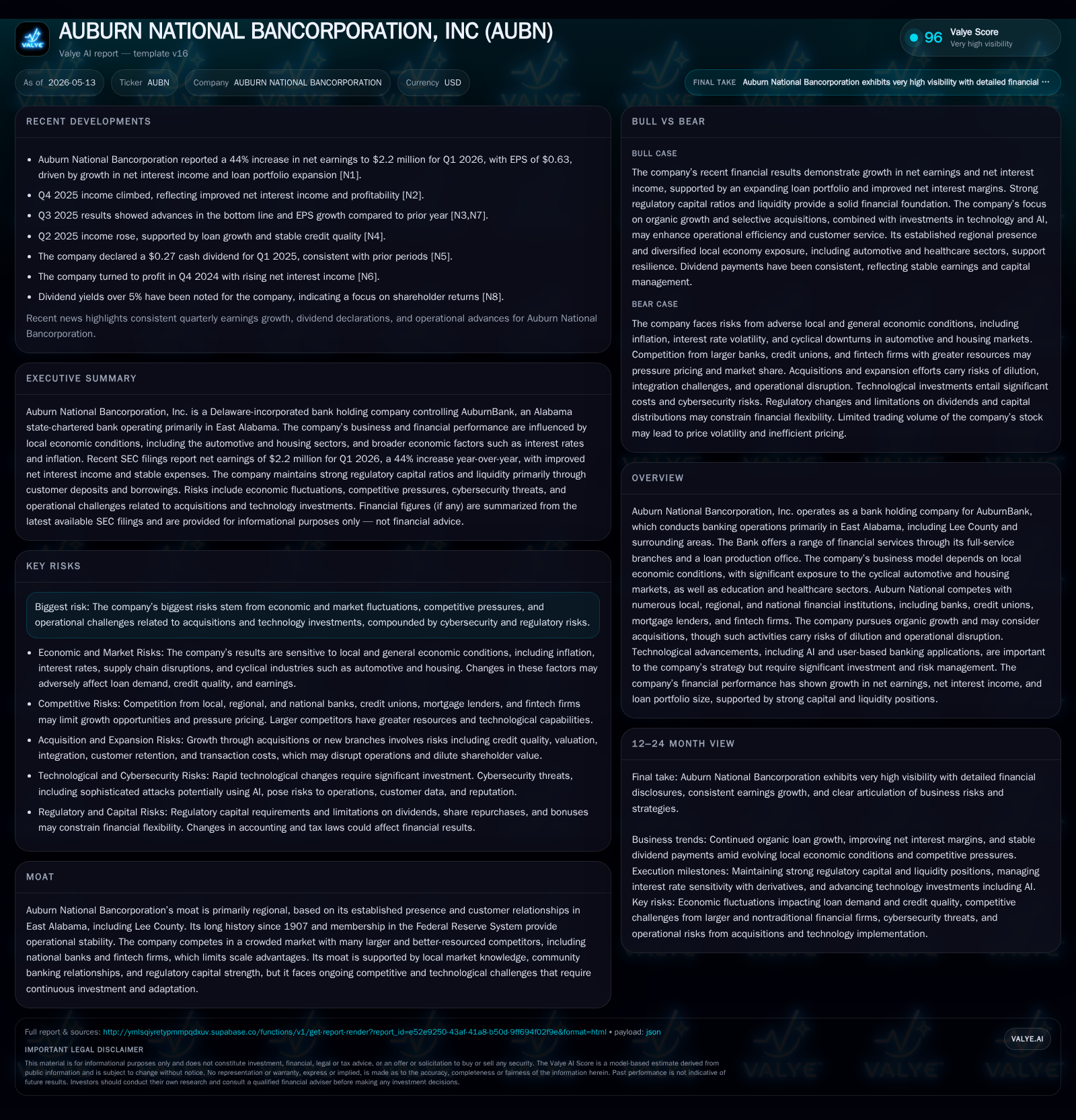
Auburn National Bancorporation’s Q1 2026 update reflects solid capital adequacy and improving asset quality amid local economic cyclicality and competitive pressures.
In its latest quarter, Auburn National Bancorporation showed resilient financial performance with a modest rise in net interest income and strong capital ratios. The company’s business model centers on community banking in East Alabama, heavily influenced by cyclical automotive and housing sectors. Competitive dynamics feature pressure from larger banks, fintech entrants, and credit unions, challenging pricing power and scale economies. Growth prospects hinge on organic loan expansion, enhanced mortgage income, selective acquisitions, and technology investments, particularly in digital banking and early-stage AI. Key risks include macroeconomic fluctuations affecting credit quality, interest rate volatility impacting margins, technology investment demands amid limited resources, and regulatory compliance complexities.
Latest Quarterly Operating Overview: Key Developments and Their Implications
Auburn National Bancorporation’s first quarter 2026 filing offers a detailed snapshot of its operating environment showing resilience during ongoing regional economic cycles. Net interest income grew by 10% to $7.8 million compared to the prior year’s period, boosted by both expansion in average interest-earning assets ($577.5 million) and improved net interest margins (3.28% vs 3.09% prior year) due to elevated yields and favorable asset mix shifts [S2][S13]. Meanwhile, noninterest income climbed modestly by approximately 29%, primarily on the back of increased mortgage lending revenue—a segment that has rebounded after a lull in recent years [S13].
Credit quality remains strong as evidenced by very low nonperforming loans ratios ranging between 0.01% to 0.05% of total loans—the trend supported by cautious underwriting during localized economic factors like automotive production sensitivity and real estate supply constraints [S2]. The provision for credit losses remained slightly negative at $(76) thousand reflecting minimal net charge-offs relative to portfolio size and an internal assessment expecting stable borrower repayment capacity despite inflationary pressures [S2][S13].
Liquidity management revealed a near-term shift where uninsured deposits represent approximately 41% of total deposits but importantly include government entity accounts constituting about 61% of uninsured sums that are collateralized with securities—mitigating risk while supporting funding stability [S2]. Regulatory capital remains robust with common equity tier 1 (CET1) ratio at 16.12%, comfortably above regulatory well-capitalized thresholds underpinning confidence in AuburnBank’s balance sheet strength [S2]. Additionally, the declaration of a quarterly dividend underlines sustained shareholder return priorities during this operating backdrop [S3].
Collectively these indicators suggest Auburn National is navigating cyclicality as an embedded regional institution maintaining disciplined growth parameters while managing credit exposure prudently.
Business Model Fundamentals: Local Community Banking and Product Relevance
Auburn National Bancorporation serves as the holding company for AuburnBank which operates primarily within East Alabama counties including Lee County—a region with a historically stable but cyclical economy linked closely to automobile manufacturing hubs as well as educational institutions like Auburn University and healthcare providers [S1]. The bank operates multiple full-service branches complemented by a loan production office providing deposit products alongside commercial loans, residential mortgages, construction financing, and consumer installment loans tailored largely for those local communities.
Revenue streams derive chiefly from net interest income generated through lending activities funded predominantly by customer deposits rather than wholesale funding sources fostering robust relationship banking qualities but also concentrating Achilles’ heels tied to local economic swings especially in auto sales and housing markets which are sensitive to inflationary hikes and monetary policy shifts affecting affordability [S1][S2]. Mortgage lending serves as a key product line where the company sells conforming loans into secondary markets yet retains servicing rights delivering additional fee income that stabilized noninterest revenue somewhat against industry volatility [S2][S16].
The bank’s product relevance balances traditional community banking relationships with incremental integration of digital channels enabling customer convenience albeit constrained versus large peers by scale limitations affecting capacity for rapid tech innovation or broad geographic diversification investments.
Competitive Environment in East Alabama: Players and Pressure Points
Situated in a densely penetrated market segment crowded with numerous competitors—from larger regional banks wielding greater resource depth to agile credit unions offering competitive rates to fintech disruptors innovating user experience—the bank operates in a highly contestable milieu impacting pricing power negatively despite entrenched customer loyalties based on decades-old relationships [S1].
Scale disadvantages hinder Auburn National’s ability to achieve cost efficiencies on par with national counterparts who can amortize technology investments over broader depositor bases or offer more diverse products through digital platforms effectively drawing younger demographics away from legacy institutions.
Regulatory oversight adds operational complexity though simultaneously reinforces stability through stringent capital requirements ensuring durability under stress scenarios. To differentiate itself sufficiently the bank must continuously invest in customer service excellence combined with strategic tech deployments enabling timely adaptation without eroding margin structures too severely.
Growth Drivers: Organic Expansion, Technology Adoption, and Select Acquisitions
With an emphasis on organic loan book growth aligned closely with local economic factors—especially commercial real estate linked to automotive sector suppliers—Auburn National aims to leverage market knowledge for measured expansion while cautiously pursuing acquisition targets that complement geographic penetration or enhance deposit gathering capabilities without overextending operating bandwidth or diluting returns [S1].
Mortgage lending income recovery is evident with quarterly noninterest income increasing partly from seasoned mortgage originations servicing enhancements demonstrating effectiveness of product line diversification attempts beyond pure spread-based operations [S13][S16].
Digital transformation initiatives emphasizing mobile banking enhancements alongside nascent explorations into artificial intelligence applications signal recognition of evolving customer expectations; however these efforts require significant investment weighing heavily on tightly controlled expense budgets posing execution challenge as the competitive landscape intensifies technologically-driven disruption [S1].
Selective deployment of capital toward technology that improves efficiency or unlocks new revenue channels remains crucial for sustainable growth versus relying solely on volume gains subject to cyclical headwinds.
Risks and Constraints: Credit Sensitivities, Interest Rate Exposure, and Tech Investment Challenges
Substantive risk factors stem primarily from concentrated exposure to sectors vulnerable to wider macroeconomic cycles including automotive manufacturing fluctuations impacting borrower cash flows and potentially elevating delinquency rates if adverse conditions persist beyond manageable levels; similarly housing market tightness linked to supply shortages interplays with inflationary-induced affordability pressures presenting credit provisioning uncertainties under CECL guidelines adjusted for regional forecasts [S1][S2].
Interest rate environment presents dual headwinds whereby a significant portion of lending features fixed rates delaying repricing benefits while deposit cost adjustments occur more rapidly exerting temporary compression on net interest margin until asset yields reset via new loan originations or portfolio mix changes per monetary policy developments monitored closely by ALCO committees for risk mitigation tuning [S1][S13][S19].
Technology investments required for competitive parity impose constraints due to resource limitations compared with larger peers introducing operational risk vis-à-vis execution delays or cost overruns potentially impairing financial outcomes temporarily.
Government deposit concentrations classified as uninsured but collateralized develop layered liquidity nuances requiring constant regulatory monitoring alongside cybersecurity threats demanding vigilant controls given expanding digital service footprint.
Upcoming Milestones and Indicators to Monitor
Key markers moving forward include quarterly updates on net interest margin trajectories reflecting loan yield repricing rhythms against deposit expense volatility; changes in provision for credit losses highlighting portfolio health evolution vis-à-vis macroeconomic signals; announcements regarding new branch openings or acquisitions providing tangible growth evidence; disclosure of technology platform upgrades or AI integration progress offering insight into innovation adoption pace; dividend continuation patterns serving as barometers of capital adequacy confidence under shifting earnings environments [S2][S3].
Market share movements relative to peer group activity locally—though less overtly measurable—will also furnish valuable qualitative feedback on competitive positioning adjustments over time.
Financial Profile: Capital Strength, Loan Quality, and Deposit Composition
The financial footing at March 31, 2026 underscores conservatism paired with operational stability: CET1 ratio remained elevated at 16.12%, tier 1 leverage ratio held firm around 10.60%, all surpassing regulatory expectations ensuring ample buffers against shocks [S2][S19]. Nonperforming loan ratios continue near historic lows (0.01%-0.05%), underscoring effective credit risk management despite inherent industrial cyclicality exposure segments such as commercial real estate comprising over half the loan book [S2][S17].
Deposit base features uninsured elements constituting roughly two-fifths total balances but mainly attributable (61%) to government accounts collateralized reliably with securities enhancing liquidity resilience amidst potential funding stresses thus furnishing the institution flexibility absent material external debt burden—which remained zero per best available data bolstering balance sheet purity from leverage risks faced across broader banking landscape segments historically challenged post-2008 crisis era norms [F1][S2].
Noninterest expense stability with slight professional fees uptick offsetting occupancy cost declines points toward disciplined cost frameworks balancing support for strategic investment initiatives while maintaining efficiency ratios competitive within peer brackets sustaining profitability fundamentals.
This analysis synthesizes Auburn National Bancorporation’s latest SEC filings contextualized within its operational ecosystem without speculative extrapolation beyond disclosed facts. No investment recommendations are provided herein.
Disclaimer: This is research-only, informational analysis and not investment advice. It may include AI-generated interpretation and general industry context. Always verify important details using primary sources.

Comments