
Hawkeye Systems Navigates Post-Acquisition Transition with AI Security and PPE Focus Amid Liquidity Challenges
Following a change in control and board expansion, Hawkeye Systems is repositioning around cybersecurity innovations and PPE manufacturing while facing tight financial constraints.
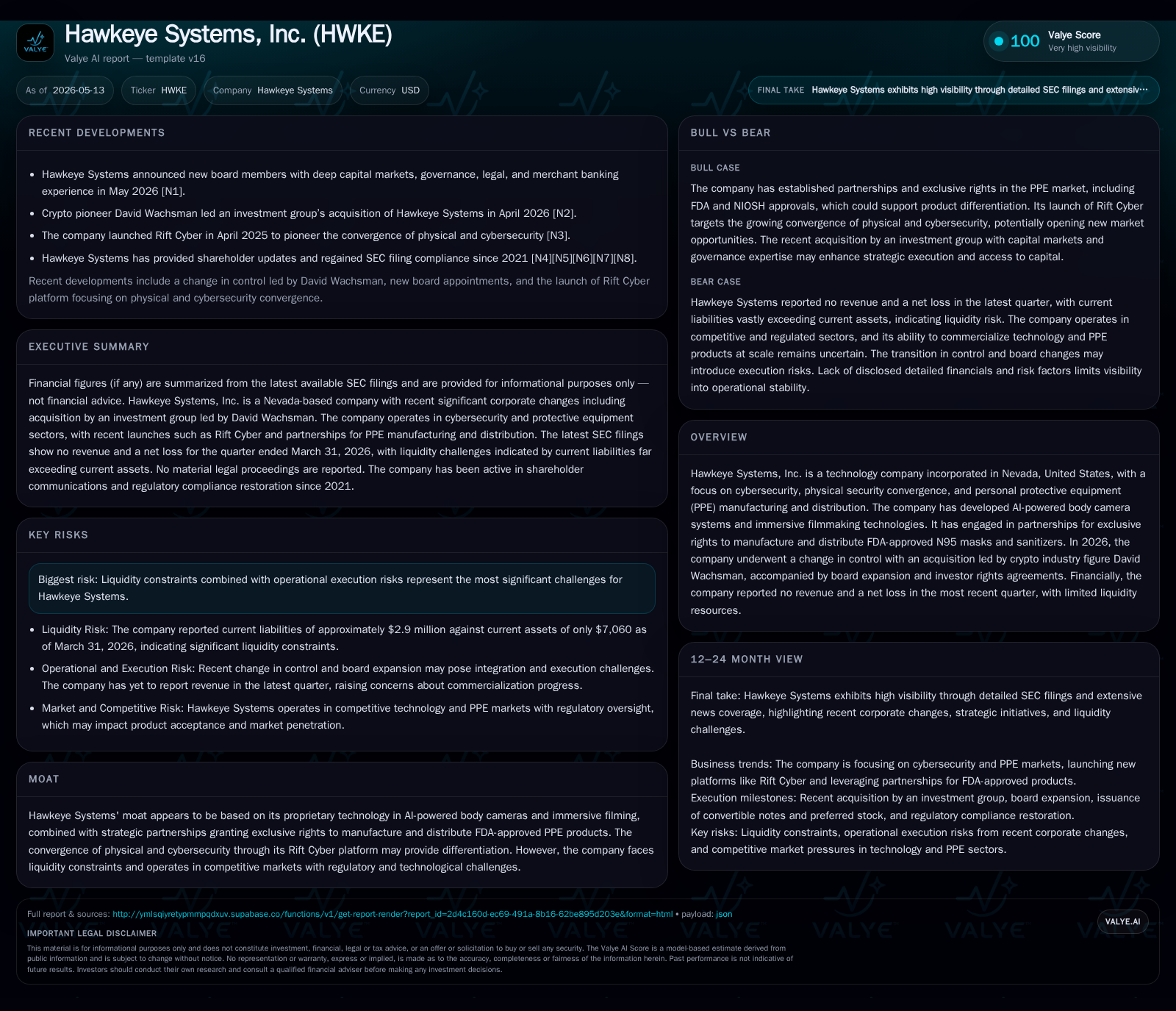
Hawkeye Systems, Inc. reported no revenue and continued net losses in its latest quarter ending March 2026, reflecting ongoing operational pressures and liquidity challenges. The company recently experienced a significant ownership change, led by crypto industry veteran David Wachsman, accompanied by an expanded board and a strategic pivot toward AI-powered cybersecurity products and exclusive distribution of FDA-approved PPE. Its business model integrates proprietary body camera and immersive filming technologies alongside physical-cybersecurity convergence software, but limited capital and competitive market dynamics constrain near-term growth. Watchpoints include upcoming capital raises, commercialization milestones for its Rift Cyber platform, and ability to monetize PPE partnerships.
Recent Operating Update
The most recent quarterly filing dated May 13, 2026 ([S2]) reveals that Hawkeye Systems continues to report zero revenues for the period ended March 31, 2026. The company sustained net losses consistent with prior periods. Total debt stood near $2.3 million ([F1]). This financial snapshot underscores ongoing cash flow challenges facing the company.
April 2026 marked a significant corporate milestone with a change in control driven by David Wachsman—a prominent figure in crypto strategic advisory—and his investment group ([N1],[S3],[S14]). This transition triggered governance reforms including expanding the Board from one director to five with four independent directors appointed under an investor rights agreement ([S14]). New officers were also appointed: David Wachsman as President and Quinton Byron Hamlett as CFO ([S26]).
Moreover, the OTC Markets Group downgraded Hawkeye Systems’ listing status from OTCQB Venture Market to OTC Pink Limited Market due to the ownership change ([S4]), reflecting lower market tier classification which could impact investor visibility.
Business Model & Strategic Positioning
Hawkeye Systems operates at the nexus of physical security hardware/software and personal protective equipment manufacturing. Its business model has historically relied on proprietary development of AI-powered body camera systems designed for law enforcement or security personnel use. Additionally, they've developed immersive filmmaking technologies aimed at next-generation content creation workflows ([S1]).
In parallel with its tech assets is Hawkeye’s engagement in exclusive manufacture and distribution rights for FDA-approved N95 masks and sanitizers—a pivot into pandemic-accelerated PPE demand sectors ([S1]). This dual approach theoretically leverages synergies between public safety device innovation and health protection products but remains nascent without recorded sales.
Crucially, Hawkeye formed Rift Cyber LLC with significant third-party IP contributions representing its push into physical-cybersecurity convergence technology where digital risk mitigation integrates closely with physical site security applications ([S12]). This positions them uniquely compared to standalone cybersecurity vendors or purely hardware-focused security companies.
Post-acquisition stated corporate intent hints at evolving towards a merchant banking vehicle investing across crypto infrastructure platforms and frontier technologies—suggesting strategic diversification beyond their immediate product lines. Such diversification may dilute operational focus but could stabilize longer-term capital access ([S14]).
Industry Structure & Competitive Landscape
Hawkeye’s primary markets straddle fragmented segments:
- Cyber-Physical Security: A rapidly evolving arena merging cybersecurity protocols with physical access controls; competitors include established firms like Verkada or Motorola Solutions whose integrated offerings command strong brand recognition.
- Body Camera Hardware: Highly competitive with incumbents like Axon Enterprise dominating public safety procurement via robust ecosystems connecting hardware to data analytics services.
- PPE Manufacturing & Distribution: Characterized by regulatory scrutiny (FDA approval) and price-sensitive bulk contracting customers; competitive pressure from global manufacturers limits pricing power especially post-pandemic when demand normalization occurs.
Hawkeye’s moat arguably stems from its early integration efforts between AI-driven devices and cyber monitoring platforms (Rift Cyber), rather than pure hardware or commodity PPE products alone. However, execution risk given resource constraints tempers this advantage.
Growth Drivers
- Commercialization of Rift Cyber Platform: The innovative physical-cybersecurity fusion technology could address unmet integration demand within enterprise security frameworks if successfully marketed.
- Scaling FDA-Approved PPE Production/Distribution: Exclusive rights offer potential revenue streams contingent upon operational capacity expansions and contract wins.
- Capital Raising & Strategic Investments: The management-led initiative towards merchant banking activity aims to raise funds for acquisitions or investments aligned with fintech/crypto themes enhancing capitalization.
- Board Expertise Leveraging: Newly appointed directors bring extensive financial markets experience potentially facilitating access to capital markets and partnerships ([N2],[S14]).
- IP Monetization: Licensing or joint ventures leveraging Rift Cyber’s proprietary IP could accelerate market penetration versus sole reliance on direct product sales.
Risks & Growth Constraints
- Liquidity & Funding Risk: With cash and equivalents at approximately $7,060 relative to liabilities exceeding $2.9 million ([F1]), failure to secure immediate equity or debt financing imperils operations.
- Revenue Absence & Commercial Execution: Lack of reported revenues decades into operation questions current go-to-market efficacy.
- Competitive Market Pressures: Entrenched incumbents possess superior scale/distribution limiting pricing flexibility.
- Regulatory Compliance: Manufacturing/distributing FDA-regulated PPE carries inspection/audit risks that might delay or curtail sales ramp.
- Operational Disruption from Ownership Change: Post-acquisition transitions often distract management focus during critical early commercialization phases.
- Dilution & Capital Structure Complexity: Convertible promissory notes introduce potential dilution risking shareholder values if conversions are triggered ([S25]).
What to Watch Next
Key milestones will revolve around:
- Public disclosure of planned financing rounds or capital injections vital for liquidity relief.
- Progress announcements regarding sales contracts or commercial pilots involving Rift Cyber technology.
- Expansion updates on PPE manufacturing agreements or deliveries indicating tangible revenue buildup.
- Board meeting disclosures highlighting strategic pivots or partnership pipelines aligned with merchant banking ambitions.
- Regulatory filings confirming compliance milestones important for FDA-approved product marketing efficacy.
Financial Snapshot (As of March 31, 2026) [F1][S2]
| Metric | Value | Period |
|---|---|---|
| Total debt | $2.3 million | |
| 2026-03-31 | ||
| Net debt | $2.3 million | |
| 2026-03-31 | ||
| Current assets | $7,060 | |
| 2026-03-31 | ||
| Current liabilities | $2.9 million | |
| 2026-03-31 | ||
| Current ratio | Approx 0 | |
| 2026-03-31 |
Source: SEC companyfacts cache [F1].
This snapshot illustrates acute short-term financial distress exacerbated by liabilities far exceeding liquid assets.
Disclaimer: This analysis is based solely on publicly available documents filed with the SEC and other referenced sources as of May 2026. It does not constitute investment advice or recommendations. Readers should consider the inherent risks of small-cap technology firms undergoing ownership transitions with constrained financial resources prior to forming conclusions.
Disclaimer: This is research-only, informational analysis and not investment advice. It may include AI-generated interpretation and general industry context. Always verify important details using primary sources.

Comments