
UTG INC's Strategic Stability: Balancing Policy Retention with Capital Adequacy
Latest quarterly filing underscores UTG’s conservative approach centered on servicing in-force life insurance policies and maintaining strong capital buffers.
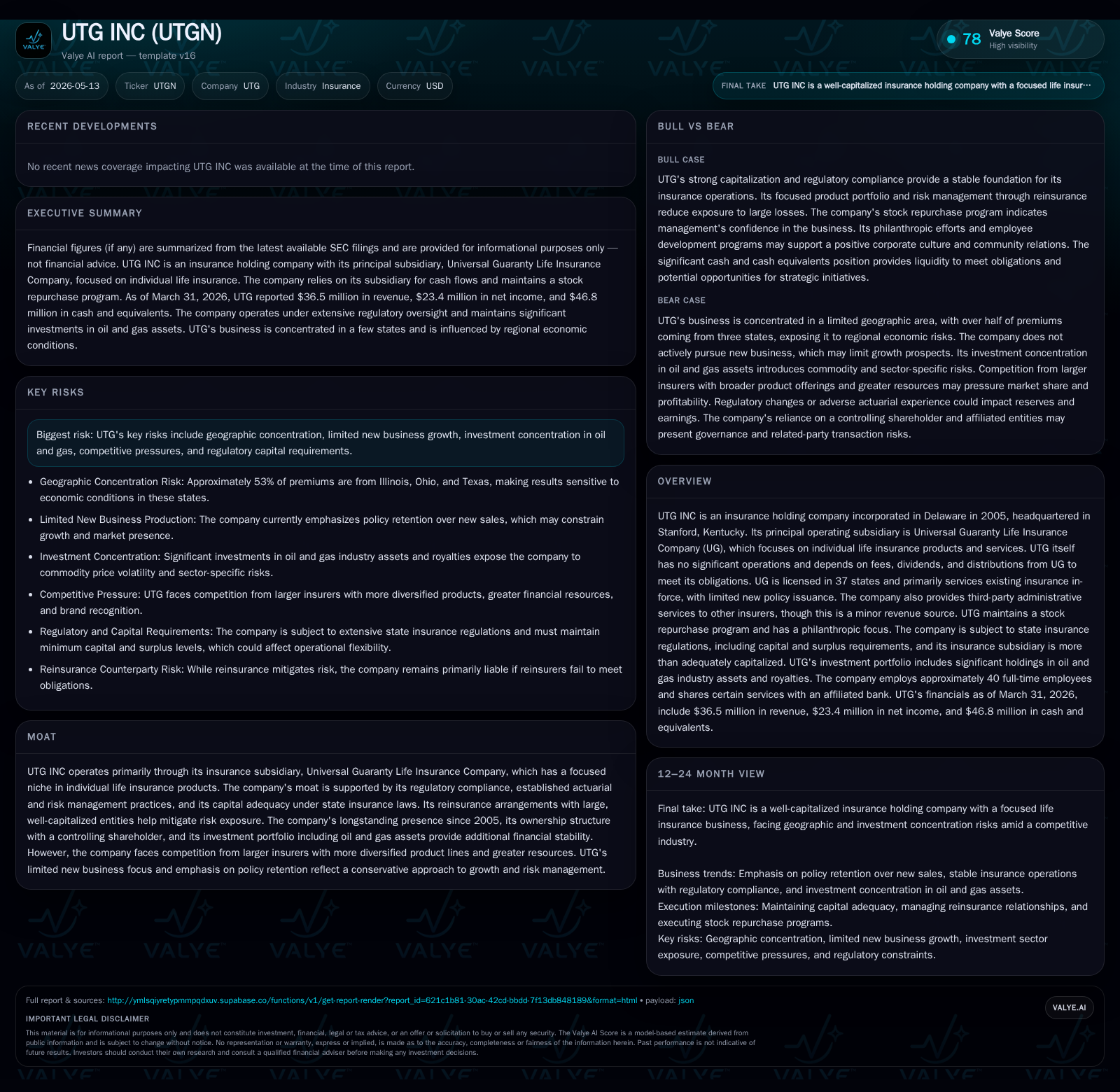
UTG INC continues to operate primarily via its subsidiary Universal Guaranty Life Insurance Company, focusing on servicing existing individual life insurance policies rather than pursuing aggressive new business. The company’s 2026 first-quarter filings reaffirm steady operational consistency with primary revenue derived from fees, dividends, and policy premiums. Regulatory compliance and capital adequacy remain foundational pillars supporting its risk-managed model amid competitive pressures and geographic concentration risks. Growth is driven largely by policy retention and selective service expansion rather than volume growth. Investment concentration in oil and gas royalties alongside licensing restricted to 37 states mark key ongoing risk factors.
Latest Quarterly Developments Highlight Operating Consistency
The May 13, 2026 10-Q filing for UTG INC reveals a continuation of the company’s conservative operating posture. There were no significant deviations or transformative events reported compared to prior periods. The holding company remains reliant on dividends and fees flowing primarily from its insurance subsidiary Universal Guaranty Life Insurance Company (UG) to meet holding company obligations [S2]. Revenue recognition continues to be linked chiefly to servicing an established base of in-force individual life insurance policies without meaningful new underwriting activity. This steady-state approach highlights UTG’s strategic focus on preserving capital strength and minimizing exposure to underwriting risk. No material shifts were disclosed regarding capital structure or liquidity conditions during the quarter.
Business Model Focused on Individual Life Insurance Servicing
UTG INC operates almost entirely through UG, an Ohio-based life insurer licensed in 37 states with a dominant product focus on individual life insurance contracts. These products vary primarily by premium payment duration, coverage period length, and cash value accumulation features — core typical offerings including fixed premium whole life plans under the “Tradition” brand along with limited-term annuity products [S1, S7].
Notably, the company has deprioritized writing new policies due to the high fixed costs inherent in underwriting and administration plus risk management considerations. Instead, it largely targets policy retention or conservation efforts among existing insureds as its growth vector. This approach reflects a cost-conscious model prioritizing persistency improvements over volume growth to stabilize margins. Ancillary third-party administrative services for other insurers exist but contribute narrowly to overall revenue streams [S23].
By restricting underwriting activity yet maintaining active risk management through reinsurance placed with large rated entities, UTG manages its insured risk exposures carefully while focusing on legacy book profitability.
Competitive Environment and Regulatory Context
UTG occupies a niche segment within a highly competitive individual life insurance marketplace dominated by large players possessing broader product portfolios and extensive agent networks [S5]. Such scale advantages place pressure on pricing flexibility for smaller participants like UTG, limiting their ability to compete aggressively for new business.
Regulatory oversight by state insurance departments is extensive given UG’s multi-state licensing footprint. Compliance includes stringent capital adequacy standards primarily driven by NAIC risk-based capital rules which act as thresholds triggering regulatory attention if breached but do not imply ratings [S11]. The insurer maintains surplus levels comfortably above required minimums providing resilience against adverse underwriting or investment scenarios.
Investment constraints defined by insurance regulation also shape portfolio composition—particularly regarding permissible asset classes and issuer concentration limits. Reinsurer insolvency risks are mitigated through diversification across several well-capitalized counterparties [S17].
Growth Drivers Centered on Retention and Selective New Business
UTG adopts a notably cautious growth strategy focused predominantly on maximizing persistency rates within its existing book of policies rather than scaling new issuance materially [S1]. Sales efforts target add-on coverage requests or conservation strategies designed to reduce lapsation among current policyholders rather than opening broad market campaigns.
This measured approach curtails acquisition costs and operational complexity while stabilizing expected cash flows embedded within long-duration contracts. Modest expansion into third-party administrative services has the potential for incremental revenue increases but remains marginal relative to core underwriting activities [S23].
Overall, the structural growth vector hinges on customer loyalty maintenance backed by reliable service delivery and actuarial discipline.
Risks and Constraints Including Geographic and Investment Concentrations
Several risk factors merit close attention given their potential impact on sustained operational stability:
- Geographic Concentration: Approximately half of UG's premium income derives from Illinois, Ohio, and Texas combined—a concentration that exposes results to regional economic cyclicality impacting premium payments or lapse behaviors [S5].
- Investment Concentration: Roughly 35% of total invested assets are tied up in oil and gas industry investments including royalty interests representing about 30% of real estate holdings—highlighting exposure to commodity price volatility specific to that sector [S5].
- Competitive Limitations: UTG faces challenges scaling product innovation or distribution breadth relative to larger insurers who command economies of scale across marketing, underwriting technology platforms, and agent networks.
- Regulatory Capital Requirements: Maintaining statutory surplus above minimums reduces financial flexibility for rapid strategic moves; regulatory scrutiny can also constrain intra-group fund flows between UG and holding entity UTG [S11].
- Operational Risks: As with any insurer managing long-duration liabilities, accuracy in assumptions underpinning mortality rates, lapse patterns, discount rates affects future benefit reserves adequacy requiring ongoing actuarial vigilance [S17].
Monitoring these parameters over upcoming quarters will offer clarity into UTG’s ability to execute its conservative retention-focused model sustainably.
Brief Financial Overview Supporting Operating Narrative
As of March 31, 2026 quarter-end, UTG held approximately $46.8 million in cash and equivalents [F1]. This liquidity position supports ongoing operational expenditures including policy servicing costs as well as share repurchases authorized by management totaling $26 million since program inception plus an additional $2 million approved in early 2025 [S3].
This financial profile complements the conservative underwriting stance underscored elsewhere providing confidence that capital adequacy does not constrain routine business execution at present.
Disclaimer: This report is intended solely for informational purposes based on public filings as cited. It does not constitute investment advice nor a recommendation regarding securities of UTG INC.
Disclaimer: This is research-only, informational analysis and not investment advice. It may include AI-generated interpretation and general industry context. Always verify important details using primary sources.

Comments