
Huachen AI Parking Shifts Focus to Equipment Parts and EV Charging After Smart Parking Divestiture
The company’s 2025 divestiture marks a strategic pivot towards asset-light equipment parts and nascent electric vehicle charging operations.
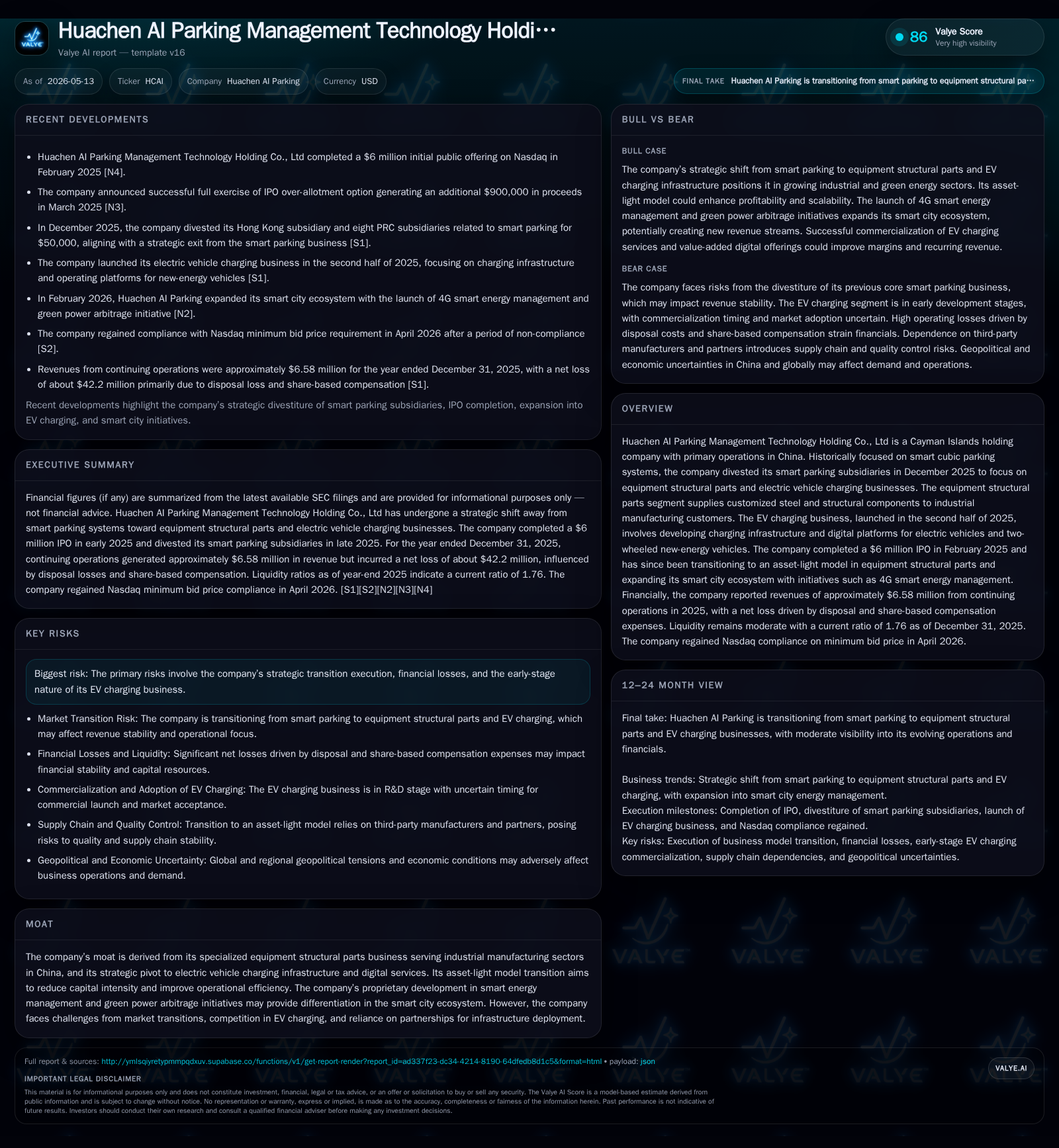
Huachen AI Parking Management Technology Holding Co., Ltd has completed a significant business transformation by exiting its historical smart parking segment through subsidiary sales in late 2025. Its core operations now concentrate on supplying customized equipment structural parts to industrial manufacturers in China and developing electric vehicle (EV) charging infrastructure launched in the second half of 2025. The company is shifting towards an asset-light model, aiming for operational efficiency and strategic positioning within China’s emerging EV infrastructure sector. Despite revenue generation from continuing operations beginning in 2025, profitability remains challenged due to large non-cash charges and transition costs, with future growth hinging on successful commercialization of its EV platform and managing third-party production partnerships.
Recent Operating Update
Huachen AI Parking Management Technology Holding Co., Ltd's latest quarterly filings reveal pivotal developments reshaping its business trajectory. Most notably, the company completed divesting all smart parking-related subsidiaries by December 2025 for $50,000, reflecting a strategic withdrawal from a market slowed by China's cooling real estate sector [S1]. This sale includes subsidiaries engaged in smart cubic parking technology and attendant parking facilities management—sectors that contributed $8.32 million to revenue prior but have now been classified as discontinued operations.
Post-divestiture, Huachen's ongoing activities focus strictly on two areas: equipment structural parts provision through Jiaxing XC (established September 2025) and electric vehicle (EV) charging infrastructure operated by Hangzhou ZHC (incorporated November 2025) [S1][S4]. The EV charging business represents an emergent vertical launched mid-2025 targeting comprehensive charging solutions for both electric four-wheel vehicles and newer segments like two-wheeled new-energy vehicles. This diversification evidences the company's intent to pivot towards sectors with promising growth dynamics aligned with global green energy trends.
Complementing this restructuring was a Nasdaq reverse stock split approved at one-for-thirty ratio in March 2026 to address prolonged sub-$1 per share pricing challenges detected since August 2025. The company regained compliance by mid-April 2026 following this measure, stabilizing its listing status [S2][S3].
Business Model
Huachen generates revenue primarily via the sale of customized steel and structural components used in industrial machinery manufacturing within China’s industrial base. Typical customers include manufacturers producing mining haulers, conveyors, railroad accessories, among other heavy equipment—markets requiring high-grade load-bearing steel parts tailored to exact specifications [S1]. This B2B equipment structural parts segment reflects a transition from internally heavy manufacturing towards an asset-light model based on trading and agency agreements with third-party producers, aiming to reduce fixed capital investment while expanding reach [S4]. Such a strategy requires strong supply chain management capabilities to ensure quality control and pricing power amid competitive pressures.
Parallelly, the company’s nascent EV charging segment operates by constructing physical charging stations alongside integrated digital platforms facilitating user access and service monetization for electric vehicles—as well as two-wheeled new-energy vehicles gaining adoption across urban China [S1][S4]. This business is currently R&D-heavy and pre-commercial, targeting a launch window in the latter half of 2026. Revenue potential hinges on converting growing EV traffic into recurring data-driven income streams such as subscription services or value-added digital memberships, supported by proprietary communication protocols under development [S1].
The combined model thus blends hardware/trading revenues from structural components with emerging platform-based services intended for scalable monetization in clean energy infrastructure [S1][S4].
Industry Structure and Competitive Position
The equipment structural parts market serves established industrial manufacturers with moderate fragmentation—the critical differentiators are customization capabilities, supply chain reliability, cost control, and ability to capture aftermarket component demand. Huachen’s local presence within China’s manufacturing hubs provides ready proximity advantages though it faces competition from larger steel conglomerates and component fabricators.
The EV charging infrastructure market is intensely competitive both globally and regionally within China’s rapidly expanding green transportation ecosystem. Established players include state-owned enterprises with deep pocketed backing alongside tech-forward startups focusing on IoT-enabled chargers and integrated energy management systems. Huachen seeks differentiation via its integration within a broader smart city framework emphasizing green power arbitrage initiatives like 4G smart energy management platforms—a niche potentially providing cross-selling opportunities beyond simple charge point installation [N/A analysis based on filings].
However, the company's early entrant status places it at risk amid technological innovation cycles and regulatory policies evolving rapidly around data privacy and charging standards—a domain requiring specialized MCU/software engineering talent that Huachen admits recruiting challenges hinder currently [S1].
Growth Drivers
Commercial Launch of EV Charging Services
Slated for second half of calendar year 2026, the transition from R&D to commercial operation in this segment is paramount. Success entails timely deployment of charging stations across urban conglomerates aligning with national new-energy vehicle adoption targets plus effective user acquisition enabling sustainable revenue streams from recurring digital services [S1].
Asset-Light Model Execution in Equipment Structural Parts
Moving away from capital-intensive manufacturing allows for potentially higher margin profiles by focusing on trade/agency coordination. The ability to establish robust networks of third-party producers offering competitive prices without sacrificing quality will dictate margin expansion prospects as well as scale growth beyond localized industrial hubs [S4].
Expansion within Smart City Ecosystem
Huachen plans initiatives like 4G smart energy management interconnected with its infrastructure could unlock synergies enabling incremental monetization avenues—coupling physical assets with software-driven analytics poses long-term upside if user engagement reaches critical mass [N/A industry analysis].
Risks / Watchpoints / Growth Constraints
Transition execution risks loom large given the company’s heavy recent net losses ($42.2 million net loss including $22.1 million disposal loss) and significant share-based compensation ($20.9 million) inflating operating expenses [F1][S8]. Delays or technical hurdles in proprietary protocol development or product launches would postpone revenue onset compromising liquidity.
Its reliance on third-party manufacturers introduces quality control risks that could impact customer satisfaction or result in margin pressure if favorable agency terms cannot be sustained amidst industry competition [S4]. Moreover, emerging EV infrastructure markets face regulatory uncertainty concerning data privacy laws which could limit monetization channels based on user data engagement 9[S1]9.
Share price volatility remedied via a reverse split signals underlying investor confidence challenges; navigating market perceptions alongside genuine operational turnaround will be imperative.
What to Watch Next
- Progress updates on EV charging network rollout milestones targeted for H2 2026 commercial launch.
- Booking levels or initial contract wins within the equipment structural parts trade/agency channels evidencing network scale-up.
- Financial metrics showing improvement in gross margins or reduction in operating losses signaling operational leverage gains.
- Regulatory developments impacting data use or EV infrastructure subsidies relevant to the company’s value-added services roadmap.
- Quarterly cash flow trends reflecting working capital management particularly accounts receivable turnover progress given noted increases impacting liquidity [S8][F1].
Financial Profile Snapshot (FY ended December 31, 2025)
Latest financial snapshot
| Metric | Value | Period |
|---|---|---|
| Cash & equivalents | $389 | |
| 2025-12-31 | ||
| Current assets | $12mm | |
| 2025-12-31 | ||
| Current liabilities | $7mm | |
| 2025-12-31 | ||
| Current ratio | 1.76x | |
| 2025-12-31 |
Source: SEC companyfacts cache [F1].
Liquidity is strained given nominal cash reserves despite positive current ratio driven by sizeable accounts receivable balances mainly due to Jiaxing XC customer advances; total debt is light relative to assets but net debt remains elevated around $3.5 million when considering cash held [F1][S8][S17].
Conclusion
Huachen AI Parking has decisively repositioned itself away from stagnating smart parking solutions toward strategic plays in industrial components provisioning and emergent EV charging infrastructure complemented by innovative smart city initiatives. While foundational revenue streams have begun materializing post-transition, the road to profitability depends critically on executing an asset-light manufacturing model effectively while navigating complex R&D commitments for its digital EV platform under challenging competitive conditions. Ongoing monitoring of deployment milestones inside rapidly evolving Chinese green transport ecosystems will be key barometers for the company’s medium-term operational viability.
This analysis is based exclusively on publicly filed SEC documents up to May 13, 2026 () and supported financial snapshot data ([F1]). No investment recommendations are expressed or implied herein.
Disclaimer: This is research-only, informational analysis and not investment advice. It may include AI-generated interpretation and general industry context. Always verify important details using primary sources.

Comments