
Canary Marinade Solana ETF Explores Growth Through Strategic Staking and Operational Refinements
Recent quarterly disclosures highlight Canary Marinade Solana ETF's focus on staking optimization and operational mechanics that enhance exposure to Solana's ecosystem.
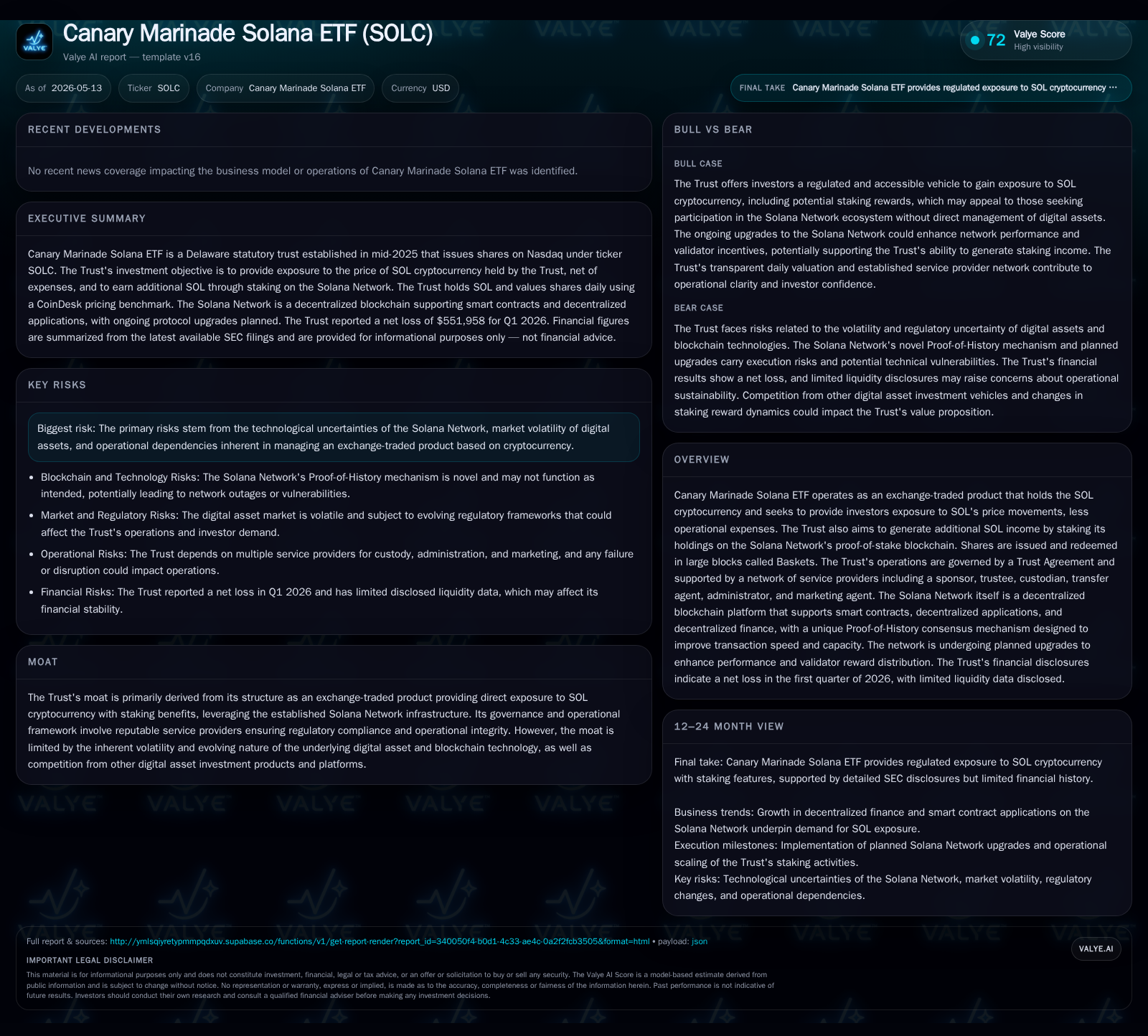
Canary Marinade Solana ETF (SOLC) offers investors direct, liquid exposure to the SOL cryptocurrency combined with the benefits of staking income. The latest 10-Q filing for Q1 2026 underscores steady operational refinement, including efficient share issuance/redemption mechanisms and staking yield management crucial for competitiveness in the crypto ETP space. As SOLC operates within the evolving Solana blockchain environment characterized by planned upgrades and Proof-of-History consensus, these network developments serve as significant demand drivers. However, risks related to technological stability, regulatory treatment of staking income, and digital asset volatility introduce operational complexities that require close monitoring.
Recent Quarterly Operating Highlights and Implications
The Canary Marinade Solana ETF's latest quarterly report dated May 13, 2026, provides an operational snapshot centered primarily on its continued commitment to delivering efficient exposure to the SOL token alongside the benefits of staking revenue accrual. The filing indicates no significant disruptions or deviations in share creation/redemption processes involving baskets of 10,000 shares each—an approach designed to maintain liquidity and tightly track NAV relative to SOL price movements [S2]. This steadiness is critical given cryptocurrency markets' typical volatility.
Moreover, operational communications reveal the Trust's ability to sustain staking yields by actively participating in Solana’s proof-of-stake validation processes. This mechanism enhances return potential beyond mere price appreciation of SOL itself, a distinguishing feature that sets the product apart from passive holding alternatives. While exact staking yields are not quantified in this disclosure, maintenance of these programs signals operational stability important to existing and prospective investors [S2].
Canary Marinade Solana ETF Business Model and Product Attributes
SOLC operates within a conventional exchange-traded product framework but distinguishes itself by directly holding physical SOL tokens rather than derivatives or futures-based instruments [S1]. Investors gain exposure through purchasing shares listed on Nasdaq under ticker “SOLC.” Shares are issued and redeemed in "baskets" of 10,000 shares each; this basket structure efficiently aligns underlying asset ownership with fund liabilities while facilitating arbitrage activities that help keep market prices close to NAV.
Staking functionality is embedded into the business model: the Trust delegates its SOL holdings to validators within the Solana Network’s proof-of-stake system, seeking to earn rewards tied to securing blockchain transactions. These rewards accrue back into the Trust’s assets, effectively enhancing shareholder value over time beyond usual token price fluctuations. This operational choice leverages the network’s design where staked tokens contribute both security and transaction finality.
Governance and operations rest on a robust network of service providers: Canary Capital Group LLC acts as Sponsor overseeing strategic direction; CSC Delaware Trust Company serves as Trustee ensuring fiduciary responsibility; BitGo Trust Company is Custodian safeguarding assets with institutional-grade custody solutions; U.S. Bancorp Fund Services acts as Transfer Agent and Administrator handling shareholder records and fund accounting; Paralel Distributors manages marketing outreach [S1]. Together they form an infrastructure designed to instill confidence amid a sector often scrutinized for security vulnerabilities.
Industry Context and Competitive Benchmarking
Within the broad cryptocurrency ETF marketplace, SOLC competes by offering native token exposure combined with staking yield—a route not universally available in all crypto investment vehicles which often rely on futures or synthetic products. This dual-exposure approach links directly to the structural attributes of the Solana blockchain which employs a Proof-of-History consensus mechanism enhancing transaction throughput rates significantly versus older blockchain protocols like Ethereum’s initial iterations.
This product-level moat arises because investors seeking liquid access to SOL with income-generation capability have limited alternatives combining these qualities seamlessly under regulatory oversight. However, this moat remains constrained by high competition overall among digital asset ETPs covering major cryptocurrencies like Bitcoin or Ethereum plus emerging altcoins.
Regulatory scrutiny around crypto ETFs continues evolving globally; notably, products incorporating staking rewards must navigate complex securities law interpretations impacting tax treatment and investor disclosures. SOLC's registered trust framework with well-known custodians partly mitigates such concerns by enhancing transparency and adherence to established financial regulations [S1].
Growth Catalysts Shaping Demand for SOL Exposure
Several tangible drivers underpin prospective growth for CANARY MARINADE SOLANA ETF. Foremost among them is Solana Network’s active roadmap focused on performance enhancements through scheduled technological upgrades aimed at increasing capacity and reducing latency—the backbone needed for next-generation decentralized applications (dApps) especially in decentralized finance (DeFi) sectors where speed equates directly to competitive advantage.
As DeFi ecosystems flourish on Solana with greater adoption by institutional and retail clients alike, demand for SOL tokens inherently rises since they function as gas fees for executing smart contracts and validating transactions. Concurrently, heightened retail interest in income-generating crypto products supports inflows into staking-enabled vehicles like SOLC amid broader shifts toward yield generation beyond traditional fixed income. The Trust’s design specifically captures these trends by converting staked assets into compounding potential returns accessible via public equity-like trading.
Challenges, Risk Factors, and Market Headwinds
Despite strategic advantages, SOLC confronts material risks primarily anchored in technology stability and market conditions inherent to digital assets. The Solana Network has previously experienced sporadic outages impacting transaction finality—these technical interruptions can jeopardize continuous accrual of staking rewards crucial for trust performance continuity. Additionally, any failure or bug within validator protocols could lead to penalties or slashing events reducing token holdings.
Market volatility poses another substantial challenge: sharp downward swings in SOL prices affect net asset values directly given their full backing by physical tokens. This volatility could suppress investor interest in risk-sensitive periods despite ongoing yield benefits derived from staking operations.
Regulatory uncertainties particularly concerning how jurisdictions treat earnings from crypto staking complicate compliance efforts. Changes in legal definitions or reporting requirements might affect fund costs or shareholder tax treatments indirectly influencing investment appetite.
Operationally, reliance on third-party custodians (e.g., BitGo) introduces counterparty risk though mitigated through industry-leading custody protocols designed specifically for digital asset safekeeping [S1]. The interplay between these factors dictates a cautious but watchful approach regarding growth prospects.
Key Milestones and Events to Monitor
Investors following Canary Marinade Solana ETF should keenly observe upcoming quarterly filings which will provide updated metrics on NAV adjustment attributable both to price movements of SOL tokens and accrued staking income reflecting operational efficiency [S2][S1].
Equally impactful will be announcements surrounding major Solana Network upgrades — their successful deployments can materially stimulate network utility thus potentially lifting token valuations over time. On the administrative front, any changes announced by Sponsor or Trustee relating to fee structures, governance enhancements, or service provider agreements warrant attention as indicators of evolving fund strategy or risk posture.
Continued transparency via publicly accessible reports hosted by Canary Capital further ensures real-time investor awareness concerning both operational performance dynamics and external environment factors affecting this niche exchange-traded product.
This analysis is informed solely by public SEC filings up to May 13, 2026, including Canary Marinade Solana ETF's Q1 2026 Form 10-Q report and annual disclosures as well as Valye proprietary industry insight. It does not constitute investment advice or recommendations but aims to illuminate key operational features shaping the Trust's positioning within cryptocurrency exchange-traded products.
Disclaimer: This is research-only, informational analysis and not investment advice. It may include AI-generated interpretation and general industry context. Always verify important details using primary sources.

Comments