
NeuroOne Medical Technologies Accelerates Commercialization After FDA Clearance
NeuroOne’s latest quarter underscores operational momentum in deploying its OneRF trigeminal nerve ablation system following FDA approval.
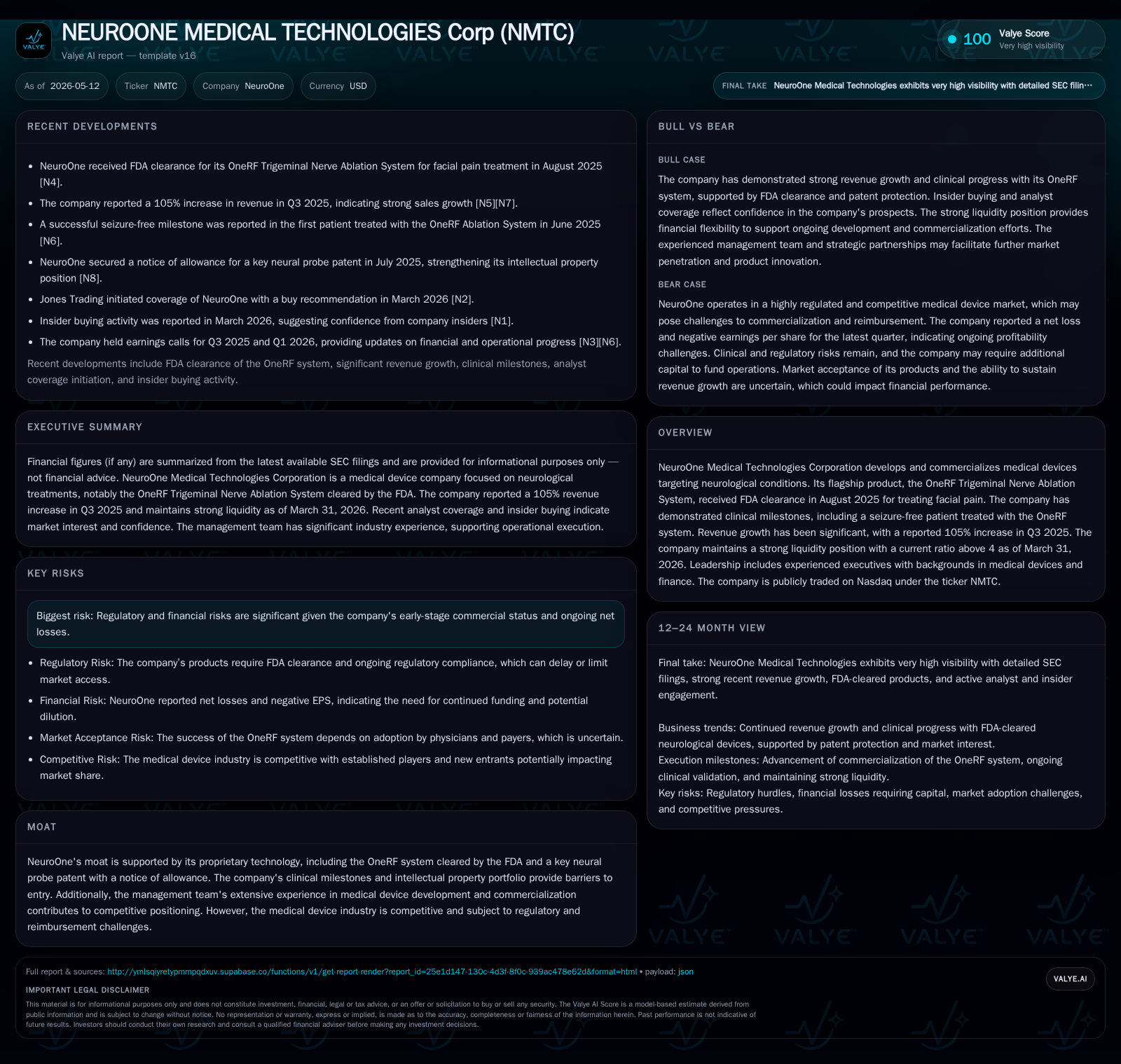
The May 2026 quarter marks a significant phase for NeuroOne as it drives commercialization of its FDA-cleared OneRF system targeting neurological conditions like facial pain. The company reports strong liquidity with a current ratio of 4.38 and over $2.8 million in cash, supporting ongoing sales and clinical activities. While revenue growth is evident from prior periods, the firm remains in early-stage commercialization with continued net losses and regulatory/reimbursement challenges ahead. Intellectual property protections and clinical milestone achievements provide competitive leverage amid a complex neurological medical device landscape.
Recent Quarterly Operating Highlights and Developments
NeuroOne Medical Technologies Corporation’s latest filing dated May 12, 2026 ([S2], [S3]) highlights ongoing momentum in its product commercialization following the FDA clearance of its flagship OneRF Trigeminal Nerve Ablation System in August 2025. This clearance marks a pivotal regulatory milestone enabling broader clinical use for treating facial pain associated with trigeminal neuralgia and related neurological disorders.
The company's Q1 fiscal 2026 results detail advancement from nascent commercial launch to increasing procedure volumes facilitated by clinician training and early adopter hospital engagements. While explicit quarterly revenue figures are not freshly disclosed beyond the $9.1 million reported in Q3 FY 2025 [F1], management commentary signals continued sales ramp aligned with commercialization strategy execution. The company also referenced notable clinical outcomes, such as cases of seizure-free status post-treatment with OneRF, underpinning the system's therapeutic potential.
Liquidity is robust at quarter-end March 31, 2026, with cash and cash equivalents standing at approximately $2.8 million [F1], indicating a healthy short-term balance sheet position to fund operational needs amidst early-stage launch costs.
Business Model and Product Portfolio: The OneRF System
NeuroOne’s revenue model primarily derives from direct sales of the OneRF system—a proprietary device designed for minimally invasive trigeminal nerve ablation—and associated disposable neural probes integral to each treatment procedure. This unit-based model benefits from recurring consumable usage linked to repeatable treatment protocols.
The technology leverages radiofrequency energy delivered via patented neural probes cleared by the FDA ([S1]), positioning it as an advanced therapeutic alternative within the neuromodulation space. The system addresses facial neuropathic pain symptoms by precise lesioning of affected nerve fibers, offering a novel solution compared to pharmacological or more invasive surgical options.
Ongoing R&D efforts aim at broadening the product pipeline through additional neural interface innovations protected by intellectual property rights—manifested notably by patent allowances for key probe designs—thereby enhancing long-term product differentiation.
Pricing structures involve capital equipment sales supplemented by margin-rich disposables reflecting clinician preference dynamics and procedural frequency. Early indications of positive clinical adoption are encouraging indicators of potential volume-driven margin expansion as installed base grows.
Industry Environment and NeuroOne's Competitive Moat
Within the neurological device sector, competition spans established medtech giants offering comprehensive pain management solutions alongside innovative startups pursuing niche applications such as neuromodulation or neuroablation. NeuroOne differentiates via focused specialization on trigeminal nerve conditions leveraging minimally invasive techniques validated through FDA clearanceand growing clinical endorsements (, [S1]).
Barriers to entry are fortified by regulatory hurdles requiring extensive safety and efficacy documentation, plus intellectual property protections around neural probe technologies which form a core element of the systems functionality. Such patents create defensible technical moats that complicate replication by competitors.
However, reimbursement pathways remain a structural challenge across neurological interventions generally; securing insurer coverage for novel procedures like those enabled by OneRF will materially affect adoption curves and sustained market penetration.
Supply chain reliability is another critical factor; the company must ensure consistent availability of specialized consumables amid global medtech component shortages impacting the sector broadly.
Growth Catalysts: Market Penetration and Clinical Validation
Growth hinges on clinical evidence generation amplifying physician confidence. Documented cases such as seizure remission post-OneRF treatment align with industry expectations for neurology interventions where measurable patient outcomes drive expanded usage (, [S2]).
Market penetration will involve scaling physician training programs to increase qualified users capable of deploying the system safely and effectively. Early adopter feedback loops can accelerate refinement cycles enhancing usability.
Regulatory expansion into adjunct or new indications beyond facial pain could open additional addressable markets; these prospective filings warrant close attention from industry observers tracking growth inflections.
Geographical expansion beyond initial U.S.-centric commercialization depends on securing foreign regulatory approvals plus establishing distribution partnerships consistent with sector norms.
Incremental revenue growth correlates directly to device placements (installed base), usage frequency (procedural volume), pricing adjustments for value enhancement, and higher-margin service contracts supporting after-sale maintenance or software upgrades where applicable.
Risks and Constraints: Regulatory, Financial, and Market Adoption
NeuroOne operates under substantial risk vectors typical of early-stage medtech enterprises. Sustained net losses reflect upfront investment in commercialization infrastructure against still-building revenue streams.
FDA clearance notwithstanding, regulatory oversight continues post-market surveillance obligations that may expose new liabilities or require costly adaptations.
Reimbursement policy uncertainties can delay or restrict patient access if payers do not recognize procedural codes adequately or apply restrictive coverage criteria limiting usage scope.
The rapidly evolving technological landscape invites continuous innovation pressure; larger competitors may respond with enhanced offerings eroding relative advantages unless NeuroOne maintains aggressive IP enforcement and R&D cadence.[F1]
Cash runway visibility supported by liquidity requires vigilant monitoring given operational scale-up needs; unplanned delays or expense overruns could necessitate additional financing rounds dilutive to existing stakeholders.
Market acceptance risk exists as clinicians balance adoption against entrenched therapies1 safety profile validation coupled with demonstrable efficacy remains paramount to overcoming inertia inherent in medical practice changes.
Key Upcoming Milestones and Investor Watchpoints
Stakeholders should focus on quarterly revenue progression in forthcoming SEC filings ([S3]) as leading indicators of commercial traction. Clinical data outputs validating broader efficacy or tolerability dimensions will be critical catalysts potentially driving consensus re-rating.
Regulatory announcements regarding supplemental indications or international authorizations represent important growth levers to follow closely.
Partnership developments involving sales/distribution expansion or co-marketing agreements could accelerate network effects fundamental to building durable installed base scale.
Investor watchpoints also comprise capital structure moves that might affect financing capacity or shareholder dilution profiles given ongoing cash burn observed from loss-generation cycles.
Concise Financial Profile and Liquidity Status
Latest financial snapshot
| Metric | Value | Period |
|---|---|---|
| Cash & equivalents | $2.8mm | |
| 2026-03-31 | ||
| Current assets | $7.4mm | |
| 2026-03-31 | ||
| Current liabilities | $1.7mm | |
| 2026-03-31 | ||
| Current ratio | 4.38x | |
| 2026-03-31 |
Source: SEC companyfacts cache [F1].
| Metric | Value | Period End |
|---|---|---|
| Cash & Equivalents | $2,804,011 | |
| 2026-03-31 | ||
| Total Debt | $55,284 | |
| 2023-09-30 | ||
| Current Ratio | 4.38 | |
| 2026-03-31 | ||
| Recent Reported Revenue | $9.1 million (FY2025 Q3) | |
| 2025-09-30 |
As of March 31, 2026 ([F1]), NeuroOne maintains over $2.8 million in readily available cash resources offset against nominal debt obligations providing strong liquidity cushions during scale-up phases.
Disclaimer: This analysis synthesizes publicly filed SEC documents up to May 12, 2026, combined with Valye News proprietary research insights for informational purposes only without providing any investment advice or recommendations.
Disclaimer: This is research-only, informational analysis and not investment advice. It may include AI-generated interpretation and general industry context. Always verify important details using primary sources.

Comments