
ProMIS Neurosciences Advances Alzheimer’s Phase 1b Trial While Managing Cash for Biopharma Development
ProMIS Neurosciences extends clinical efforts in neurodegenerative therapies with solid liquidity but remains dependent on future fundraising.
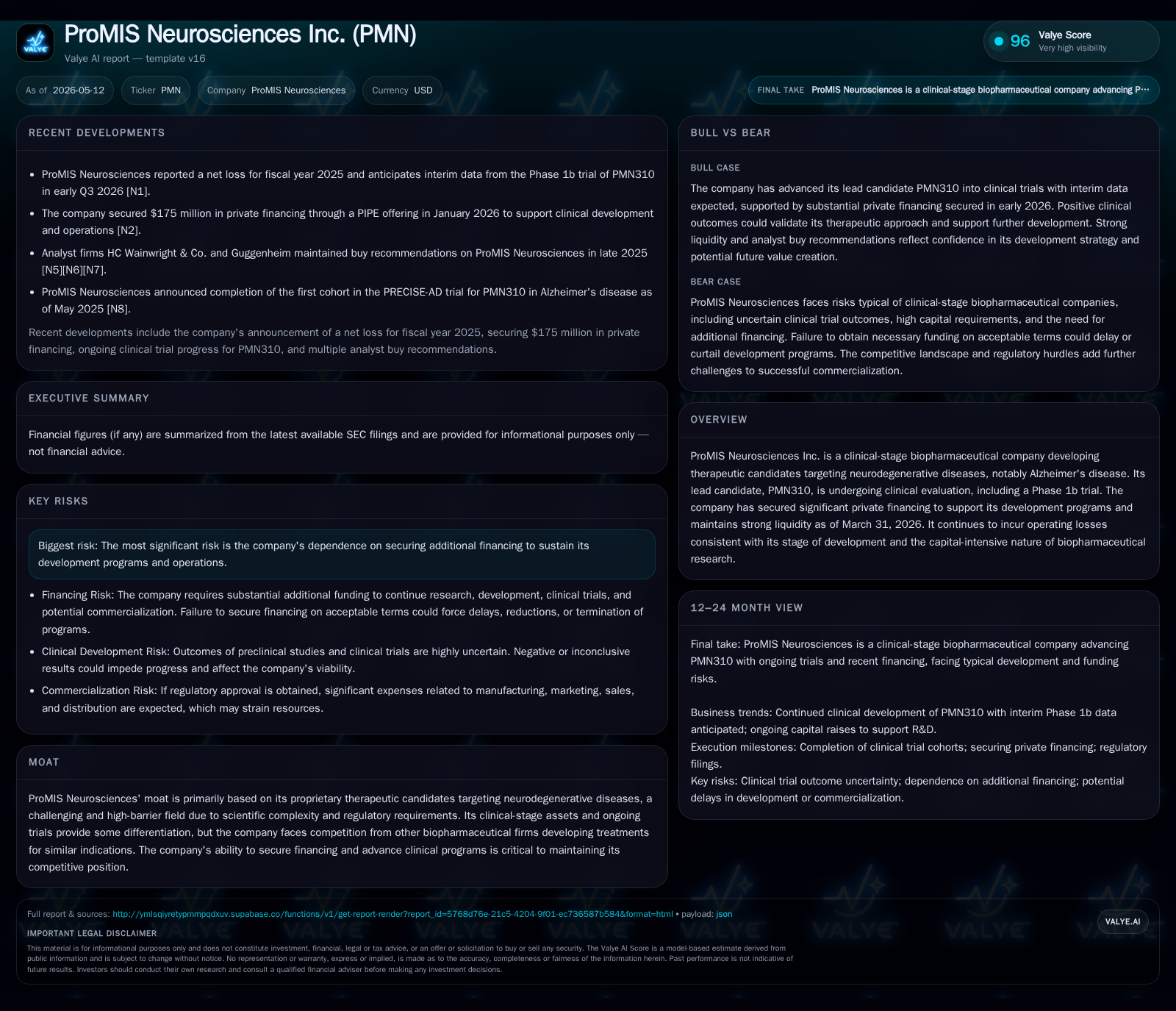
In its latest quarter ending March 31, 2026, ProMIS Neurosciences continues to progress its Phase 1b trial of PMN310 for Alzheimer's disease, targeting key data milestones mid-2026. The company maintains a strong cash position of approximately $63.8 million and no debt, supporting its capital-intensive development model. Nevertheless, continued operating losses and reliance on additional financing highlight funding risk intrinsic to early-stage biopharma firms. ProMIS operates in a competitive neurodegenerative disease landscape, with a differentiated proprietary asset base focused on precision therapeutics.
Recent Operating Update: Progressing Clinical Trials Amid Strong Liquidity
ProMIS Neurosciences’ latest quarterly report as of March 31, 2026 ([S2]) anchors this analysis. The company updates ongoing clinical trial activity on its lead asset PMN310—a monoclonal antibody candidate targeting Alzheimer’s disease. The Phase 1b PRECISE-AD study continues patient enrollment and is set to complete six-month assessments by Q2 2026, with a blinded interim analysis planned for early Q3. This timeline signifies advancing momentum toward obtaining initial safety and pharmacodynamic data crucial for de-risking the program.
Financially, ProMIS reports working capital of approximately $59 million at quarter-end supported by a robust cash balance of $63.8 million ([F1]). Notably, the company carries no long-term debt ([F1]), positioning it with favorable liquidity to support ongoing clinical expenses in the near term.
The quarterly disclosure also emphasizes persistent operating losses reflecting heavy R&D expenditure typical for clinical-stage biopharma entities focused on complex neurodegenerative indications ([S2]). Management underscores the need for substantial additional financing beyond current resources to sustain expanded clinical testing and preparatory commercialization activities.
A January 2026 equity raise secured gross proceeds around $75 million via PIPE financing ([S19]), adding depth to recent capital inflows and reinforcing balance sheet strength.
Business Model: Clinical-Stage Development Focused on Neurodegenerative Therapeutics
ProMIS operates exclusively as a clinical-stage biopharmaceutical developer specializing in therapeutic candidates aimed at central nervous system diseases characterized by amyloid pathology—primarily Alzheimer’s disease ([S1]). Revenue streams are currently non-existent from product sales; all financial support derives from equity financings accompanied by potential collaborations or grants.
Its proprietary technology platform identifies conformational epitopes exclusive to toxic oligomers implicated in neurodegeneration, enabling selective targeting unmatched by broadly binding antibodies ([S1], analysis). The business model involves progressing candidates through phased clinical trials culminating in regulatory approval and commercialization. Given typical timelines extending several years plus significant costs inherent to CNS drug development, ProMIS relies heavily on strategic capital raises timed alongside clinical milestones.
Margins are presently non-applicable as the company expends cash rather than generating revenue. Future high fixed costs related to manufacturing scale-up and commercial launch would necessitate either partnerships or direct market entry strategies once efficacy is demonstrated.
Industry Structure and Competitive Position
Alzheimer’s disease drug development stands among the most scientifically challenging areas within biotechnology due to complex pathophysiology and historically high late-stage failure rates ([S1], industry knowledge). The neurodegenerative treatment market is highly competitive with large established players (e.g., Biogen, Eli Lilly) alongside emerging specialized biotechs focusing on amyloid-beta or tau protein mechanisms.
ProMIS differentiates itself through its novel selection platform designed to bind oligomeric species without interaction with monomeric or fibrillar forms—potentially reducing off-target effects seen in prior antibody therapies ([S1]). However, competitive advantage depends on demonstrating superior safety and cognitive benefit signals amid a crowded pipeline where multiple agents vie for similar indications.
Regulatory scrutiny is intense due to previous controversies surrounding amyloid-targeting treatments. Market entry barriers thus include not only patent protections but demonstration of robust positive clinical outcomes convincing payers and prescribers.
Growth Drivers
Growth prospects primarily hinge on clinical development progress:
- Milestone-driven Clinical Advancement: Completion of six-month patient assessments in PRECISE-AD trial (expected Q2 2026) offers first meaningful human pharmacodynamics data.
- Data Readouts: Blinded interim analysis projected early Q3 2026 will influence decisions on pivotal studies initiation or partnering interest.
- Capital Raising Success: Timely financing events underpin continue R&D investment scale-up necessary for moving from Phase 1b into Phase 2/3 stages.
- Strategic Collaborations: Potential alliances could provide not only capital but access to regulatory expertise or commercial infrastructure.
Structural demand supporting the Alzheimer’s therapeutic market is strong given demographic trends projecting nearly doubling U.S. incidence by 2050 ([S1]). This growing unmet need sets a backdrop favoring successful novel therapies if efficacy can be validated.
Risks and Watchpoints
Several challenges pose risks that bear monitoring:
- Funding Dependence: Despite respectable cash reserves ($63.8M), ProMIS explicitly states need for further financing due to ongoing costly preclinical/clinical studies ([S2]). Failure or delays in raising capital may curtail operations.
- Clinical Trial Uncertainty: High attrition rates in neurodegenerative trials mean even advancing into Phase 2/3 hinges critically on intermediary data outcomes from current studies ([S2],[S18]).
- Regulatory Approval Risks: Demonstrating clear benefit over placebo with acceptable safety profiles is a stringent bar increasingly scrutinized post FDA controversies involving other amyloid agents ([S1]).
- Competitive Pressure: Major pharmaceutical firms with deeper pockets intensify competition potentially limiting ProMIS’s market penetration absent partnership.
- Commercialization Costs: If approved, launch execution demands substantial investment beyond current scale requiring either external partnerships or significant internal resource allocation.
What to Watch Next
Key near-term catalysts to assess execution progress:
- Completion of six-month assessments in PRECISE-AD Phase 1b trial expected Q2 2026 ([S1]), providing important data regarding safety/tolerability/class effect measures.
- Release of blinded interim analysis results anticipated early Q3 2026 which will validate clinical hypothesis critical for next stage trial design or partnering discussions ([S1]).
- Any announcements regarding new financing rounds or collaboration agreements which would underpin continued operational funding post current liquidity horizon.
- Regulatory interactions or guidance updates that could inform likelihood/timeline of eventual product approval pathways.
Financial Profile Summary
Latest financial snapshot
| Metric | Value | Period |
|---|---|---|
| Cash & equivalents | $64mm | |
| 2026-03-31 | ||
| Current assets | $66mm | |
| 2026-03-31 | ||
| Current liabilities | $7mm | |
| 2026-03-31 | ||
| Current ratio | 9.92x | |
| 2026-03-31 |
Source: SEC companyfacts cache [F1].
The balance sheet reflects substantial liquidity relative to liabilities allowing sustained funding of R&D programs over the near term without leverage pressure. Operating losses consistent with research-heavy growth stage profile continue driven by investment in clinical trial activities ([F1]). Capital efficiency will be increasingly tested as scale increases pending trial success.
This analysis is based on publicly available filings including ProMIS Neurosciences’ latest quarterly report dated May 12, 2026 (Form 10-Q) along with related SEC disclosures. It does not include forward-looking guidance or investment advice.
Disclaimer: This is research-only, informational analysis and not investment advice. It may include AI-generated interpretation and general industry context. Always verify important details using primary sources.

Comments