
CF Bankshares’ Liquidity Strength and Debt Profile Shape Near-Term Strategic Flexibility
Recent quarterly filings highlight stable liquidity, rising SOFR-linked debt costs, and ongoing share repurchases at CF Bankshares.
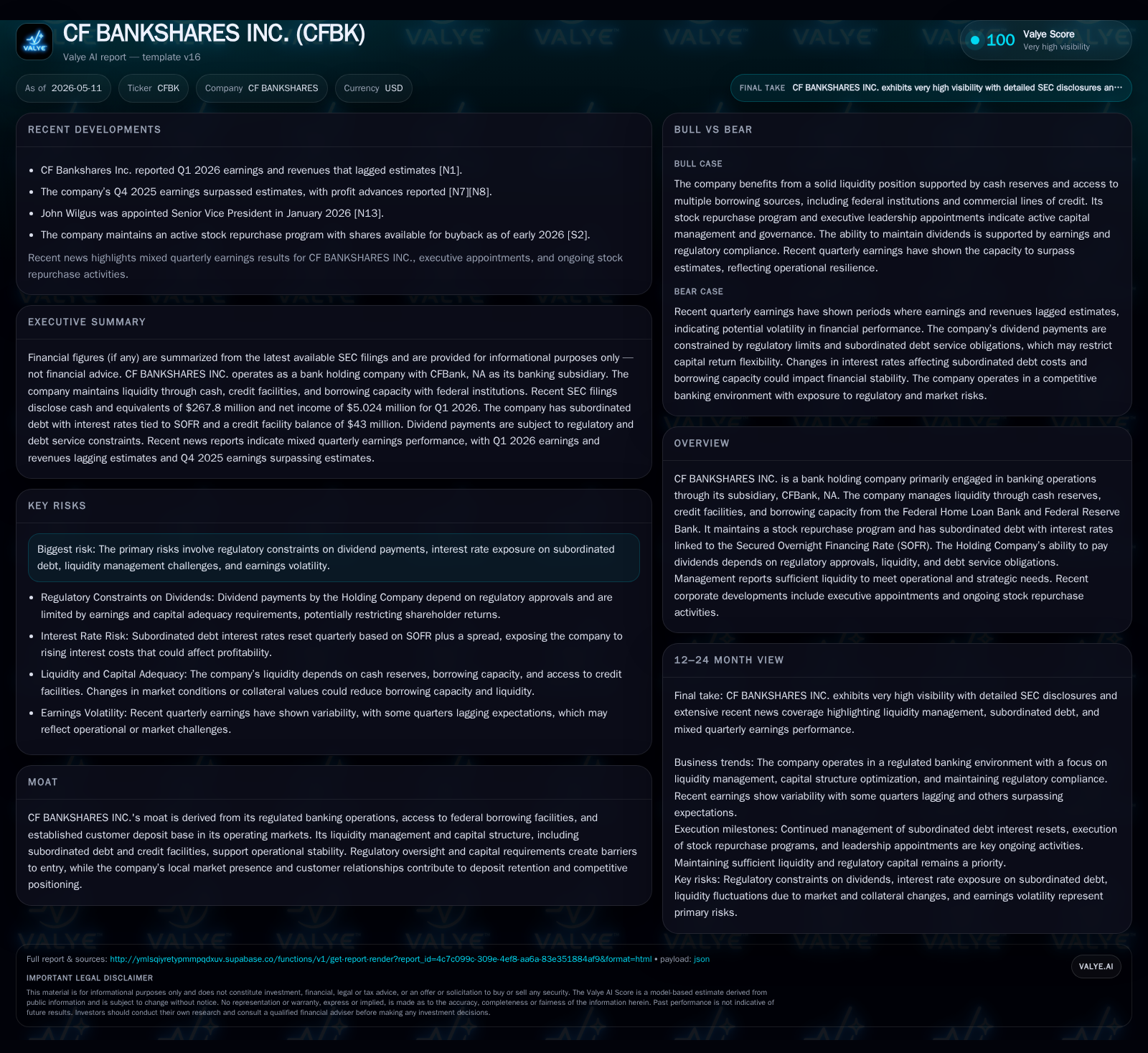
CF Bankshares Inc., primarily operating through its banking subsidiary CFBank, continues to demonstrate strong liquidity management with substantial cash reserves and diversified borrowing capacity. Its subordinated debt interest payments are increasingly tied to the Secured Overnight Financing Rate (SOFR), introducing sensitivity to interest rate volatility. The company has actively managed capital allocation through an extended share repurchase program. While regulatory controls on dividend payments remain a constraint, CF Bankshares leverages its established customer deposit base and federal borrowing facilities to maintain competitive positioning. Key risks include servicing floating-rate subordinated debt amid rate fluctuations and maintaining regulatory capital requirements. Upcoming monitoring should focus on liquidity trends, interest expense evolution, dividend policy adherence, and execution of share repurchase authorizations.
Recent Operating Update: Liquidity Stability Amid Rising Interest Rates
CF Bankshares Inc.'s latest quarterly filing dated May 11, 2026 ([S2]) sharpens focus on the company’s capital structure nuances influencing near-term financial operations. Separately, its $10 million fixed-to-floating rate subordinated notes demand roughly $810,000 in annual interest expense; since December 2023 this resets quarterly to SOFR plus 4.402%, rendering an effective rate of 8.10% at quarter-end [S2]. This evolution points to mounting borrowing costs correlated with rising short-term rates.
The Holding Company maintains a credit facility with a third-party bank having an outstanding net balance of $43 million as of March 31, 2026 ([S2]). This facility includes both long-term term note features and a revolving line of credit injected as Tier 1 capital into CFBank during Q2 2025. Meanwhile, aggregate cash and cash equivalents stood robustly at $267.8 million at quarter-end ([F1]), underscoring ample liquidity that supports operational needs alongside strategic initiatives.
In tandem with capital management efforts, CF Bankshares is actively repurchasing shares under a Board-authorized program initiated in early 2025, now extended through August 15, 2026 [S20], [S27]. During Q1 2026 alone approximately 5,547 shares were repurchased or surrendered for tax settlements at an average price just below $29 per share.
Business Model: Banking Operations Anchored in Deposit Gathering and Lending
CF Bankshares operates chiefly through its wholly owned subsidiary CFBank NA ([S1]). The revenue model relies primarily on net interest income generated by lending activities funded predominantly by customer deposits sourced locally in CFBank's geographic footprint. Deposit pricing remains market-competitive—key for retention—while lending spans consumer and commercial segments typical for regional banks.
The Holding Company distinguishes itself by managing liquidity through:
- High-quality cash reserves
- Access to wholesale funding via FHLB advances secured against collateralized loans
- A revolving credit facility providing flexibility
At the Holding Company level, dividend payment capacity depends critically on the receipt of upstream dividends from CFBank subject to regulatory limits ([S2]). These regulatory thresholds impose constraints tied to current-year earnings plus retained prior profits ensuring capital adequacy post-dividend payment.
Debt instruments like subordinated debentures carry quarterly variable rates linked explicitly to SOFR benchmarks ([S2]), inflecting interest expense volatility based on macroeconomic monetary policy movements.
Industry Structure and Competitive Position
CF Bankshares operates within the crowded regional bank holding company sector where regulatory oversight elevates barriers to entry while balancing competitive forces among peer community banks. Its competitive advantages include:
- Established customer relationships fostering stickiness in deposits
- Federal borrowing connections (FHLB/FRB) bolstering liquidity agility
- A controlled liability mix blending retail deposits with subordinated debt financing that aligns cost with asset yields
However, competition from larger regional banks and emerging fintech deposit platforms challenges pricing power on core deposit gathering. The company mitigates this through emphasis on customer service quality and localized market expertise.
Growth Drivers
Growth primarily stems from expanding net interest income supported by:
- Stable deposit base augmented through competitive pricing strategies addressing regional market dynamics.
- Strategic utilization of liquidity including incremental loan originations financed by core deposits supported by FHLB/FRB advances.
- Capital expenditure focused on technology improvements enhancing customer experience and operational efficiency (annual filings allude to ongoing enhancements without explicit dollar figures).
- Continued execution of share repurchase programs optimizing capital structure while signaling confidence in underlying business strength.
Customer retention benefits from FDIC insurance coverage capped at $250k per depositor which curbs withdrawal risk during economic uncertainty ([S4]).
Risks / Watchpoints / Growth Constraints
Key risk elements revolve around:
- Interest Rate Sensitivity: Rising SOFR rates elevate floating-rate subordinate debt costs materially as evident from Q1 reset levels ([S2]). This pressure may compress net interest margins if asset yields do not keep pace or wholesale funding costs rise further.
- Regulatory Dividend Limitations: Dividend payments at the holding company require careful calibration against earnings caps and regulator approvals restricting free cash flow distribution flexibility ([S2]).
- Liquidity Reliance: Though well funded presently, sudden shifts in pledged collateral value or tightening FHLB/FRB policies could reduce additional borrowing capacity impacting operational leverage ([S4], [S6]).
- Market Competition: Sustained competition for deposits especially from alternative digital platforms erodes pricing power potentially increasing funding costs over time.
- Earnings Volatility: Earnings may fluctuate due to changes in loan demand cycles impacting volume growth or credit quality assumptions inherent in underlying portfolios ([S12]).
What to Watch Next
Investors should monitor:
- Quarterly updates for SOFR rate resets impacting subordinated debt servicing costs (seasonal patterns could amplify volatility).
- Dividend declaration cadence vis-à-vis earnings realization and regulatory announcements clarifying distribution limitations.
- Progress against remaining stock repurchase authorization (~270k shares available) as a barometer of management confidence in valuation.
- Liquidity metrics including changes in cash reserves and borrowing capacities at FHLB/FRB levels following quarterly disclosures.
- Loan portfolio growth trends driven by localized economic conditions relative to peer benchmarks.
Financial Profile Summary (Supporting Context)
At Q1 end March 31, 2026, cash & equivalents were reported at approximately $267.8 million with total debt around $29.5 million implicitly resulting in a net cash position given minimal long-term liabilities relative to liquid assets ([F1]). The weighted average effective borrowing costs on subordinated notes have increased considerably due to benchmark linkages — a critical factor for future margin analysis ([S2]). Management commentary confirms sufficient liquidity coverage aligned with operational demands ([S2],[S3]).
This analysis integrates information primarily derived from CF Bankshares Inc.'s recent SEC filings including Form 10-Q dated May 11, 2026 ([S2]), Form 8-K dated May 5, 2026 ([S3]), and annual report Form 10-K dated March 12, 2026 ([S1]), supplemented by contemporaneous news sources corroborating operating trends [N1]. All numeric data points presented here are directly supported by these references or official company facts [F1]. This report does not constitute investment advice but aims to provide an informed synthesis of CF Bankshares' current operating environment within its peer context.
Disclaimer: This is research-only, informational analysis and not investment advice. It may include AI-generated interpretation and general industry context. Always verify important details using primary sources.

Comments