
Inotiv, Inc. Struggles With Liquidity Despite Proprietary Drug Discovery Advantages
Recent quarterly disclosures highlight Inotiv’s liquidity challenges amid reliance on proprietary translational research platforms.
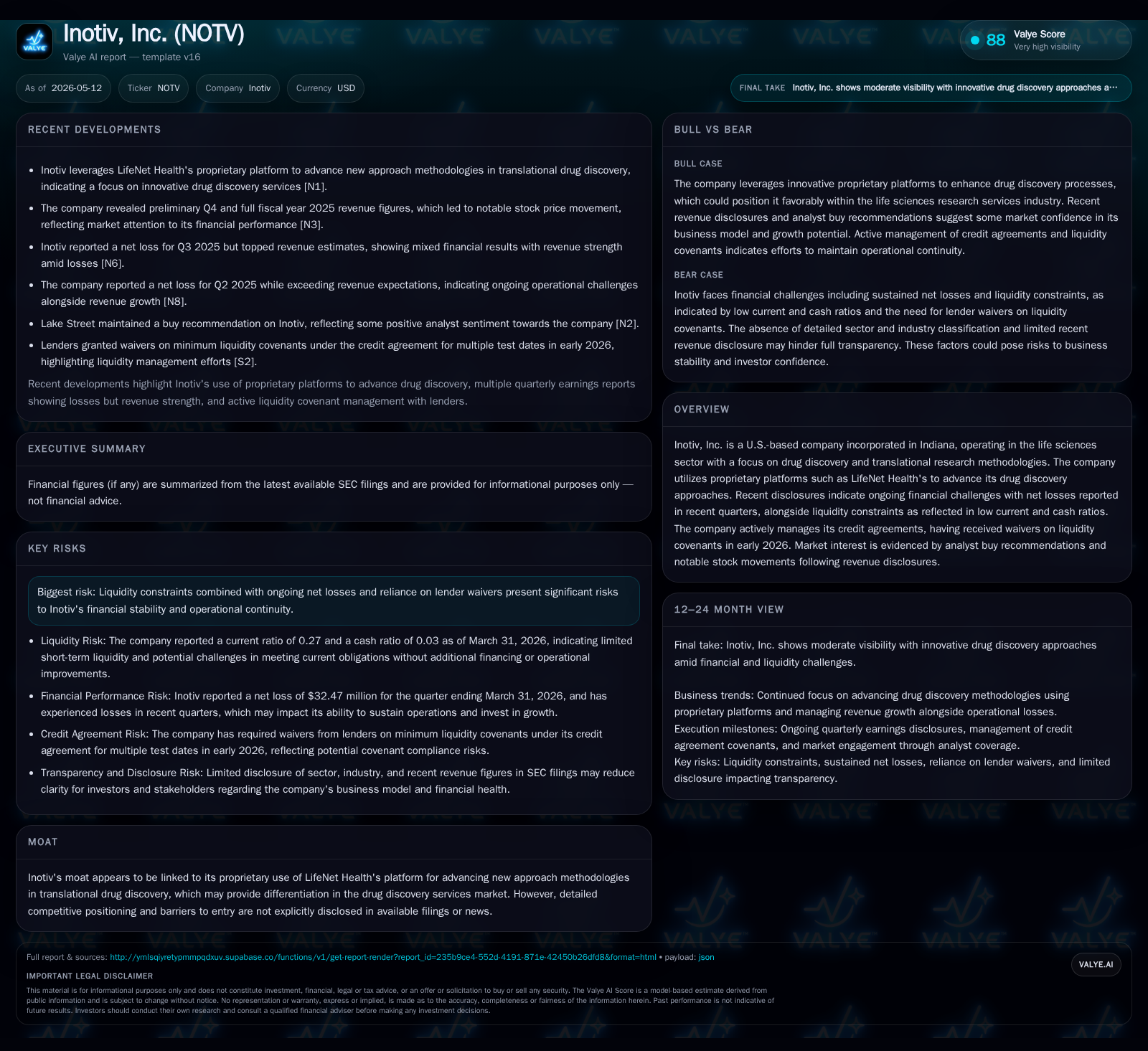
Inotiv's latest quarterly filing reveals acute liquidity stress underscored by a current ratio of 0.27 and multiple lender waivers of minimum liquidity covenants. The company’s business model centers on drug discovery services enhanced by LifeNet Health’s proprietary translational methodologies, which provide some differentiation but have yet to translate into financial stability. Industry pressures, including pricing competition and regulatory hurdles for innovative approaches, compound near-term growth challenges. Monitoring forthcoming liquidity tests and platform adoption metrics is critical as Inotiv navigates operational continuity risks.
Latest Quarterly Update Highlights Key Financial Strains
As of March 31, 2026, Inotiv reported current assets of approximately $144.5 million against current liabilities totaling around $540.3 million, resulting in an alarmingly low current ratio of 0.27 [S2][F1]. This mismatch illustrates an acute working capital deficiency that could threaten operational fluidity if unaddressed.
Supporting this assessment, Inotiv announced in the subsequent May 5, 2026 Form 8-K that its lenders granted waivers for the minimum liquidity covenant tied to the Credit Agreement for the May 1 and May 8, 2026 test dates [S3]. These waivers, a continuation of recent precedent given multiple prior concessions during the first quarter of calendar-year 2026, reflect the company’s ongoing struggle to maintain required liquidity thresholds under tight financial covenants. Although no amendments were made to the Credit Agreement terms beyond these temporary reliefs, this pattern signals stress in Inotiv's near-term financing profile.
The combined evidence from these filings portrays a firm navigating significant financial headwinds with strained cash flow and working capital deficits necessitating lender accommodation to sustain operations.
Business Model and Competitive Differentiation in Translational Research
According to the company’s amended annual report filed January 28, 2026, Inotiv positions itself within the life sciences sector primarily as a provider of drug discovery and translational research services [S1]. Central to its value proposition is the application of proprietary platforms licensed through LifeNet Health. These enable advanced new approach methodologies aimed at enhancing the predictive accuracy and efficiency in preclinical drug development.
The company's revenue derives mainly from contracted services where clients—pharmaceutical companies and biotechnology firms—pay for specific research activities spanning in vitro screening, in vivo pharmacology studies, ADME (absorption, distribution, metabolism, excretion) analyses, and toxicology evaluations. Volume expansions hinge on increasing contract wins or deepening engagement scopes with existing customers.
While LifeNet Health's proprietary technologies offer a differentiator by potentially accelerating translational insights and reducing costly late-stage failures in drug pipelines, Inotiv has not explicitly detailed structural barriers or sustainable competitive moats beyond this technological edge [S1]. The business model appears reliant on maintaining high standards of scientific quality and customer service to ensure recurring revenue streams amid a fragmented CRO (contract research organization) services landscape.
Industry Environment and Competitive Challenges in Drug Discovery Services
The industry backdrop for Inotiv includes well-established CRO competitors varying from large global incumbents to specialized niche providers focused on translational or early-stage research. Pricing tends to be pressured due to commoditization risks; clients often demand discounts or leverage bundled contract negotiations across service categories.
Further complicating market dynamics is regulatory scrutiny over incorporating novel preclinical methodologies. Adoption cycles for new platforms are cautious as validation proofs accumulate slowly. Regulatory acceptance critically influences customer willingness to shift from validated models to newer translational approaches that claim better predictiveness.
Capacity constraints occasionally limit growth when demand outpaces lab space or scientific personnel availability. Given these structural factors coupled with macroeconomic cyclicality affecting drug development budgets, profit margins tend to be moderate with episodic volatility driven by lumpiness in contract wins or pipeline project schedules [S1].
Growth Catalysts: Opportunities from Proprietary Platforms and Demand Expansion
Despite the immediate financial headwinds, Inotiv identifies concrete growth drivers linked to broader client adoption of LifeNet Health’s novel methodologies embedded within their service offerings [S1][S2]. Expanding these translational tools’ usage can enhance differentiation especially if clients observe better predictive outcomes translating into shorter development timelines or improved candidate selection.
Potential exists for incremental market penetration by extending services into adjacent translational segments such as biomarker development or mechanistic toxicology studies. Innovation-led service enhancements could also support margin expansion if priced premiums can be realized based on demonstrated value-add.
Moreover, secular trends favoring outsourcing early-stage R&D functions after pharmaceutical companies seek cost efficiencies provide a tailwind underpinning demand for reliable CRO partners like Inotiv.
Key Risks: Liquidity Pressures, Net Losses, and Covenant Dependencies
Risks surrounding Inotiv are dominated by its precarious liquidity profile highlighted by continuing net losses documented in prior annual reports alongside sizable debt load nearing $416 million as of Q2 FY2026 end [S1][F1]. The net debt position stands close to $401 million after accounting for cash reserves.
Ongoing reliance on temporary lender waivers for liquidity covenant compliance underscores vulnerability to worsening operational performance or delays in generating positive cash flows [S3][F1]. Failure to cure deficits could trigger defaults or necessitate costly restructuring initiatives disrupting business continuity.
Operationally, sustaining client contracts while investing sufficiently into platform innovation without cash flow sufficiency places added strain on management execution capabilities. External industry factors such as cyclical R&D spending downturns or adverse regulatory stances towards newer methodologies further amplify downside risks.
Monitoring Points: Upcoming Operating Metrics and Covenant Compliance
Investors following Inotiv should closely monitor upcoming quarterly filings providing updated liquidity test results referencing Credit Agreement covenant adherence dates post-May 2026 [S2][S3]. Revenue progression tied explicitly to client uptake levels of LifeNet Health-enabled services will also be vital numerically indicative milestones.
Additionally, any management disclosures relating to credit facility negotiations or refinancing attempts could materially affect risk assessments. Progress updates on scientific validation milestones that underpin platform competitiveness would offer qualitative visibility into organic growth drivers.
Consolidated Financial Overview and Balance Sheet Health
Latest financial snapshot
| Metric | Value | Period |
|---|---|---|
| Cash & equivalents | $15mm | |
| 2026-03-31 | ||
| Total debt | $416mm | |
| 2026-03-31 | ||
| Net debt | $401mm | |
| 2026-03-31 | ||
| Current assets | $144mm | |
| 2026-03-31 | ||
| Current liabilities | $540mm | |
| 2026-03-31 | ||
| Current ratio | 0.27x | |
| 2026-03-31 |
Source: SEC companyfacts cache [F1].
| Metric | Amount (USD) |
|---|---|
| Cash & Equivalents | $15,180,000 |
| Total Debt | $416,276,000 |
| Net Debt | $401,096,000 |
| Current Assets | $144,469,000 |
| Current Liabilities | $540,285,000 |
| Current Ratio | 0.27 |
This snapshot encapsulates the challenging financial state affirming analysis presented earlier.
This analysis is based solely on public SEC filings and relevant data sources cited herein as of May 12, 2026. It does not constitute investment advice or recommendations but serves informational purposes rooted in documented operating facts.
Disclaimer: This is research-only, informational analysis and not investment advice. It may include AI-generated interpretation and general industry context. Always verify important details using primary sources.

Comments