
F&M Bank Corp Advances Liquidity and Earnings Through Strategic Asset Management
The bank’s Q1 2026 results demonstrate improved net interest margin and liquidity resilience driven by loan growth and liability optimization.
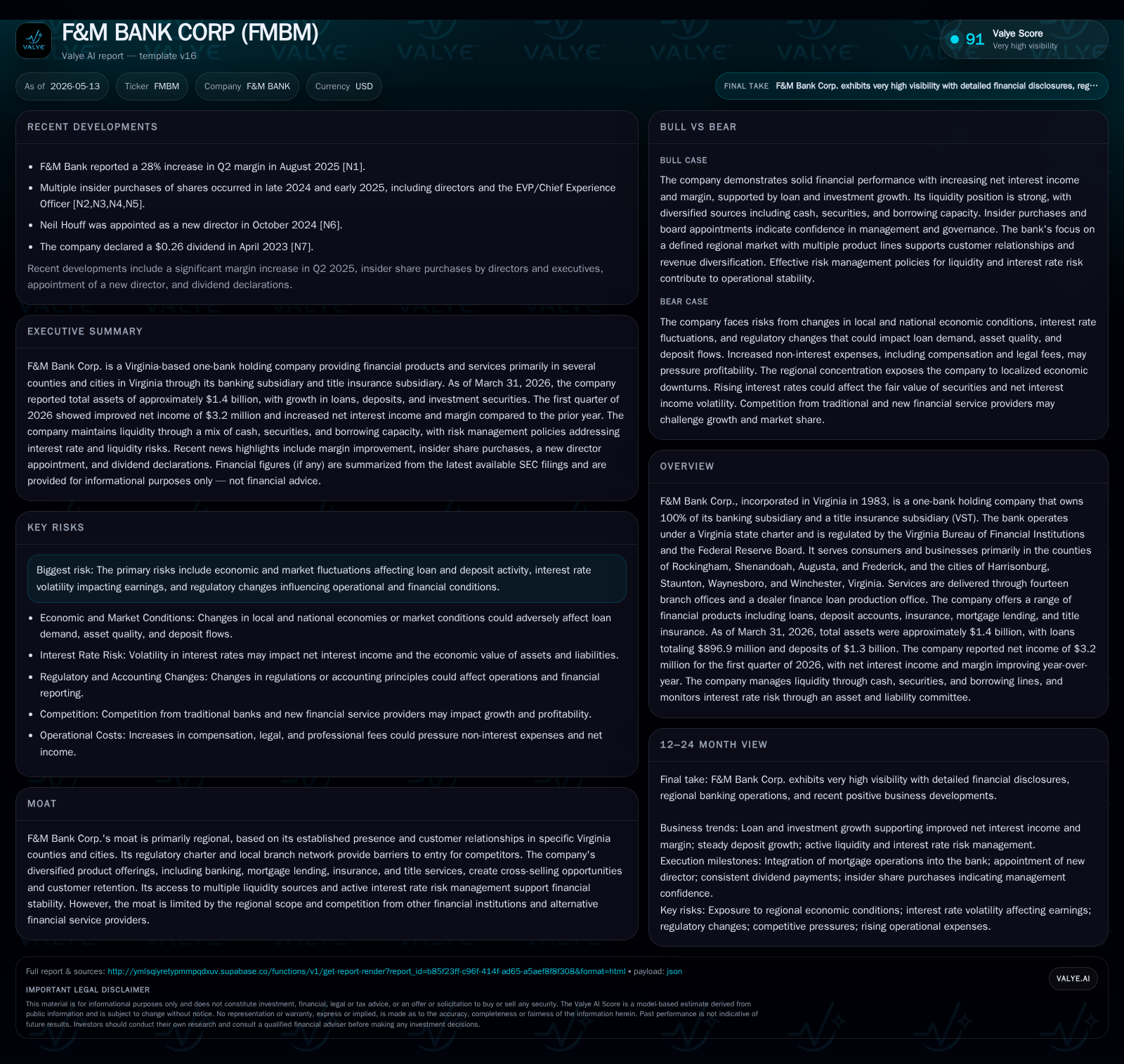
F&M Bank Corp reported a net interest margin improvement to 3.56% in Q1 2026, supported by strategic loan and securities portfolio expansion alongside a deposit mix shift toward lower-cost liabilities. The company maintains robust liquidity buffers through significant liquid assets and multiple credit facilities. Its regional focus within Virginia, coupled with diversified offerings including mortgage, insurance, and title services, underpins stable customer relationships and cross-selling opportunities. While interest rate volatility presents challenges via securities portfolio fair value pressures, disciplined asset-liability management and capital adequacy bolster financial stability going forward.
Quarterly Performance Highlights: Margin Expansion and Liquidity Status
F&M Bank Corp’s first quarter of 2026 showcased operational momentum anchored in net interest income growth supported by both increased earning assets and enhanced funding efficiency. Interest income rose $1.2 million quarter-over-quarter attributable primarily to loan portfolio expansion alongside steady investment securities purchases [S2]. Concurrently, interest expense declined by $756,000 largely due to an intentional shift away from higher-cost time deposits toward lower-cost checking and money market accounts — an effective liability management strategy [S2]. This double benefit lifted net interest margin (NIM) by 41 basis points to 3.56%, with yielding assets increasing minimally yet cost of liabilities falling substantially by 45 basis points to 2.49% [S2]. Asset yield edged up slightly by one basis point to 5.44%, indicating the quality of asset mix was sustained despite rate pressures.
Liquid assets totaled $121.5 million representing 8.6% of total assets as of March-end. Liquid earning assets also stood at approximately $103 million or nearly 7.8% of earning assets [S2]. The firm benefits from diverse off-balance sheet liquidity avenues including a secured Federal Home Loan Bank line of credit with $201 million available plus unsecured federal funds lines aggregating $90 million — together ensuring material capacity to meet depositor withdrawals or loan demand shocks without distress borrowing [S2]. No draws on the Federal Reserve Discount Window occurred during the quarter despite pledged collateral well in excess of current borrowing needs [S2].
Business Model: Regional Banking with Cross-Selling Depth
F&M Bank Corp operates principally as a community financial institution embedded in select Virginia counties — Rockingham, Shenandoah, Augusta, Frederick — plus key cities such as Harrisonburg and Winchester [S1,S2]. Operating fourteen branch offices complemented by dealer finance loan production capability allows for local presence while targeting business verticals requiring specialized financing solutions.
Its business model generates revenues mainly from net interest income through lending activities spanning residential mortgages, commercial real estate, farmland secured loans as well as automotive financing channels managed within its dealership divisions [S9]. On the liability side customer deposits form the core low-cost funding source underpinning asset growth.
Beyond traditional banking products, F&M expands wallet share via subsidiaries offering mortgage lending support services and title insurance solutions (through VST). These ancillary financial service streams drive noninterest income diversification while fostering stickiness in customer relationships. Such cross-functional integration contributes to incremental fee-based revenue without substantially increasing capital consumption or operational risk.
Competitive Positioning in the Virginia Financial Services Market
F&M Bank’s competitive strength is notably anchored in its regional footprint which affords valuable customer loyalty benefits amid a moderately fragmented local banking landscape [S1,S2]. The bank’s state charter under Virginia regulations along with Federal Reserve oversight establishes robust governance frameworks while defining permissible activity boundaries.
The comprehensive service offering — spanning traditional deposit/lending products alongside insurance and title agents — creates formidable switching cost dynamics for customers seeking convenience within a single provider ecosystem. Although competition persists from larger regional banks as well as fintech entrants focusing on specific financial verticals, F&M’s entrenched presence cultivated over decades fosters durable brand recognition.
Furthermore, deliberate asset-liability committee (ALCO) oversight functions sustain tight controls on market risks such as interest rate volatility which remain paramount to preserving margin integrity in shifting yield curve environments [S8]. This ensures balance sheet posture can proactively adjust to macroeconomic developments.
Growth Drivers: Loan Portfolio Expansion and Liability Cost Optimization
Loan book expansion was a clear highlight in Q1 2026 with an aggregate increase of approximately $10.6 million spread across key sectors: residential mortgage loans grew by $8.4 million; multifamily residential up $6.4 million; commercial & industrial rose $2.9 million; farmland-backed loans also advanced $2.9 million; complemented by construction-related lending up roughly $2.8 million (partially offsetting declines elsewhere) [S9]. This cross-segment momentum frees revenue growth from dependence on any single category.
On the liability front, careful repricing efforts lowered cost of funds markedly via reduced time deposit balances replaced by cheaper money market/savings account instruments resulting in nearly $756k less quarterly interest expense versus prior periods [S2,S9]. Deposit growth was strong with total increase close to $30 million including a notable rise of almost $11 million in noninterest-bearing demand deposits strengthening stable core funding proportions [S9].
Risks and Constraints: Interest Rate Fluctuations and Local Economic Dependence
A principal risk remains sensitivity of the securities portfolio fair value to abrupt increases in market interest rates causing unrealized losses that can pressure comprehensive income measures if prolonged or severe [S2,S4,S8]. While this does not affect cash flows directly unless sales occur prematurely, it models potential mark-to-market volatility influencing regulatory capital calculations.
Operationally concentrated exposure exists around localized economic conditions impacting borrower creditworthiness or slowing demand for new loans particularly given the geographic concentration solely within parts of Virginia limiting diversification benefits relative to larger multi-state peers [S1,S8].
Uninsured deposits constitute about 14% of total deposits—meaning rapid outflows could stress liquidity under extreme events—but management’s liquidity policy including ample cash reserves plus access to FHLB facilities cushions such scenarios effectively [S8].
Future Monitoring: Structural Shifts in Deposit Mix, Regulatory Environment, and Earnings Signals
Key indicators warranting continuous observation include shifts within deposit composition especially continued migrations out of higher-cost time deposits into checking/savings buckets which materially impact net interest margin sustainability going forward [S2]. Moreover potential regulatory developments concerning liquidity ratios or capital requirements could necessitate changes in business practices or risk appetite.
Following the Bearing Insurance minority stake sale gain realized recently ($4.8M pre-tax) there may be reinvestment considerations influencing future noninterest income profiles or capital deployment priorities [S3]. Watching quarterly earnings updates for consistency in loan growth trends against macroeconomic headwinds will inform ongoing demand strength assessment.
Dividend policies relative to retained earnings accumulation provide additional insight into capital strategy balancing shareholder returns versus buffer enhancement amidst uncertain rate cycles.
Financial Snapshot: Solid Capital Fundament Amid Rising Rates
At March 31, 2026 total assets approached approximately $1.4 billion with loans standing near $897 million supported by deposits totaling roughly $1.28 billion showing quarter-over-quarter increases aiding funding stability [S2,S9]. Shareholders’ equity rose modestly to about $106.6 million reflecting accrued net income partially offset by dividends paid out during the quarter [S7,S9].
The Company abstained from any borrowing at the Discount Window during Q1 further signifying adequate internal liquidity sufficiency with available external lines enhancing optionality if needed [S2].
Disclaimer: This analysis is based exclusively on information available as of May 13, 2026 from SEC filings including Form 10-Q (May 13), Form 10-K (March 27), Form 8-K (May 5), company facts data extracts, and related disclosures without extrapolation beyond cited sources. It is intended solely for informational purposes without any investment recommendation or advice.
Disclaimer: This is research-only, informational analysis and not investment advice. It may include AI-generated interpretation and general industry context. Always verify important details using primary sources.

Comments