
Cocrystal Pharma Advances Antiviral Pipeline with Phase 1 Milestones and Robust Structure-Based Platform
Recent clinical progress and government grant awards underscore Cocrystal Pharma’s focus on broad-spectrum antivirals targeting RNA viruses.
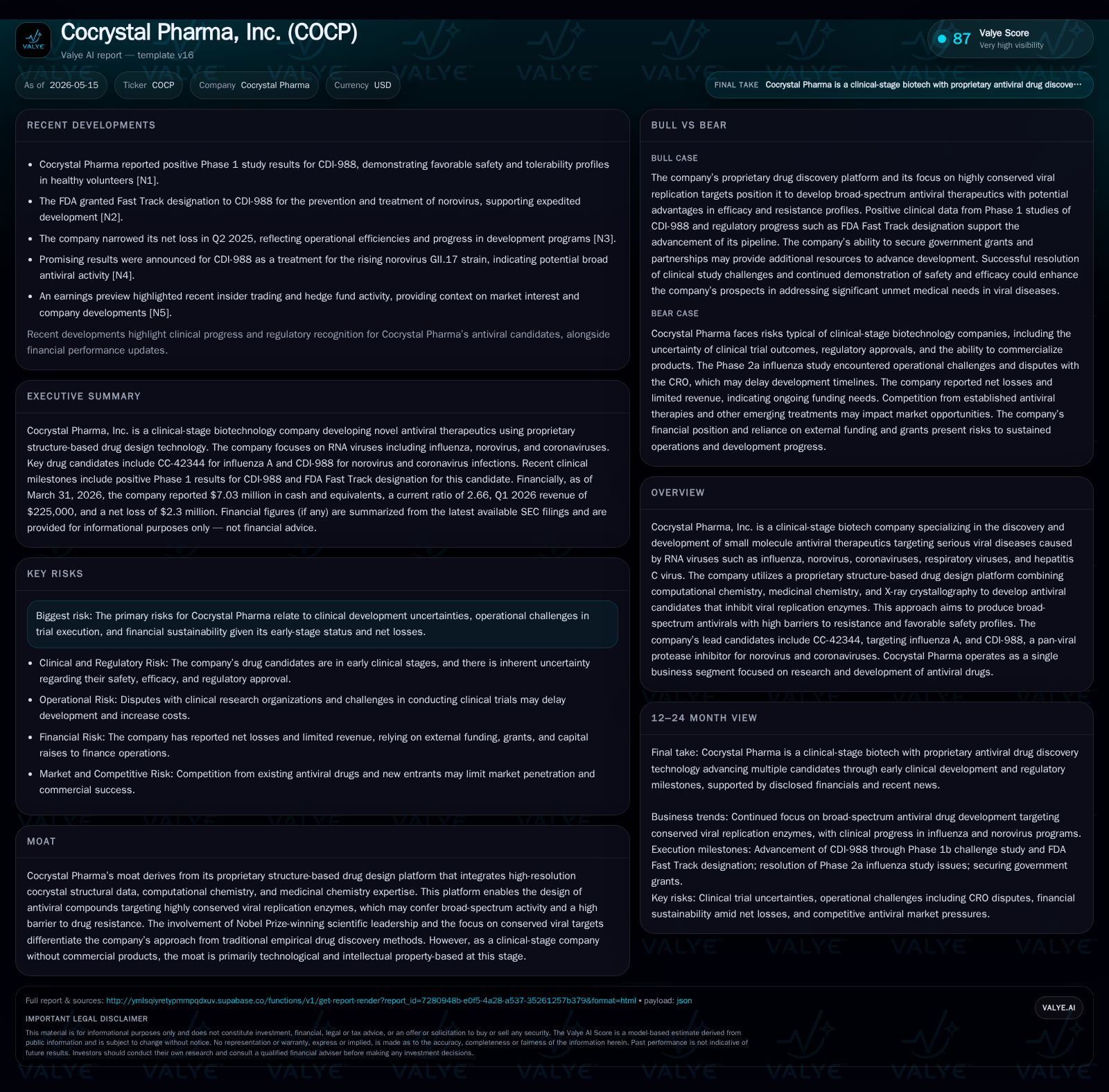
Cocrystal Pharma, a clinical-stage biotech leveraging a proprietary structure-based drug design platform, reported solid Phase 1 study results for its antiviral candidate CDI-988. The company recently secured NIH SBIR grant funding to support development of an oral influenza antiviral, CC-42344. Cocrystal’s integrated approach targets conserved viral replication enzymes to create broad-spectrum agents with high resistance barriers. While operating at an early stage without commercial products, its technological moat is bolstered by Nobel Prize-winning scientific leadership and focused R&D efforts. Financially, it remains pre-revenue with managing liquidity and trial performance as key near-term variables.
Recent Operating Update
Cocrystal Pharma’s latest quarterly report filed May 15, 2026 [S2] reflects steady operational continuity amid clinical advancement efforts. The company recognized $225,000 in grant income in Q1 tied to the $500,000 NIH Small Business Innovation Research (SBIR) Phase I award announced in October 2025 [S10], supporting development of CC-42344, its oral broad-spectrum antiviral for influenza A and B. This grant income improved revenue recognition compared to zero reported revenue a year ago but remains modest relative to overall operating expenses.
Notably, in April 2026 the company issued press releases highlighting positive Phase 1 study results for CDI-988 [N1]—a key pan-viral protease inhibitor candidate addressing norovirus and coronaviruses—and FDA Fast Track designation for CDI-988 aimed at prevention and treatment of norovirus [N2]. These developments mark critical inflection points validating the drug's mechanism of action and readiness to move into later-stage clinical trials. The company's presence at the International Conference on Antiviral Research (ICAR) spotlighted these findings [S3][S7], enhancing scientific visibility.
Operating expenses remain dominated by research and development costs ($1.04 million in Q1 2026) closely aligned with prior periods reflecting continuous investment in pipeline progression [S8]. General and administrative costs showed moderate increases tied partly to professional services. Net loss for Q1 stood at approximately $2.3 million [S8]. The company maintains a current ratio of about 2.66 as of March 31, 2026 [F1], indicating sufficient short-term liquidity to fund near-term operations without immediate refinancing needs.
Business Model Overview
Cocrystal Pharma operates within the clinical-stage biotechnology domain focused exclusively on antiviral drug discovery and development. Its revenue model currently relies entirely on external government grants such as NIH SBIR awards rather than product sales, given the absence of approved commercial therapies.
The company's unique value proposition centers on its proprietary structure-based drug design platform that integrates computational chemistry, medicinal chemistry, X-ray crystallography data, and viral enzymology insights [S1]. This platform enables identifying inhibitors targeting highly conserved viral replication enzymes across multiple RNA virus families. The tight integration aims to accelerate candidate selection while anticipating potential resistance mutations.
This technology-driven approach contrasts traditional empirical screening by focusing on atomic-level enzyme interactions derived from cocrystallization studies supervised by Nobel Laureate Dr. Roger Kornberg [S1]. The result is a pipeline of next-generation small molecules intended to offer broad-spectrum activity against influenza strains (e.g., CC-42344), pan-coronavirus threats including SARS-CoV-2 (CDI-988), norovirus, respiratory syncytial virus (RSV), plus hepatitis C variants.
Revenue generation remains dependent on successful transition from discovery through phase trials toward commercialization partnerships or licensing deals—a path typical yet challenging for biotech firms at this stage.
Industry Structure and Competitive Position
The antiviral therapeutics landscape is characterized by intense innovation driven by unmet medical need due to continual viral evolution and emerging infections. While hepatitis C direct-acting antivirals have transformed their market with well-established regimens over the past decade [S1], there remains a notable gap in effective broad-spectrum agents targeting acute respiratory viruses like influenza or noroviruses.
Cocrystal's focus on multi-targeted protease inhibitors places it among a competitive but fragmented group of developers aiming to broaden efficacy beyond single-virus targets. The company’s reliance on structure-based design potentially offers a differentiated edge enabling optimization against conserved enzyme active sites that are less prone to rapid mutation-driven resistance [S1]. However, many competitors—including larger pharmaceutical firms—possess broader late-stage pipelines and established commercial infrastructure.
Furthermore, regulatory pathways for novel antivirals can be complex due to evolving standards around efficacy endpoints and safety profiles especially in prophylactic indications which heightens risk during clinical development phases.
Growth Drivers
Key growth drivers hinge fundamentally on advancing late preclinical candidates into later-phase human studies with demonstrable efficacy signals. Positive Phase 1 results for CDI-988 constitute an important validation step toward market-readiness while fast track status accelerates regulatory engagement enabling potentially expedited approval timelines [N1][N2].
Government grant support acts as both funding fuel and external validation—NIH backing underscores confidence in the influenza program CC-42344 which if successful could open significant therapeutic opportunities given seasonal flu’s persistent global impact [S10].
Additionally, technological platform enhancements improve discovery velocity potentially expanding pipeline breadth across other viral targets over time.
Raising non-dilutive capital via grants mitigates financing risks somewhat while recent private placements issuing stock warrants further consolidate financial runway [S12].
Risks and Watchpoints
Despite promising scientific advancements, Cocrystal remains fundamentally exposed to typical early-stage biotech risks:
What to Watch Next
Stakeholders should prioritize monitoring:
- Clinical readouts from ongoing or planned Phase 2 studies for CC-42344 addressing previous enrollment issues;
- Further clinical data releases or trial initiations for CDI-988 following positive Phase 1 results;
- Updates on grant funding utilization and potential new awards expanding financial buffers;
- Equity financing activity outcomes influencing capital structure stability;
- Regulatory filings or feedback shaping development timelines;
- Scientific publications or conference presentations affirming mechanistic differentiation;
- Partnership announcements signaling commercial validation or co-development opportunities.
Financial Profile Summary
Latest financial snapshot
| Metric | Value | Period |
|---|---|---|
| Cash & equivalents | $7mm | |
| 2025-12-31 | ||
| Current assets | $6mm | |
| 2026-03-31 | ||
| Current liabilities | $2mm | |
| 2026-03-31 | ||
| Current ratio | 2.66x | |
| 2026-03-31 |
Source: SEC companyfacts cache [F1].
As of March 31, 2026, Cocrystal held $5.94 million in current assets against $2.23 million in current liabilities yielding a current ratio of approximately 2.66 which indicates adequate short-term liquidity [F1]. Total debt disclosed was historical at around $2.58 million but appears non-problematic relative to cash/resources available as net debt stands negative indicating more cash than debt liabilities [F1].
Cash burn reflected by quarterly net losses near $2.3 million aligns with ongoing research expenditures exceeding revenues derived mostly from grants totaling $225,000 this quarter [S8][S10].
Recent registered direct offerings raising roughly $4.18 million net proceeds alongside warrant issuances provide extended capital runway facilitating upcoming trials funding needs [S12].
Operating lease commitments across locations add predictable fixed overhead costs but are manageable given cash reserves [S15][S21]. Stock-based compensation expense is modest but reflects efforts to align incentives through recent equity incentive plan approvals expanding available shares for grants beyond expired prior plans [S16][S17].
Overall financials confirm early-stage biotech profile requiring efficient capital deployment towards pipeline milestones increasingly pivotal for sustaining investor support.
This report is intended solely for informational purposes based on publicly available information as of May 15, 2026. It does not constitute investment advice or recommendations.
Disclaimer: This is research-only, informational analysis and not investment advice. It may include AI-generated interpretation and general industry context. Always verify important details using primary sources.

Comments