
Agape ATP Corp Expands Health and Wellness Network While Advancing Renewable Energy Ventures
Latest quarterly disclosure highlights sustained direct-selling strength and strategic diversification in Southeast Asia.
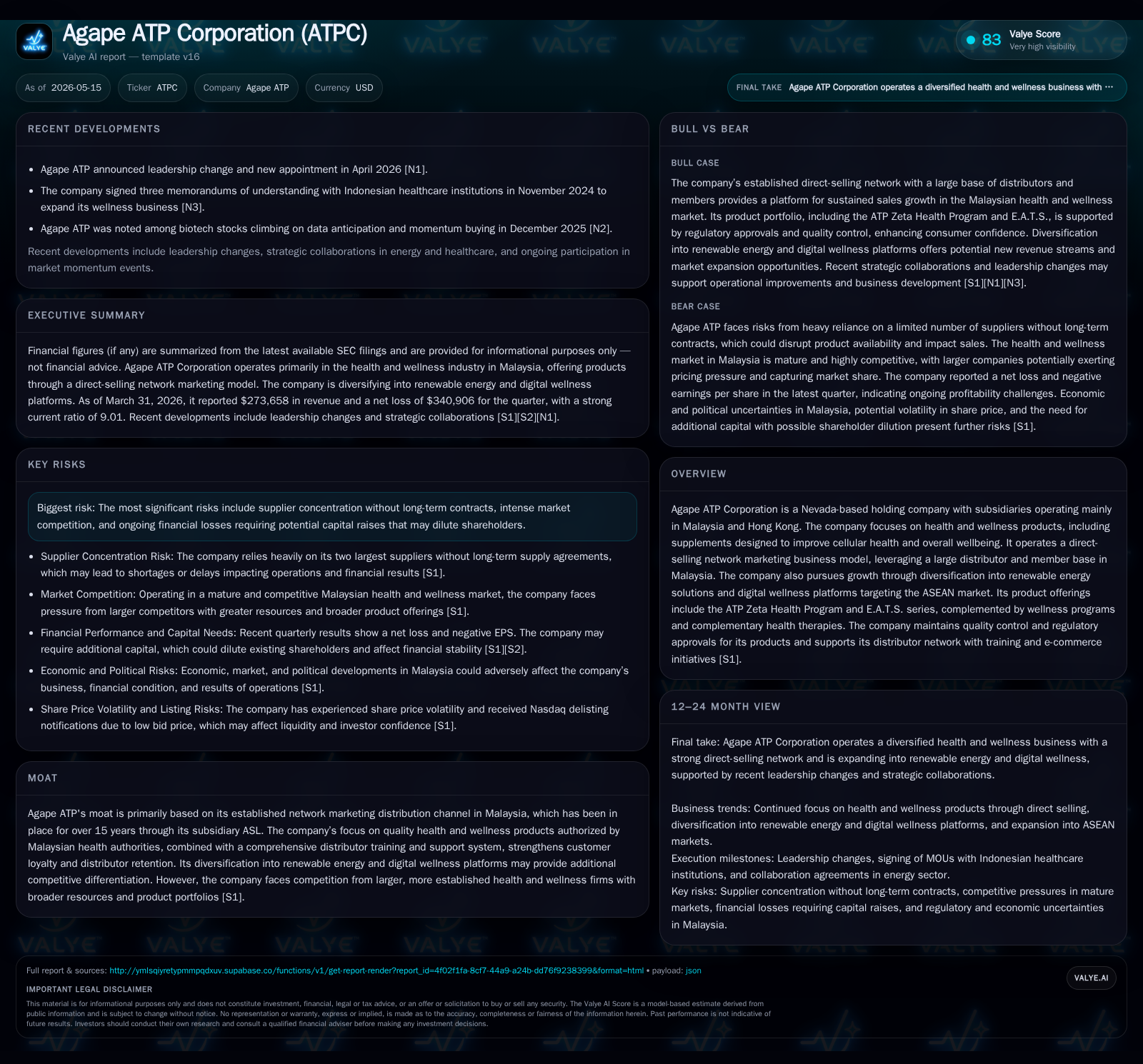
Agape ATP Corporation's latest 10-Q affirms its established direct-selling model focused on health supplements in Malaysia, supported by a robust distributor network and regulatory approvals. The company continues to invest in digital wellness platforms and renewable energy through subsidiaries, signaling a dual-pronged growth strategy targeting both health-conscious consumers and sustainability sectors in ASEAN markets. Supplier concentration and market competition remain notable risks, alongside ongoing operating losses. Financially, the firm maintains strong liquidity with a high current ratio but faces pressures from negative operating margins.
Recent Operating Update
Agape ATP Corporation's most recent quarterly filing dated May 15, 2026 [S2] reaffirms its strategic emphasis on health and wellness product sales through established network marketing channels primarily based in Malaysia. There are no material risk-factor updates this quarter relative to the previous annual disclosures. The company maintains operational continuity amid ongoing investments in technology platforms and renewable energy ventures.
A noteworthy event earlier this year was the March 2026 announcement of a non-exclusive collaboration with Citadel Investment LLC [S3], aiming to leverage mutual connections for business opportunities involving oil, gas, refinery, and petrochemical products. While not core to its health segment, this move signals Agape ATP's broadened ambition in the energy domain.
Business Model
At its core, Agape ATP operates a direct-selling network marketing model that generates revenue predominantly through sales of health supplements and wellness products. Revenue mechanics revolve around distributors purchasing product inventory at preferential rates for resale to customers while recruiting further distributors under them to build downline networks [S17][S23]. This multilevel structure incentivizes personal relationships and trust-based recommendations which can fuel volume growth.
Distributors gain from retail margins plus performance bonuses tied to their personal sales and those of their recruited networks. Customers can also become lifetime members via one-time fees enabling discounted purchases [S23]. The company's product range centers on proprietary wellness programs like the ATP Zeta Health Program—targeting detoxification and cellular renewal—and E.A.T.S., focusing on convenient nutrition approaches. Complementary therapies are offered through DSY Wellness subsidiary.
Quality assurance is maintained via compliance with Malaysian health authorities' rigorous authorizations for food-grade supplements—a critical trust factor supporting distributor confidence [S1][S17]. Inventory is centrally managed through Kuala Lumpur headquarters with regional stockists facilitating physical retail presence for convenience.
Additionally, the company leverages digital channels including an evolving e-commerce platform aimed at expanding online sales and recruitment capabilities beyond geographic confines [S15]. This blend of personal engagement backed by online tools forms a hybrid go-to-market approach.
Financial incentives structured along multiple distributor tiers promote retention by scaling reward potential as sales groups grow [S23]. Continuous training programs further support distributor effectiveness by syncing product knowledge with selling skills.
Industry Structure and Competitive Position
Agape ATP operates within the fragmented Southeast Asian health supplement market characterized by numerous small players alongside larger multinational firms with broader portfolios and deeper resources [S1][S19]. Competitors often capitalize on extensive retail footprints or traditional supply chains rather than multi-level marketing. This creates segmentation where Agape's strength lies in leveraging personal rapport through its dedicated distributor base.
However, supplier concentration remains an inherent vulnerability—three main suppliers accounted for over 87% of purchases for the last fiscal year without binding long-term agreements [S1][S4]. Such dependence presents execution risk should supply constraints or price hikes emerge.
In addition to pure-play supplement companies, increasing competition arises from lifestyle brands integrating wellness with digital platforms; here Agape's recent digital wellness push attempts to capture comparable market share [S8]. Its green energy expansion also sets it apart by diversifying into an adjacent but distinct sector whose growth dynamics are driven by environmental policies more than consumer habits.
Regulatory compliance is stringent given Malaysia's robust frameworks governing consumables. Agape's track record of obtaining necessary Food Safety and Quality Division approvals conveys credibility which smaller or newer entrants may find costly or slow to secure [S17].
Growth Drivers
Growth is anchored primarily on expanding direct selling distribution networks that fuel recurring orders. Training programs and membership incentives seek to improve recruitment depth and distributor productivity. Product innovation within existing lines—such as enhancements to ATP Zeta formulations—and expansion of complementary therapies offer avenues for cross-selling.
Digital wellness platforms developed under wholly owned subsidiaries target tech-savvy demographics across ASEAN markets with scalable e-commerce infrastructure. Chronic disease management services embedded therein may foster higher customer engagement beyond simple supplement sales [S8].
Renewable energy initiatives represent a strategic diversification designed to tap growing commercial demand for sustainable power solutions across Malaysia and potentially wider ASEAN regions. Through recent collaboration agreements (e.g., March 2026 partnership with Citadel Investment LLC) [S3], Agape aims to develop project pipelines featuring solar generation, storage technologies, sustainability consulting, and associated services targeting industrial clients [S10]. These endeavors align with geopolitical emphasis on carbon footprint reduction.
Risks and Constraints
Supplier concentration without formalized long-term contracts is prominent risk material affecting timely product availability and cost stability [S1][S4]. Delays or shortages could hamper revenue cycles notably because payment milestones depend on prompt delivery.
Competitive pressures from large incumbents equipped with expansive R&D budgets bring risk of product commoditization or pricing pressures eroding margins [S1][S19]. Additionally, volatility in consumer preferences necessitates agile new product development lest legacy offerings lose relevance.
Operating losses persist despite revenue generation—latest reports show operating income remains negative reflecting significant investments causing cash burn [F1]. This financial strain increases likelihood of equity or debt raises diluting shareholders if profitability benchmarks are not met.
Regulatory landscapes encompass anti-corruption laws plus mandatory certifications subjecting the Company to reputational risk if compliance falters [S7][S11]. Social-political instabilities or economic fluctuations in Malaysia may impede consistent market growth trajectories.
What To Watch Next
Upcoming milestones include scaling traction of the digital wellness e-commerce platform beyond Malaysian borders incorporating chronic care verticals [S8]. Progression or setbacks in renewable energy project acquisition/deployment will be pivotal indicators of diversification success.
Monitoring supplier relationship developments is critical given no binding long-term purchase commitments exist currently; any shifts could impact inventory costs or availability materially [S1][S4]. Distributor base expansion metrics will signal ongoing vitality of direct-selling model despite competitive headwinds.
Further capital raising announcements or strategic partnerships related to the energy segment would clarify funding adequacy supporting operational scale-up amid loss-making status [F1]. Regulatory updates particularly related to product approvals or compliance investigations warrant attention due to reputational implications.
Financial Profile Summary
Latest financial snapshot
| Metric | Value | Period |
|---|---|---|
| Cash & equivalents | $220779 | |
| 2026-03-31 | ||
| Current assets | $25mm | |
| 2026-03-31 | ||
| Current liabilities | $3mm | |
| 2026-03-31 | ||
| Current ratio | 9.01x | |
| 2026-03-31 |
Source: SEC companyfacts cache [F1].
As of March 31, 2026, Agape ATP holds approximately $221k in cash balances against current liabilities near $2.7 million yielding a robust current ratio around 9x indicating healthy short-term liquidity [F1]. Total current assets stand at roughly $24.7 million primarily reflecting inventory stockpiles aligned with distributor demand cycles.
However, full-year reported revenue was about $1.52 million accompanied by an operating loss exceeding $3.25 million evidencing ongoing cash burn juxtaposed against nascent growth ambitions [F1]. Net loss similarly at $2.28 million underscores challenges converting top-line into profitability amidst elevated operational expenditures.
This financial snapshot supports narrative that while near-term liquidity cushions operations, sustained losses necessitate strict cost management or fresh financing rounds to ensure solvency during strategic investments execution phases.
This analysis relies exclusively on company disclosures filed up to May 2026 reflected in SEC filings (notably 10-Q dated May 15) without external forecasts or valuations. It is designed solely for informational purposes within permitted policy constraints and excludes any investment advice or recommendations.
Disclaimer: This is research-only, informational analysis and not investment advice. It may include AI-generated interpretation and general industry context. Always verify important details using primary sources.

Comments