
Genoil Accelerates Technology Development Amid Ongoing Losses and Capital Challenges
The company advances proprietary hydrocarbon-processing technology with strategic focus on securing funding and commercial partnerships.
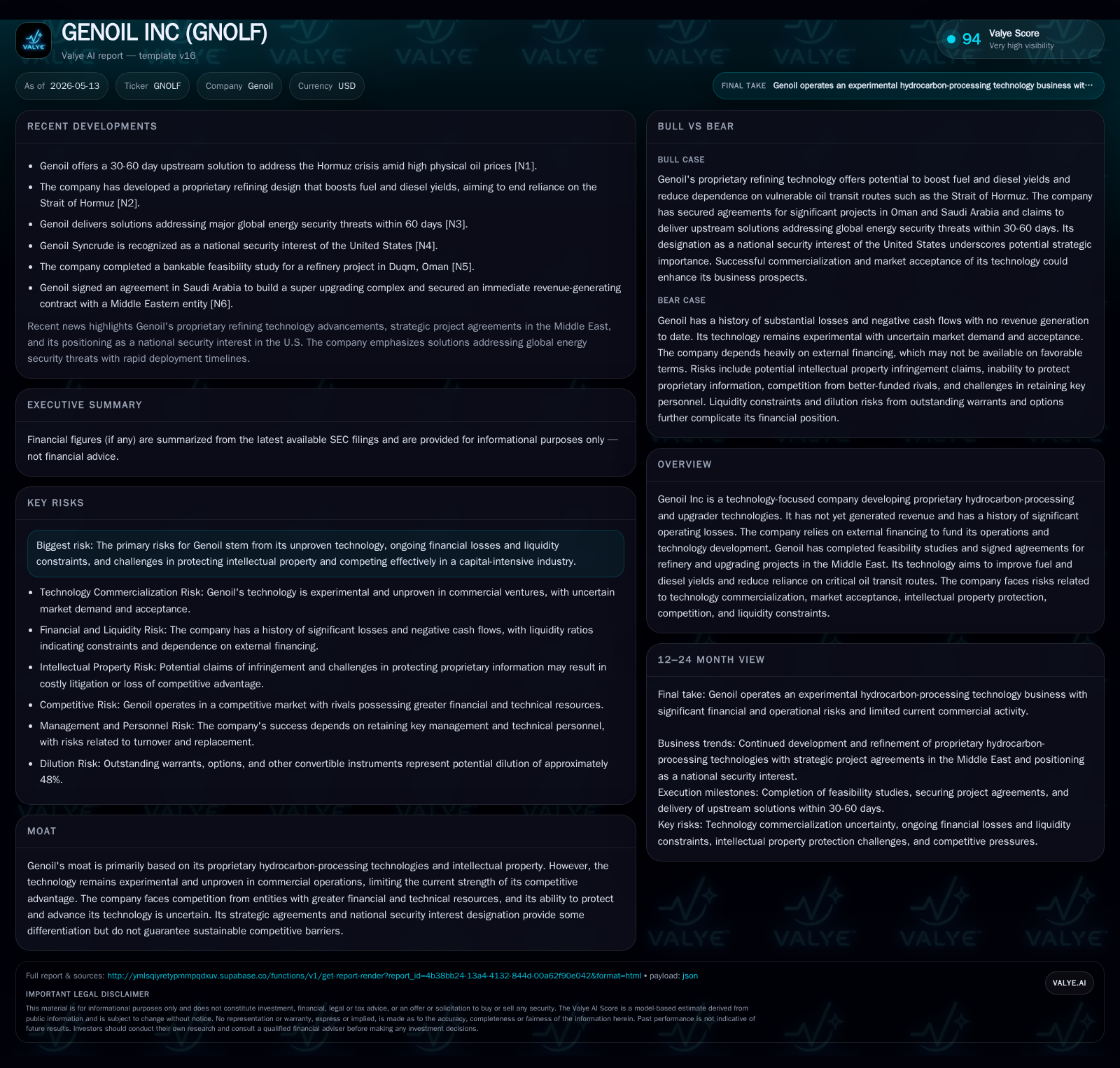
Genoil Inc remains in the developmental stage with no revenue generated to date, continuing to incur significant operating losses. The latest disclosures highlight ongoing capital raises through equity offerings to fund technology refinement and project feasibility efforts, mainly targeting refinery and upgrader applications in the Middle East. Genoil's proprietary technologies are positioned to enhance fuel yields and diversify supply chains by reducing reliance on critical transit routes such as the Strait of Hormuz. However, uncertainties around technology commercialization, market adoption, intellectual property protection, and sustained liquidity pose key challenges for near-term growth.
Recent Operating Update
Genoil's most recent SEC filing, a 6-K report dated November 14, 2025 [S2], provides an interim disclosure that reiterates the company’s continuing pattern of significant operating losses without current revenue generation. This update underscores Genoil’s dependence on capital stock offerings as the primary source of funding. Privately placed common shares issued during 2025 amounted to more than 43 million shares raising net proceeds slightly over $400,000 [S1], showcasing a persistent need to replenish working capital during ongoing research and development.
The latest annual filing dated May 13, 2026 [S1] reiterates these themes while elaborating on business structural underpinnings. Management describes expectations for continued operating losses through at least the next fiscal year alongside plans to finance capital expenditures through internal working capital supplemented by additional equity or short-term debt if required [S3]. The filings also indicate that management has not yet commercialized revenue-generating operations but remains focused on advancing proprietary hydrocarbon upgrading technologies.
Business Model
Genoil’s core business model revolves around developing proprietary hydrocarbon-processing technologies tailored for upgrading heavy crude oils into higher-value fuels. Its patented processes aim to increase yields of refined fuels such as diesel while simultaneously reducing dependencies on geopolitically sensitive oil transit corridors like the Strait of Hormuz [N2]. By improving refinery efficiency and augmenting upstream feedstock flexibility, Genoil seeks to address growing global energy security concerns in oil supply chains.
Revenue generation currently hinges on successfully commercializing these technologies through licensing agreements or integrated project implementations in strategic geographies — notably evidenced by signed project development agreements targeting refinery upgrades in Middle Eastern markets [S1]. These projects are supported by detailed feasibility studies but remain at pre-revenue or pilot stages.
The company’s operating costs skew heavily towards R&D and pilot-scale demonstrations — activities that require continual cash inputs financed through equity issuances rather than internally generated cash flows. This reflects a classic pre-commercial venture profile where value creation depends largely on proving technical efficacy at scale and securing sufficiently large commercial contracts.
Industry Structure and Competitive Position
Genoil operates within the niche hydrocarbon upgrading sector — a subset of the broader oilfield services and refining technology industry. This sector is characterized by incumbents with substantial engineering expertise, established customer bases among national oil companies (NOCs), and strong intellectual property portfolios.
Its competitive environment includes multinational technology licensors and engineering contractors capable of deploying alternative upgrading solutions backed by deep financial resources. In contrast, Genoil is a comparatively small player with an emerging technological platform still categorized as experimental [S7].
Despite its smaller scale, Genoil attempts differentiation through proprietary process innovations claimed to increase fuel yields beyond conventional methods [N2]. National security designations have granted some strategic leverage to attract collaboration offers but do not substitute for market-proven reliability or broad customer adoption.
Barriers to entry in this segment are high due to capital intensity, regulatory requirements, and the long sales cycles typical of large-scale refinery upgrade projects. However, Genoil’s current handicap lies in unproven commercial track records combined with limited financial firepower relative to entrenched competitors [S7][S14].
Growth Drivers
The path to growth for Genoil depends on several distinct but interlinked drivers:
- Technology Commercialization: Successfully completing ongoing feasibility studies and pilot demonstrations will be crucial milestones toward validating market-ready solutions.
- Strategic Partnerships: Deepening project agreements in geopolitically sensitive regions like the Middle East can provide stable footholds for scaling deployments.
- Energy Security Trends: Heightened global focus on reducing reliance on chokepoints (e.g., Strait of Hormuz) presents a structural demand tailwind for upgrading technologies that diversify feedstock sourcing.
- Equity Financing Access: Maintaining access to capital markets is vital for supporting ongoing innovation investments until revenues materialize.
- Intellectual Property Protection: Strengthening patent protections supports longer-term competitive positioning amidst increasing industry innovation.
Limited cash reserves relative to liabilities exacerbate near-term survival risk as the current ratio stands at approximately 0.4 reflecting tight short-term liquidity relative to obligations as of end-2024 [F1].
- Competitive Pressure: Larger competitors possess greater R&D budgets and market reach; Genoil may struggle to attain meaningful market penetration or sustain pricing power [S14].
- Intellectual Property Challenges: Enforcement costs against infringement claims or risks from former employees’ IP disputes add uncertainty [S11].
- Management Continuity: Reliance on key technical leadership without key-man insurance increases vulnerability from personnel turnover [S8].
- Market Adoption: Customer awareness gaps about benefits of its technology require significant sales effort; slow uptake could delay revenue realization [S15].
Monitoring financing activity and progress on partnership milestones will be essential indicators of execution momentum going forward.
What To Watch Next
Key upcoming developments that warrant close attention include:
- Announcements of new project agreements or expansions in existing Middle East partnerships reflecting successful commercialization steps [N1][N2].
- Updates on pilot plant performance or third-party validation reports confirming technology efficacy at scale.
- Capital raise timing and terms indicating continued liquidity status and investor appetite.
- Intellectual property enforcement actions or litigation outcomes impacting strategic asset rights.
- Management commentary addressing evolving geopolitical factors influencing global hydrocarbon supply chains relevant to Genoil’s solutions.
Management's guidance on timelines toward revenue generation would provide critical insight but none has been explicitly stated thus far.
Financial Profile Summary (Annual History)
Historical performance (annual)
Capital returns and efficiency (annual)
The financial trajectory reveals worsening profitability though some margin improvement between last two years. Negative equity persists signaling accumulated deficits from ongoing losses. The current ratio stands at approximately 0.4 reflecting tight short-term liquidity relative to obligations as of end-2024 [F1].
Conclusion
Genoil remains an early-stage hydrocarbon-processing technology developer facing substantial execution risks attached to unproven platforms in a capital intensive environment requiring ongoing funding injections. Its proprietary upgrading processes hold conceptual appeal given global energy security dynamics focused on supply diversification away from vulnerable transit routes. Yet realization depends heavily on converting feasibility studies into commercially viable projects before sustainable revenues emerge.
Investors monitoring Genoil should prioritize tracking progress against milestones evidencing scaling capability alongside financial strength indicators signaling continued operational viability over the next few years.
Disclaimer: This analysis is based solely on reported SEC filings and publicly available information as cited. It does not constitute investment advice or recommendations regarding GENOIL INC securities.
Disclaimer: This is research-only, informational analysis and not investment advice. It may include AI-generated interpretation and general industry context. Always verify important details using primary sources.

Comments