
Pioneer Acquisition I Corp’s Capital Strategy and Merger Execution Outlook
The latest quarterly filing affirms Pioneer Acquisition I Corp’s stable capital position amid ongoing business combination efforts in a competitive SPAC market.
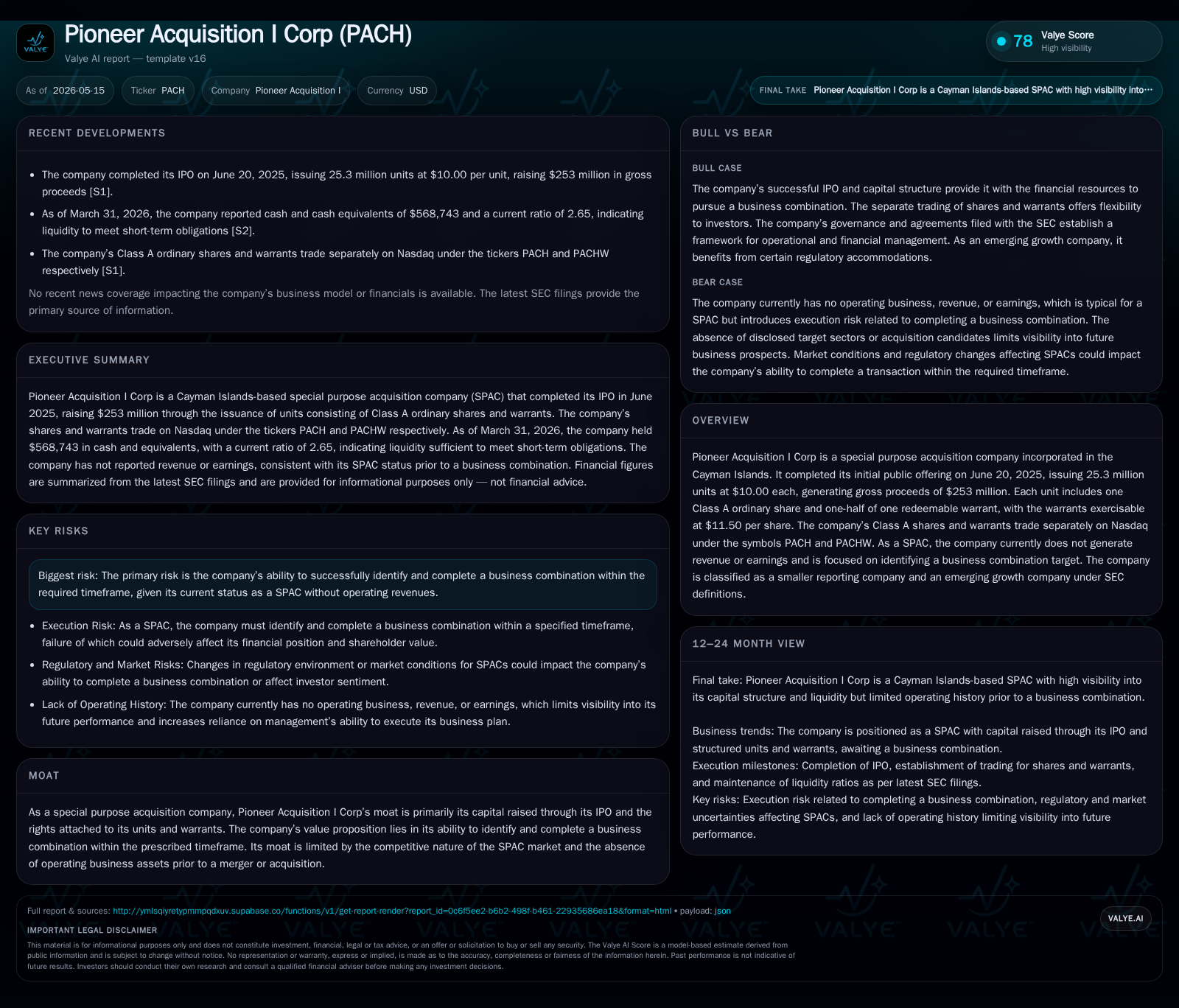
Pioneer Acquisition I Corp, a Cayman Islands-incorporated SPAC, reported in its May 2026 10-Q a stable liquidity profile with cash of $568K and a current ratio of 2.65, underscoring preparedness to pursue a qualifying merger. Having raised $253 million gross proceeds in its June 2025 IPO through units comprising Class A shares and warrants, the company remains focused on identifying and completing a business combination within the typical two-year window. Its business model centers on deploying IPO capital into a vetted target that offers potential operational scale and investor value, though it faces notable risks from timing pressures and intense SPAC competition. Ongoing market dynamics stress the importance of upcoming deal announcements and regulatory filings as key milestones to monitor.
Latest Operating Update Shapes Strategic Urgency
The May 15, 2026 quarterly report (Form 10-Q) filed by Pioneer Acquisition I Corp ([S2]) confirms that there have been no material changes to the risk factors initially outlined in the prospectus dated June 17, 2025. This status quo underlines that the core operating landscape remains unchanged but also emphasizes the ongoing criticality attached to completing a business combination within prescribed time limits.
From a capital perspective, the filing combined with updated companyfacts data ([F1]) reveals cash and equivalents totaling $568,743 as of March 31, 2026, alongside current assets valued at $654,339 against current liabilities of $247,274. This results in a current ratio of approximately 2.65 which signifies sufficient short-term liquidity for administrative costs or deal evaluation expenses even though these are relatively modest compared to capital locked in escrow.
Understanding Pioneer Acquisition I Corp’s SPAC Business Model
Incorporated in the Cayman Islands, Pioneer Acquisition I Corp operates as a special purpose acquisition company (SPAC), aiming solely at raising capital via an initial public offering for subsequent deployment into a privately negotiated business combination ([S1],[F1]). The June 20, 2025 IPO successfully generated $253 million gross proceeds by selling 25.3 million units at $10 each ([S4]). Each unit comprises one Class A ordinary share plus half of one redeemable warrant entitling holders to purchase additional shares at $11.50 exercisable price — effectively incentivizing long-term backing while introducing potential dilution post-combination ([S1],[S6]).
Post-IPO, proceeds are largely held in a trust account subject to federal regulations until released for approved merger transactions or returned if no viable deal closes within the allotted timeframe ([S1]). The company trades on Nasdaq where units initially listed under "PACHU" were separated in August 2025 into individual Class A shares ("PACH") and warrants ("PACHW") allowing differentiated investor participation preferences ([S5]).
Crucially, as a shell entity without revenue streams or operating assets pre-merger ([S1]), Pioneer's moat resides almost entirely within its capital base combined with sponsor expertise in identifying promising acquisition targets. Success hinges on converting capital into value-accretive businesses while navigating an increasingly crowded SPAC marketplace.
Competitive Landscape and Industry Dynamics of the SPAC Market
Within the broader U.S.-listed SPAC environment where numerous vehicles vie for quality business combinations, Pioneer must contend with considerable competition for attractive merger candidates ([S1],[S2]). The proliferation of SPACs since early 2020 has expanded supply beyond demand for de-SPAC transactions causing downward pressure on valuations and extending deal sourcing timelines.
Regulatory scrutiny has intensified around disclosures, underwriting practices (including PIPE), and timing constraints regulating how quickly sponsors like Pioneer must execute mergers following an IPO closing ([S2]). Moreover, shifting investor appetites reflect skepticism about too many competing SPACs potentially chasing limited high-quality private companies.
Pioneer’s listing on Nasdaq and classification as an emerging growth smaller reporting company provide regulatory benefits including reduced disclosure burdens but also frame expectations around rapid execution milestones ([S1]). The complexities embedded in negotiating PIPE financing alongside sponsor commitments further punctuate deal structuring as a key competitive factor.
Growth Catalysts: Business Combination Target Search and Timing
Future growth drivers for Pioneer revolve exclusively around its ability to consummate an initial business combination converting it from a capital pool into an operational public entity generating revenues ([S2]). Key performance indicators traceable include public announcements of targeted acquisitions often accompanied by detailed presentations outlining strategic rationale.
Following target announcement, shareholder votes are pivotal — their approval unlocks access to trust account funds fueling integration and operations post-merger. Successful completion typically expands the company’s relevant market footprint and establishes pathways toward organic revenue growth or synergistic acquisitions (99[S2]).
Given that Pioneer's timeline extends roughly two years post-IPO before mandatory liquidation or return of IPO funds is triggered ([S10]), progression on target diligence alongside PIPE financing commitments indicate market signaling criticality. Lack of progress could result in erosion of investor confidence given typical liquidity constraints faced after extended search phases.
Key Risks: Time Constraints and Market Competition
The foremost risk confronting Pioneer is failing to secure or finalize a qualifying business combination within its contractual timeframe—forcing return of funds less expenses which caps shareholder returns near IPO price levels ([S13],[S1]). Dilution risk emerges from warrant holders exercising rights potentially increasing share count without proportionate earnings contribution leading to valuation pressure.
Competitive pressures arise both from other SPAC sponsors racing for top-tier targets and fluctuating market conditions challenging price discovery post-merger. Regulatory changes tightening disclosure or approval processes could also delay timelines or introduce added compliance costs constraining sponsor flexibility ([S2]).
Potential investor skepticism regarding re-rate opportunities poses challenges where market appetite for de-SPAC equities varies significantly based on sector focus or perceived quality of acquisition candidates. Thus careful deal sourcing remains paramount amid these macro headwinds.
Watchpoints: Upcoming Milestones and Market Signals
Key upcoming monitors include public disclosures via SEC filings related to proposed business combinations which generally precede shareholder consent solicitation documents ([S4],[S5]). Trading activity shifts across PACH (shares) and PACHW (warrants) will reflect evolving market sentiment toward prospective deals including pricing dynamics influenced by PIPE underwriting arrangements if applicable.
Further events such as amendments extending merger deadlines or clarifications on transaction terms serve as important barometers for management execution capabilities ([S13]). Sponsor communication patterns regarding pipeline maturity add ancillary insight into likely timeframes.
Analysts should closely follow share price behavior relative to redemption thresholds given option-like features embedded in unit/ warrant structures impacting ultimate lockup durations post-merger closure.
Financial Snapshot: Liquidity and Balance Sheet Metrics
Latest financial snapshot
| Metric | Value | Period |
|---|---|---|
| Cash & equivalents | $568,743 | |
| 2026-03-31 | ||
| Current assets | $654,339 | |
| 2026-03-31 | ||
| Current liabilities | $247,274 | |
| 2026-03-31 | ||
| Current ratio | 2.65x | |
| 2026-03-31 |
Source: SEC companyfacts cache [F1].
Data sourced from companyfacts [F1] indicate that while cash levels appear modest compared to total IPO proceeds ($253 million), these figures represent amounts outside the trust account earmarked exclusively for operating expenses. The strong current ratio speaks to low short-term liquidity risk linked predominantly to administrative overheads rather than deal-making capacity which is supported separately by trust-held funds locked pending transaction approval ([S1],[F1]).
It contains no investment recommendations but aims to provide an informed operating assessment relevant for stakeholders tracking SPAC dynamics in contemporary equity markets.
Disclaimer: This is research-only, informational analysis and not investment advice. It may include AI-generated interpretation and general industry context. Always verify important details using primary sources.

Comments