
Park Ha Biological Technology Regains Nasdaq Compliance, Advances Growth Strategy Amid Competitive Pressures
Park Ha Biological's recent Nasdaq compliance restoration and leadership update set the stage for executing expansion plans funded by a $2.45 million capital raise, focusing on store growth, R&D innovation, and digital marketing in China’s competitive beauty market.
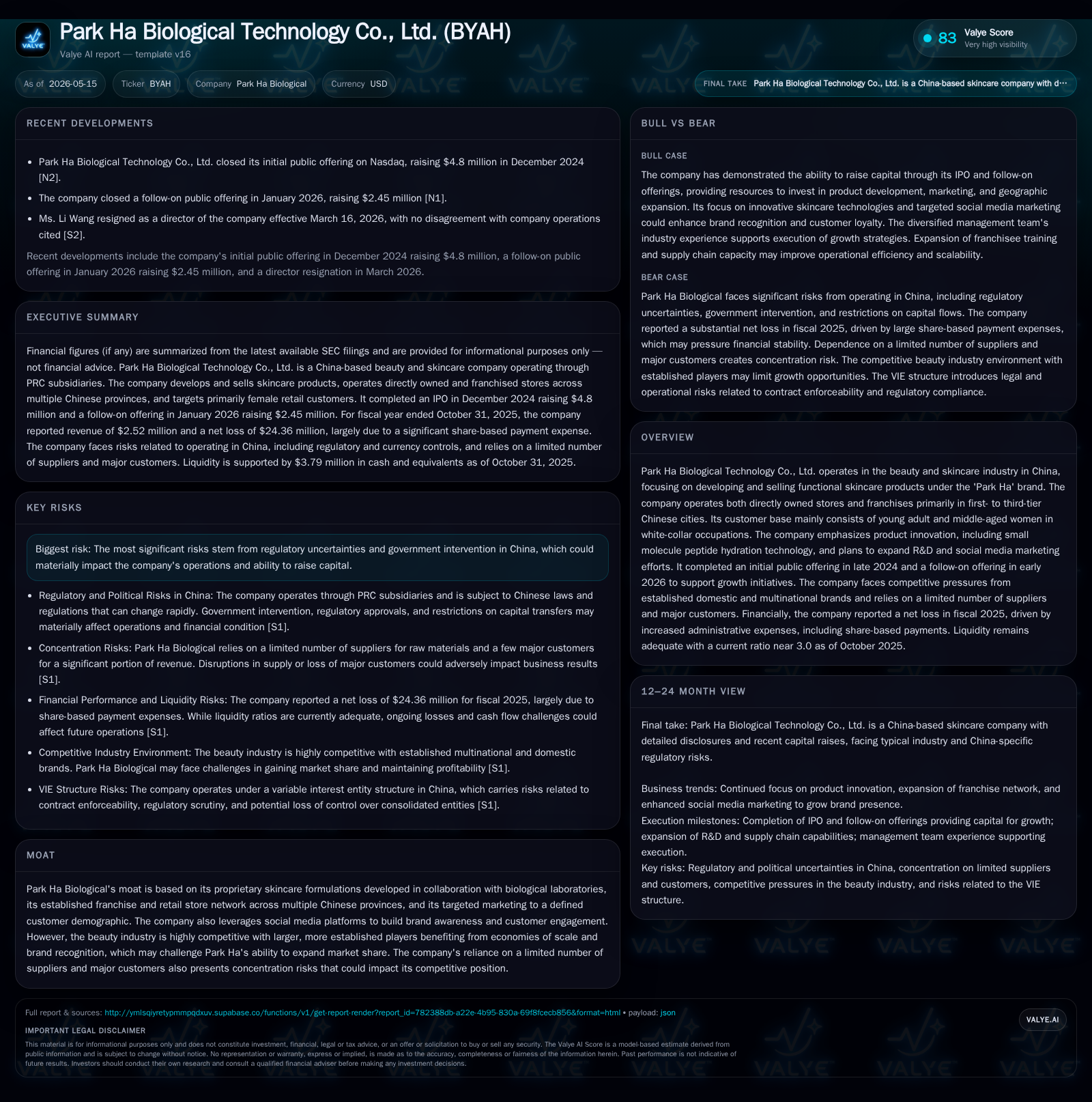
In early 2026, Park Ha Biological Technology regained Nasdaq listing compliance after meeting the minimum bid price requirement and experienced a director resignation reflecting normal governance changes. The company operates in China's beauty sector with a business model combining proprietary peptide-based skincare products and franchise operations targeting urban female consumers. Facing intense competition from domestic and multinational brands, Park Ha is pursuing growth through expanding directly operated stores supported by recent capital raises, enhancing R&D investments to drive product innovation, and leveraging social media marketing. Key risks include supplier and customer concentration and regulatory uncertainties in China. Despite significant operating losses in fiscal 2025, the company maintains strong liquidity with a current ratio near 2.9 and nearly $3.8 million cash reserves to support its near-term expansion plans.
Recent Nasdaq Compliance Recovery and Governance Update
Park Ha Biological Technology Co., Ltd. successfully resolved its Nasdaq minimum bid price deficiency by maintaining a closing bid price at or above $1.00 per share for ten consecutive business days ending March 5, 2026. Nasdaq formally confirmed compliance on March 6, closing this matter and securing the company’s continued listing on the Nasdaq Capital Market [S3]. This recovery is critical for preserving investor confidence and uninterrupted access to U.S. capital markets.
Shortly thereafter, on March 16, director Li Wang resigned effective immediately. Importantly, her departure was not due to any disagreements regarding the company's operations or policies, indicating routine board turnover rather than operational distress [S2]. These developments establish a stable platform for Park Ha’s strategic execution moving forward.
Business Model: Functional Skincare Products with Franchise Expansion
Park Ha’s business is centered on developing and selling functional skincare products under the "Park Ha" brand primarily across China. Its revenues derive mainly from direct product sales combined with franchise fees collected from independent franchisees operating under strict corporate standards to maintain brand consistency [S1].
The company leverages proprietary small molecule peptide hydration technology aimed at improving skin moisturization efficacy at the molecular level—an innovation aligned with consumer preferences for scientifically validated skincare solutions.
The target demographic includes white-collar female consumers spanning first-, second-, and third-tier Chinese cities. This geographic segmentation balances mature urban markets with emerging cities exhibiting growing disposable incomes.
Retail operations utilize a hybrid model: approximately two dozen franchisees operate branded stores adhering to corporate regulations ensuring consistent customer experience while Park Ha also directly operates select stores to capture higher margins and control key locations [S1]. The number of active franchise contracts is a crucial metric impacting revenue growth through recurring fees without proportional increases in fixed costs.
Competitive Landscape in China’s Beauty Sector
China’s beauty industry features intense competition dominated by multinational corporations like L’Oréal and Estée Lauder alongside prominent domestic players such as Pechoin. These incumbents benefit from broad brand recognition, extensive offline retail presence, robust e-commerce platforms, large marketing budgets, and well-established supply chains.
Park Ha faces challenges including:
- Building brand loyalty amid low switching costs given abundant alternatives;
- Limited pricing power compared to larger conglomerates;
- Managing potential channel conflicts between direct stores and franchisees;
- Keeping pace with rapid product innovation cycles demanded by consumer trends;
- Investing intensively in digital marketing leveraging social media influencers (KOLs) and livestream commerce platforms;
- Navigating complex regulatory requirements impacting product approvals and market access.
This environment demands agility combined with focused brand differentiation anchored in innovation.
Growth Drivers: Store Expansion, Innovation Investment, Digital Marketing
Key initiatives fueling Park Ha’s growth include:
Direct Store Expansion: The January 2026 follow-on offering raised approximately $2.45 million gross proceeds designated primarily for increasing the footprint of directly operated stores across targeted Chinese urban centers [S4]. Direct control over these outlets allows improved margin capture and controlled consumer experience experimentation complementary to franchising.
R&D Investment: In fiscal year 2025, research & development expenditures rose sharply to approximately $238 thousand (over fivefold increase year-over-year), driven largely by peptide-based innovation projects including cell therapy raw materials sourcing [S23]. Sustained technological advancement remains vital to maintaining product differentiation.
Digital Marketing Enhancements: Recognizing shifting consumer engagement toward online channels, Park Ha has intensified social media marketing efforts targeting young urban professionals through popular platforms like Xiaohongshu (Little Red Book) and Douyin (Chinese TikTok). Strategic influencer collaborations aim to cultivate authentic brand affinity particularly among millennials.
Successful scaling depends on effective capital deployment balancing retail expansion against ongoing innovation investment without overstretching operational capacity.
Risks: Concentration Vulnerabilities and Regulatory Uncertainty
Despite opportunities, Park Ha must manage notable risks:
- Supplier & Customer Concentration: Heavy reliance on limited specialized peptide suppliers exposes the company to supply disruptions or cost volatility risks. Similarly, dependence on key customers or franchisees could impact revenue stability if relationships deteriorate [S1].
- Regulatory Risks: Operating within China subjects Park Ha to evolving regulatory frameworks governing overseas listings (CSRC filings), data security oversight (CAC scrutiny), labor laws affecting costs, and restrictions on cross-border capital flows which may constrain operational flexibility [S28], [S1].
- Geopolitical Factors: U.S.-China tensions manifesting in legislation such as the Holding Foreign Companies Accountable Act (HFCAA) impose stringent audit transparency requirements potentially threatening sustained Nasdaq listing if compliance is not maintained fully or promptly [S28].
Mitigating these risks requires proactive compliance management alongside diversified sourcing strategies.
Milestones and Monitoring Focus
Stakeholders should watch for:
- Trends in active franchise contracts reflecting network health including retention rates and new acquisitions [S14];
- Sales performance of newly opened directly operated stores signaling effective use of raised capital [S4];
- Progression of R&D pipeline converting investments into commercialized peptide-based products;
- Quarterly margin trends indicating operational leverage gains coupled with marketing ROI beyond top-line growth;
- Continued Nasdaq communications confirming stable regulatory compliance amid geopolitical uncertainties.
These indicators will illuminate Park Ha’s trajectory toward scalable profitability.
Financial Position: Strong Liquidity Backing Expansion Despite Losses
Fiscal year ending October 31, 2025 showed an operating loss near $24.15 million reflecting significant upfront investments including IPO-related share-based payment expenses inflating administrative costs substantially compared to prior years [F1], [S23]. Net losses were similarly elevated.
Nonetheless, liquidity remains robust: the company held approximately $3.8 million in cash equivalents with a current ratio around 2.9 at period end providing sufficient runway for planned store expansions without immediate refinancing pressure or covenant risks [F1], [S7].
Operating cash flow generation was positive but reduced relative to prior years due largely to working capital changes requiring prudent inventory management and receivables collection focus going forward.
In summary, Park Ha Biological embodies characteristics of a high-growth enterprise investing heavily ahead of scale but supported by adequate financial resources aligned with its strategic ambitions.
This analysis utilizes SEC disclosures through March 16, 2026 ([S1]-[S29]) supplemented by latest financial snapshot data as of October 31, 2025 ([F1]). It aims to provide an informed perspective on Park Ha Biological Technology Co., Ltd.'s market positioning and growth outlook within its industry context without constituting investment advice.
Disclaimer: This is research-only, informational analysis and not investment advice. It may include AI-generated interpretation and general industry context. Always verify important details using primary sources.

Comments