
TECOGEN's Q1 Results Highlight Challenges and Pathways in Distributed Energy
Tecogen’s latest quarter reveals cash flow management nuances amid softer product sales but growing service and energy revenues tied to emerging data center cooling demand.
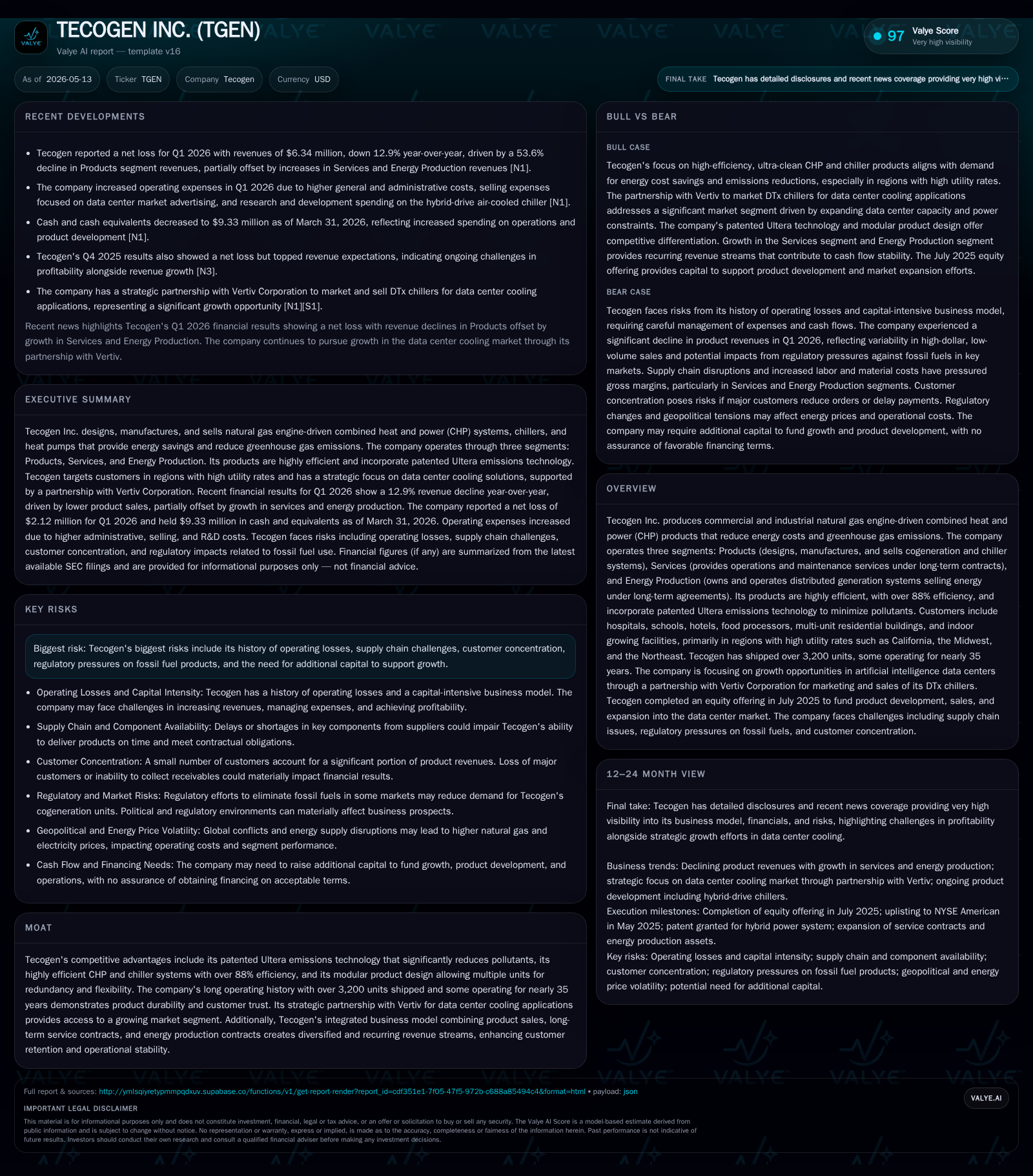
In Q1 2026, Tecogen grappled with a 12.9% revenue decline largely driven by sharply lower product sales following strong prior period shipments fueled by tax credits, while its Services and Energy Production segments showed modest growth. The company strategically increased accounts payable to fund materials ahead of anticipated shipments, reflecting operational scaling efforts. Tecogen leverages its patented Ultera emissions technology and an integrated three-segment model—Products, Services, and Energy Production—to capture rising demand tied to utility grid constraints and data center expansion. However, recurring operating losses, supply chain risks, customer concentration, and regulatory headwinds on fossil fuel reliance present ongoing challenges. The recent partnership with Vertiv targets data center chiller adoption, a key growth catalyst aligned with decarbonization trends.
Accounts payable climbed to $3.61 million from $3.38 million in December 2025, injecting approximately $230K in operational cash flow as the company accelerated procurement of raw materials ahead of anticipated product shipments—a tactical move reflecting scaling intent amid backlog fulfillment efforts [S2]. Conversely, deferred revenue dropped by about $602K due to application of customer deposits against receivables as product units shipped, signaling active progress on existing orders but also diminishing upfront cash buffers temporarily [S2].
Top-line contracted 12.9% year-over-year to approximately $6.34 million primarily because Product revenues halved (down 53.6%) following a surge in deliveries during Q1 2025 fueled by customers securing tax credits under the Inflation Reduction Act—a cyclical tailwind no longer replicable this period [S15][N1]. This episodic nature underscores that product sales are high-ticket but lumpy given build-to-order customizations with typical six- to twelve-month sales cycles [S1].
Notably, repeatable streams from Services grew by over 9%, reflecting a steady increase in installed system units accompanied by long-duration maintenance contracts that generate more predictable revenues throughout the year [S15][S1]. Energy Production revenues likewise expanded modestly (+5%), supported by extended run hours at some sites despite margin pressures from rising natural gas costs—a key sensitivity within fuel-driven distributed generation operations [S15][S19].
Power constraints emerging from rapid data center construction and EV charging load growth have heightened the attractiveness of Tecogen’s onsite generation solutions that deliver resilience while shrinking utility expenses long term. The company’s chillers can reduce electrical capacity requirements onsite by roughly 30%, addressing critical grid limitations in high-density markets like California and the Northeast [S2].
TECOGEN’s Business Model: From Products to Energy Production
Tecogen operates a tri-segment model encompassing:
- Products: Design, manufacture, and sale of natural gas engine-driven CHP systems, chillers including the hybrid-drive air-cooled DTx chillers incorporating patented Ultera emissions technology.
- Services: Operations & maintenance contracts servicing hundreds of installed units across North America, ensuring stable revenue flow linked directly to fleet size expansion.
- Energy Production: Ownership and operation of distributed energy systems selling electricity, heat, hot water, and cooling under long-term supply agreements through subsidiaries like ADGE.
Revenue mechanics pivot on product sales that deliver capital equipment but are inherently irregular due to customized configurations necessitating build-to-order timelines (~6–14 weeks). Recurring service contracts foster higher margin stability addressing hundreds of active assets predominantly under maintenance agreements established post-sale or via acquisition (e.g., Aegis maintenance contract) [S1][S15]. Meanwhile, energy sales from owned installations provide ongoing fee-for-service income with variability influenced by site operational hours and fuel cost dynamics.
The Ultera technology is a notable differentiator: it provides extremely low emission profiles for CHP systems achieving efficiencies exceeding 88%, significantly surpassing typical grid electricity efficiencies of 40–50%, cutting client greenhouse gases substantially through onsite generation improvements. This environmental edge aligns well with institutional customers across hospitals, universities, hotels, food processing plants, indoor agriculture facilities—all concentrated in regions with steep electricity tariffs where cost savings compound [S1].
Competitive Positioning Within Distributed Generation and Cooling Markets
Tecogen’s long operational history (>3,200 shipped units with some nearing 35 years in service) underpins substantial trust in product durability—a critical switching cost factor given extended lifecycles minimizing repeat unit purchases but enhancing attrition-based service opportunities [S1]. The patented Ultera emissions control technology forms a regulatory moat supporting differentiation amid tightening emissions standards impacting fossil-fuel-based cogeneration competitors.
The modularity of Tecogen’s offerings enables installation flexibility; multiple smaller units may be deployed for redundancy or phased expansions versus monolithic solutions commonly found elsewhere—a feature attractive to critical facilities demanding operational continuity [S1]. Additionally, strategic co-marketing agreements such as the two-year deal with Vertiv target explosive growth segments like data center cooling where utility grids increasingly strain under surging loads [S2][S3]. Under this partnership, Vertiv markets DTx chillers internationally and exclusively within the U.S upon reaching agreed volume targets—a channel extension augmenting scale potential while leveraging Vertiv’s engineering procurement muscle for component sourcing [S11].
Long-term service contracts complement hardware sales with predictable high-volume low-dollar transactions driving stable gross margins despite seasonality impacts — especially during the May-September chiller peak usage season when demand for cooling services spikes strongly [S2].
Growth Catalysts: Grid Constraints, Data Centers, and Regulatory Tailwinds
Structural drivers propel Tecogen's avenue toward expansion:
- Rising Utility Load Constraints: Growth in power-intensive facilities (data centers notably) coupled with accelerated EV charging installations limits grid capacity absorption rates - immediate incentive for distributed generation solutions reducing grid dependency.
- Decarbonization Regulations: Policies like New York City’s fossil fuel bans elevate hybrid chiller demand capable of flexibly switching fuel sources toward cleaner alternatives such as Renewable Natural Gas (RNG), amplifying Tecogen’s competitive position given flexibility embedded in product design.
- Vertiv Partnership: Provides an established distribution pipeline into global data center segments targeting tailored chilled water applications where reducing electrical draw can optimize operational expenses dramatically.
- Long-Term Service & Energy Contracts: Expansion of installed base plus extended contracted energy production portfolios increases recurring cash flows progressively even if hardware sales remain volatile.
Collectively these themes link to measurable KPIs such as backlog levels transitioning into shipment revenue recognizing timing volatility alongside ongoing service contract book growth monitored quarterly confirming recurring revenue momentum [S2][S12][N1].
Risks and Operational Challenges: Supply Chain, Losses, and Capital Needs
Several risks cloud current outlook:
- Operating Losses: Q1 2026 operating loss ballooned to ~$2.14 million from $0.59 million year ago tied largely to swelling R&D expenditure aimed at hybrid chiller development plus expanded general administrative costs including staff payroll & marketing related to data center push efforts [S18][S19]. Sustained losses historically suggest profitability remains elusive absent scale or margin uplift pathways.
- Supply Chain Fragility: Reliance on few large suppliers for engines/generators/compressors risks production bottlenecks aggravated by global shortages or shipment delays potentially causing backlogs or customer delivery deferrals undermining financial performance consistency [S7][S1].
- Customer Concentration: Single customers periodically represent >10% product revenue; sizable projects dominate topline fluctuations posing collection exposures curtailed somewhat by diversified installed fleet generating stable service income streams but still amplifying lumpiness via product sales variability.
- Regulatory Uncertainty: Accelerating fossil fuel restrictions vary regionally impacting cogeneration sales negatively though balanced somewhat by hybrid products judged compliant; ongoing political policy shifts add complexity requiring agile product innovation.
- Capital Requirements: Cash and equivalents stood at approximately $9.33 million as of March 31, 2026, with no reported debt, providing a strong liquidity position to support near-term working capital needs and ongoing investments [F1][S2]. Expected rising expenditures on development and market expansion portend need for future financing rounds bearing execution risk if capital access or terms deteriorate noticeably [S18].
Upcoming Milestones and Key Indicators to Monitor
Key watchpoints include:
- Backlog conversion rates translating deferred revenues into recognized shipments indicating near-term topline trajectory shifts influenced by supply/demand alignment [S2];
- Vertiv partnership volume thresholds achieved triggering exclusive U.S marketing rights could unlock broader distribution accelerating DTx unit placements within data centers globally;
- Adoption ramp of hybrid chillers within regulated urban territories such as NYC subject to phase-out timelines on pure fossil CHP;
- Cash flow trends juxtaposed against ongoing operating losses measuring burn sustainability;
- Receivables aging particularly regarding major clients assessing credit risk management effectiveness amid concentration;
- Seasonality-induced performance swings particularly service workload peak timing through summer could modulate quarterly operating results distinctly [S2];
- Progress in R&D yielding enhancements extending engine life or improving efficiency/margin profile vital to margin recuperation efforts.
Recent Financial Snapshot and Liquidity Overview
Latest financial snapshot
| Metric | Value | Period |
|---|---|---|
| Cash & equivalents | $9.33mm | |
| 2026-03-31 | ||
| Current assets | $26.5mm | |
| 2026-03-31 | ||
| Current liabilities | $8.8mm | |
| 2026-03-31 | ||
| Current ratio | 3.02x | |
| 2026-03-31 |
Source: SEC companyfacts cache [F1].
Tecogen remains debt-free with strong liquidity positioning balancing near-term working capital needs driven by material purchases evidenced by rising payables alongside shrinking deferred revenue deposits usage indicating progress toward order fulfillment cycles ([F1],[S2],[S18]). Despite this cushion underlying losses continue reflecting costly investment phases particularly focused on product innovation aiming at data center markets requiring significant upfront outlays before attaining scaled returns ([S18],[N1]). Monitoring evolving expense control measures versus revenue stabilization will be critical going forward.
This analysis is based strictly on documented SEC filings and public disclosures as of May 13, 2026 without any speculative projections or investment advice.
Disclaimer: This is research-only, informational analysis and not investment advice. It may include AI-generated interpretation and general industry context. Always verify important details using primary sources.

Comments