
Inflection Point Acquisition Corp. IV Shifts Strategy Post-Merger with Merlin Labs
The recent quarterly filing reveals operational and control challenges following the merger, redefining the company as an autonomous aerospace technology developer.
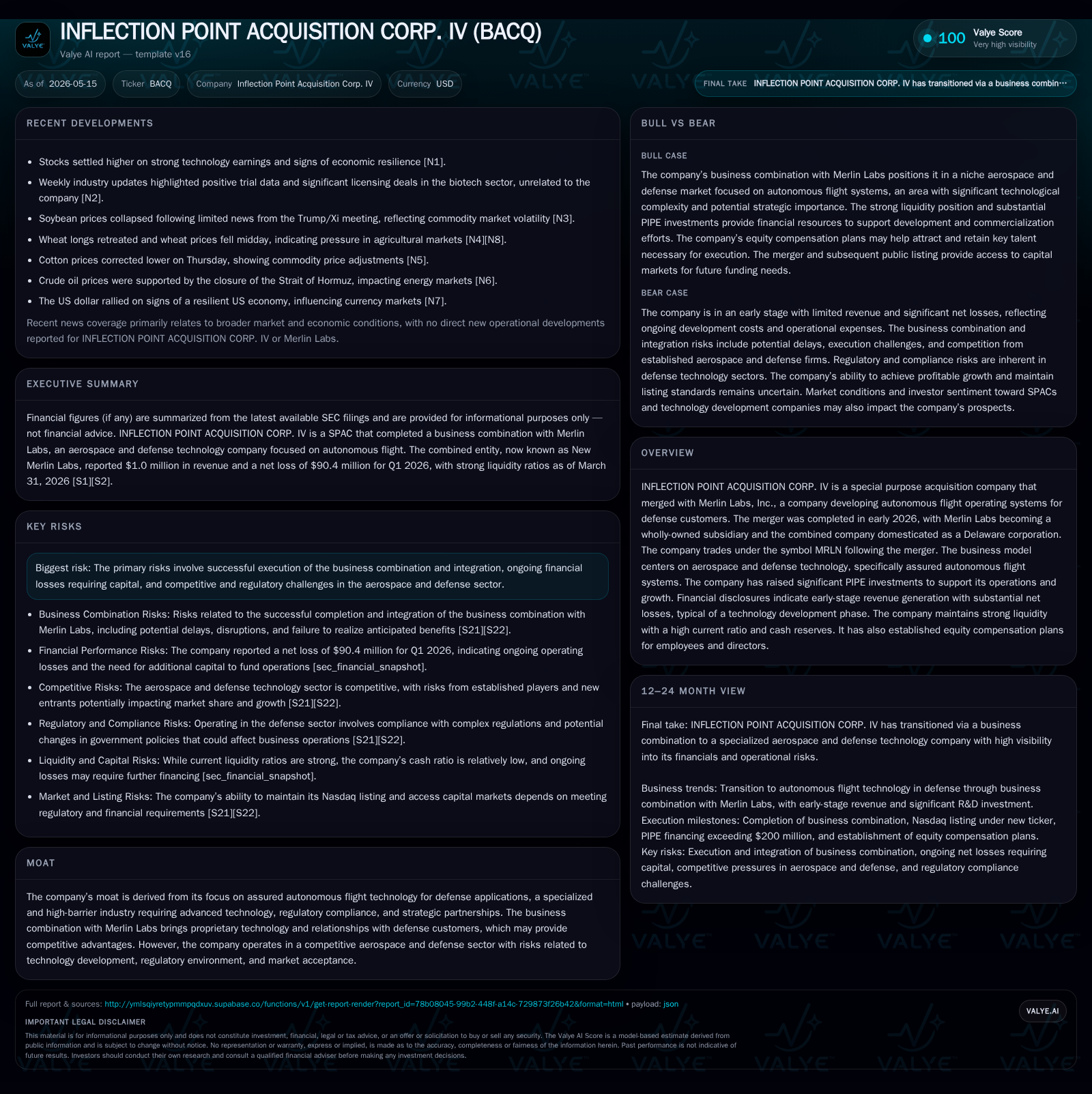
Inflection Point Acquisition Corp. IV completed its business combination with Merlin Labs in early 2026, transforming from a SPAC shell into a specialized aerospace and defense technology company focused on assured autonomous flight systems. The latest 10-Q discloses material weaknesses in internal controls and ongoing net losses typical of an early-stage tech firm, alongside strong liquidity supported by PIPE financing. This shift positions the company within a high-barrier aerospace defense sector characterized by complex regulatory requirements and long sales cycles, with growth driven by technological innovation and strategic partnerships such as the one with GE Aerospace. Key risks include integration execution, control remediation, and competitive pressure inherent to the defense industry.
Latest Operational Developments and Implications
Simultaneously, the company continues to operate at an early development stage where revenue generation is nascent but losses are substantial—reflective of a typical technology commercialization phase in aerospace autonomy sectors where product-market fit and scale remain works in progress. However, strong liquidity enabled by PIPE funding rounds supports operational runway without immediate financing pressure while these capabilities mature. This dual reality of promising technology investment counterbalanced by financial control challenges frames the near-term narrative.
Business Model Evolution Post-Merger with Merlin Labs
Originally formed as a blank check company (SPAC), Inflection Point Acquisition Corp. IV decisively transitioned into an aerospace technology platform through its business combination agreement executed August 2025 and finalized in early 2026 [S1], [S4]. The merger brought Merlin Labs’ proprietary assured autonomous flight operating systems under a combined Delaware corporation trading as MRLN post-merger [S3].
Merlin Labs develops sophisticated software operating systems tailored for enabling autonomous flight in defense applications—an area requiring high safety assurance standards given mission-critical military usage. Revenues will be primarily derived from contracting with government defense agencies or prime contractors integrating assured autonomy capabilities into their platforms. Monetization likely involves milestone-based contracts tied to delivery and certification achievements rather than traditional product sales.
The company’s capital structure reflects this shift as well: substantial PIPE investments secured at closing provide growth capital aimed at accelerating product development, regulatory certification pursuits, and scaling operations beyond pre-combination startup phases. Importantly, Inflection Point legally ceased to be a shell entity post-merger—with Merlin fully assimilated as a wholly owned subsidiary leveraging both balance sheet resources and public market access for future financial needs.
Competitive Landscape in Autonomous Aerospace Systems
Merlin operates within a highly specialized segment of the aerospace-defense ecosystem marked by pronounced barriers to entry. These include the need for deep technological expertise in AI-enabled autonomy algorithms; securing rigorous regulatory certifications required for assured autonomous flight; lengthy defense procurement timelines; and cultivating trust-based partnerships with established prime contractors or governmental entities.
This dynamic positions Merlin against competitors ranging across advanced UAV developers to integrated avionics suppliers offering varying degrees of autonomy features. However, Merlin’s moat centers on its focus on "assured autonomy"—a term referring to certifiable reliability tailored for defense standards—and its emerging alliance with GE Aerospace aimed at developing next-generation pilot-assist platforms integrating AI capabilities [S4], which enhance its market differentiation.
Product complexity drives prolonged development cycles necessitating substantial engineering capacity. Switching costs stem from customers’ reliance on proven certification pathways that ensure operational safety—a nontrivial hurdle discouraging rapid supplier churn once baseline qualification is achieved. Additionally, stringent governmental oversight introduces regulatory compliance challenges that shape innovation pacing.
Growth Drivers Linked to Technological Innovation and Defense Contracts
Growth vectors are anchored on multiple fronts:
- Technological Advancement: Continuous enhancement of AI algorithms enables incremental improvements in autonomous flight decision-making under diverse mission scenarios.
- Strategic Partnerships: Collaborations like that established with GE Aerospace facilitate access to complementary aerospace technologies expanding market opportunities beyond pure software into integrated pilot-assist solutions.
- Defense Spending Trends: Sustained or increased defense budgets allocated toward autonomy initiatives underpin demand prospects for assured autonomy systems addressing force modernization priorities.
- Commercialization Trajectory: Successful accomplishment of technology development milestones translates into expanded customer engagements leading toward revenue ramp acceleration supported by scalable capital commitments from prior PIPE rounds.
These drivers hinge on measurable KPIs including contract backlog accumulation, successful milestone completions attesting to software robustness against stringent military standards, retention of key engineering talent amid competitive hiring markets for autonomy specialists, and System Under Test (SUT) performance metrics validating operational reliability.
Key Risks: Integration, Financial Control Weaknesses, and Regulatory Challenges
Critical risks warrant close attention:
- Integration Execution: Navigating the cultural and procedural amalgamation between former SPAC governance structures and Merlin’s technology-centric operational model may introduce inefficiencies or distractions affecting product delivery timelines.
- Remediation of Internal Controls: Failure or delay in resolving identified material weaknesses concerning complex accounting treatments could impair financial statement reliability thereby undermining investor confidence and capital access conditions.
- Capital Burn Legacies: Persistent net losses expected throughout technology maturation phases necessitate continued reliance on external funding beyond existing PIPE proceeds unless commercial traction materializes swiftly enough to offset operating expenses.
- Industry Regulatory Hurdles: Evolving government regulations pertaining to autonomous systems—particularly those influencing certification criteria or export controls—pose uncertainties impacting product deployment cadence and geographic reach.
- Competitive Intensity: Established aerospace primes developing proprietary or partnered autonomy solutions represent formidable competition potentially constraining market penetration if differentiation does not sustain.
These interconnected risk factors underscore execution complexity during early commercialization within a scrutinized defense industrial landscape.
Upcoming Milestones and Market Signals to Monitor
Important near-term progress indicators include:
- Completion status reports on internal control remediation plans such as successful implementation of enhanced process automation or staffing augmentations described in filings [S2].
- Announcements relating to new contract awards or extensions from governmental agencies or industry partners signaling validation of technical solutions or strategic positioning relative to peers.
- Demonstrations or validation events showcasing autonomous flight operational capabilities under realistic environmental conditions included in investor communications or public engagements.
- Incremental quarterly revenue growth indicating transition beyond R&D phase toward recognized commercial adoption.
- Any supplemental capital raising activities reflecting management’s outlook on required financial runway aligned with product deployment schedules.
Monitoring these concrete execution points will provide essential insight into whether the company navigates typical post-business combination challenges effectively while progressing toward sustainable growth objectives [S3].
Disclaimer: This analysis is based solely on publicly available SEC filings and reported developments up to May 15, 2026. It does not constitute investment advice or recommendations.
Disclaimer: This is research-only, informational analysis and not investment advice. It may include AI-generated interpretation and general industry context. Always verify important details using primary sources.

Comments