
Jyong Biotech Advances Botanical Drug Pipeline Under New CFO Leadership
Appointment of an experienced CFO marks a strategic inflection as Jyong Biotech navigates clinical and regulatory hurdles with its lead botanical drug candidate.
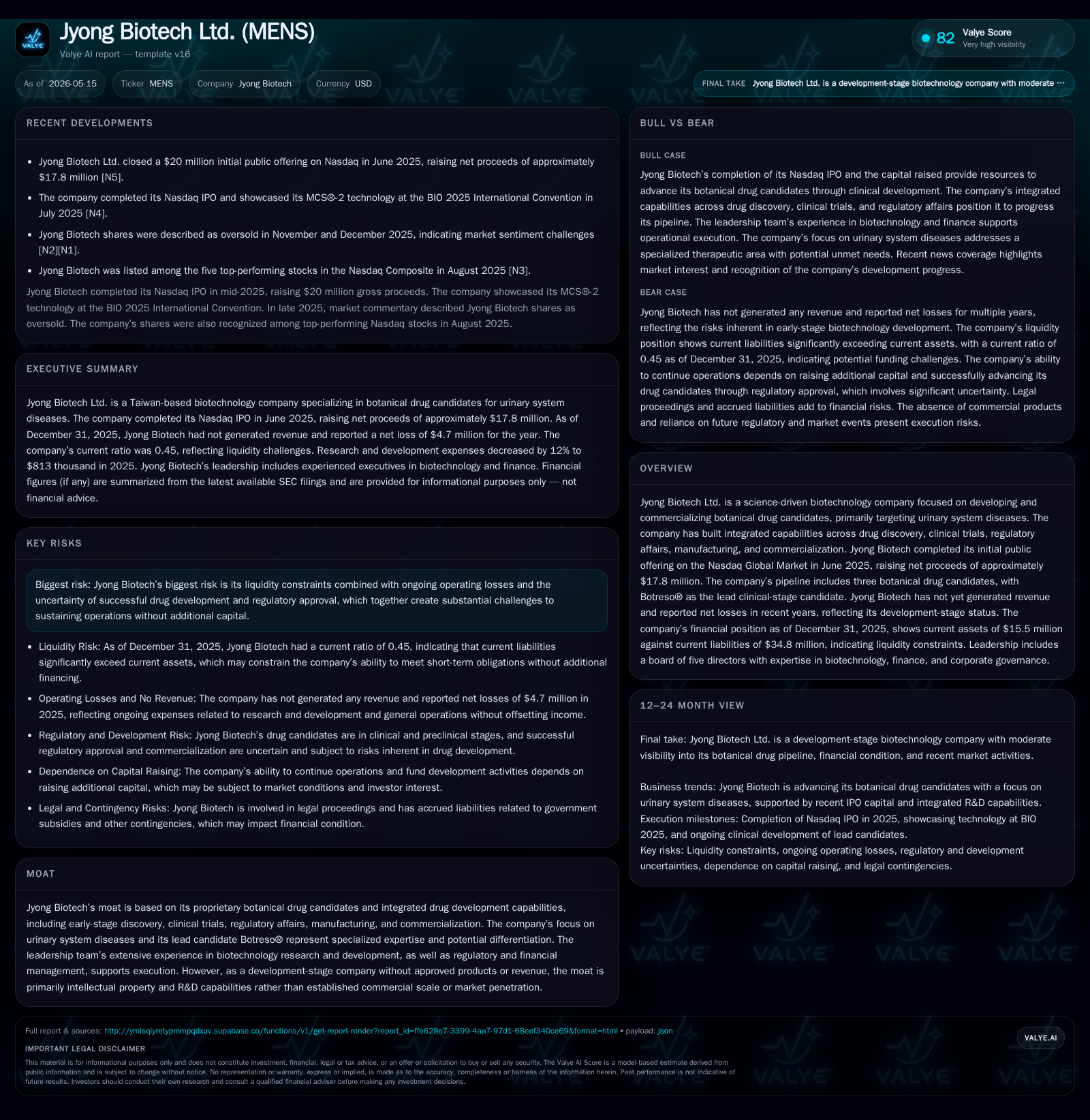
In its latest quarterly 6-K filing dated February 6, 2026, Jyong Biotech announced the appointment of Wei (Vivi) Zhang as Chief Financial Officer, signaling renewed focus on financial stewardship amid ongoing capital needs. The company remains centered on advancing its core botanical drug candidate, Botreso®, targeting urinary system diseases, notably benign prostatic hyperplasia/lower urinary tract symptoms (BPH/LUTS). Botreso® faces regulatory challenges following a voluntary NDA withdrawal due to efficacy concerns and API sourcing issues, now pursuing resubmission strategies. Despite no current revenue and a development-stage status marked by liquidity constraints, Jyong’s integrated drug discovery-to-commercialization model and intellectual property portfolio underpin its competitive moat. Upcoming catalysts include FDA engagements on NDA resubmission and potential financing initiatives to sustain operations.
Recent Operational Update: Leadership Change and Strategic Focus
On February 6, 2026, Jyong Biotech Ltd. announced the appointment of Wei (Vivi) Zhang as its new Chief Financial Officer, succeeding Alfred Ying [S2]. Ms. Zhang brings significant expertise in managing public company finances and capital raising, with a track record that includes serving as CFO at a Nasdaq-listed company and consultant roles supporting IPO processes. This leadership change is pivotal for a development-stage biotech navigating challenging regulatory scrutiny and liquidity pressures post-IPO. Her arrival signals heightened focus on financial governance to support Jyong’s near-term capital strategies crucial for sustaining operations through costly clinical programs.
Jyong Biotech’s Business Model: Botanical Drug Development Framework
Founded in 2002 and headquartered in Taiwan, Jyong Biotech operates as an integrated botanical drug discovery and development company specializing primarily in urinary system diseases across global markets including the U.S., EU, and Asia [S1]. The company’s business model centers around internally generating botanical pharmaceuticals—leveraging proprietary raw material sources—and shepherding these candidates through early discovery, preclinical/clinical development, regulatory affairs, manufacturing scale-up, and eventual commercialization.
This vertical integration aims to control critical drug substance patentability, quality assurance, regulatory submissions, and supply chain management — essential where botanical medicines face complex quality characterization challenges compared to synthetic drugs. Botreso®’s active pharmaceutical ingredients are patented carotenoid-rich extracts sourced from Lycopersecum Esculentum enhanced via chylomicron technology designed to increase bioavailability — an advanced formulation distinguishing it within botanical therapeutics.
Jyong advanced Botreso® through four Phase III trials in Taiwan and the U.S., including two pivotal studies using API-1 as the botanical drug substance. Unfortunately, the critical U.S. trial failed to demonstrate statistically significant efficacy versus placebo on the primary endpoint leading to a complex FDA review. After an initial NDA submission accepted "with issues identified" in December 2021, the FDA cited lack of efficacy differentiation alongside pharmacology, toxicology concerns, API unavailability (API-1), analytical statistics gaps, and labeling deficiencies [S1].
Beyond Botreso®, Jyong’s pipeline includes a clinical-stage candidate focused on prostate cancer prevention (PCP), which recently completed Phase II trials, alongside earlier-stage preclinical programs targeting interstitial cystitis. While these diversify risk exposure slightly, Botreso® remains the sole asset closest to potential commercialization.
Competitive Positioning in Botanical Therapeutics Targeting Urinary Diseases
Within the relatively niche segment of urinary system botanicals—a subset of biopharmaceuticals—Jyong positions itself through proprietary plant-based IP combined with chylomicron-enhanced bioavailability formulations. This offers differentiation compared with traditional synthetic small molecules or generics commonly employed in BPH/LUTS therapy.
Nevertheless, the “botanical drug” designation imposes pronounced regulatory complexity — proving consistent pharmacological activity amid natural product variability remains challenging. FDA scrutiny tends to be stringent regarding compositional uniformity, clinical efficacy demonstration relative to placebo controls, and source material consistency across manufacturing sites.
Competitors include both large established pharma developing novel synthetic urology agents and smaller players exploring natural product derivatives but few match Jyong’s integrated scale from discovery through commercialization or possess similar advanced chylomicron technologies linked directly to marketed botanical candidates.
Thus far Jyong’s moat is primarily scientific expertise combined with accumulated clinical datasets plus intellectual-property protection on specific carotenoids but commercial success hinges critically on overcoming regulatory validation hurdles.
Growth Drivers: Clinical Trials, Regulatory Milestones, and Market Potential
Short- and medium-term growth prospects pivot largely on reengagement with the US FDA via an NDA resubmission incorporating robust data illustrating equivalence between API-1 and API-2 sources alongside addressing prior efficacy concerns [S16]. Success would unlock potential market entry into BPH/LUTS treatment — a sizable indication with substantial unmet patient need given side effects of existing therapeutics.
Parallel advancement of PCP candidate through late-phase trials could broaden commercial pipeline compatibility while regional expansions into Asian markets leverage Jyong’s Taiwanese operational base.
Milestone events such as completed clinical readouts underscoring improved endpoints or favorable regulatory decisions form critical valuation driver moments that influence financing capacity or partnership attractiveness. Additionally, potential out-license deals may supplement internal funding although these remain speculative without explicit guidance [S1].
The nascent public listing since mid-2025 supplies some capital cushion but finite cash runway drives urgency for effective capital raises aligned with clear clinical validation signs.
Key Risks: Regulatory Challenges, Liquidity Constraints, and Pipeline Uncertainties
Jyong confronts multifaceted execution risks chiefly from its FDA interactions—the withdrawal followed by indications of insufficient botanical comparability underscores inherent challenges in botanical drug approval pathways compounded by natural product variability issues [S1,S16]. Failure or protracted delays would impair time-to-market or potentially terminate lucrative BPH/LUTS ambitions.
Financially, Jyong reports no revenues alongside sustained operating losses exceeding $4 million annually over recent years highlighting acute dependence on incremental financings [S11].
These fiscal pressures are exacerbated by mounting administrative overheads typical for newly public firms including Nasdaq fees growing nearly $300k annualized plus compliance-related professional services climbing [$181k] [S1]. Without timely capital injections—via public offerings or strategic alliances—there lies significant jeopardy over maintaining R&D continuity beyond mid-2027 horizon projections [S24].
Drug development pipelines inherently bear scientific failure risks amplified here by botanic source material complexities creating layered uncertainties impacting long-term viability absent clear regulatory wins.
Near-Term Watchpoints: NDA Resubmission, Clinical Data Updates, and Financing Efforts
Critical next steps revolve around successful resubmission of Botreso®’s NDA under original application number incorporating comprehensive comparative API bridging studies along with further clinical justifications responsive to FDA feedback timelines yet unspecified thus far [S16]. Monitoring agency communication will be vital to gauge clearance probability shaping investor sentiment.
Concurrently progress updates regarding PCP phase II follow-up developments or interstitial cystitis candidate maturation could diversify forward-looking value propositions albeit these assets remain relatively nascent.
Capital markets engagement remains paramount; Jyong explicitly acknowledges both pending equity/dilutive offerings or alternate financing measures including related-party loans as fallback options needed before April 2027 to preserve operational viability [S24]. Changes in cash burn rates tied closely with expanded trial activities should also be observed as proxy KPIs forecasting runway extension success.
Lastly leadership continuity around financial oversight rooted in CFO Zhang’s IPO/public market experience is expected to enhance diligence surrounding upcoming fundraising rounds aligning scientific progress with credible capital access strategies critical during this development inflection phase.
Disclaimer: This analysis does not constitute investment advice or recommendations regarding Jyong Biotech Ltd.’s securities but rather presents an evaluative perspective grounded exclusively on disclosed filings as per Valye News’ internal research protocols.
Disclaimer: This is research-only, informational analysis and not investment advice. It may include AI-generated interpretation and general industry context. Always verify important details using primary sources.

Comments