
Fermi Inc. Advances Project Matador Despite Leadership and Financing Challenges
Fermi’s latest quarter reveals modest development progress shadowed by leadership upheaval and restrictive debt terms.
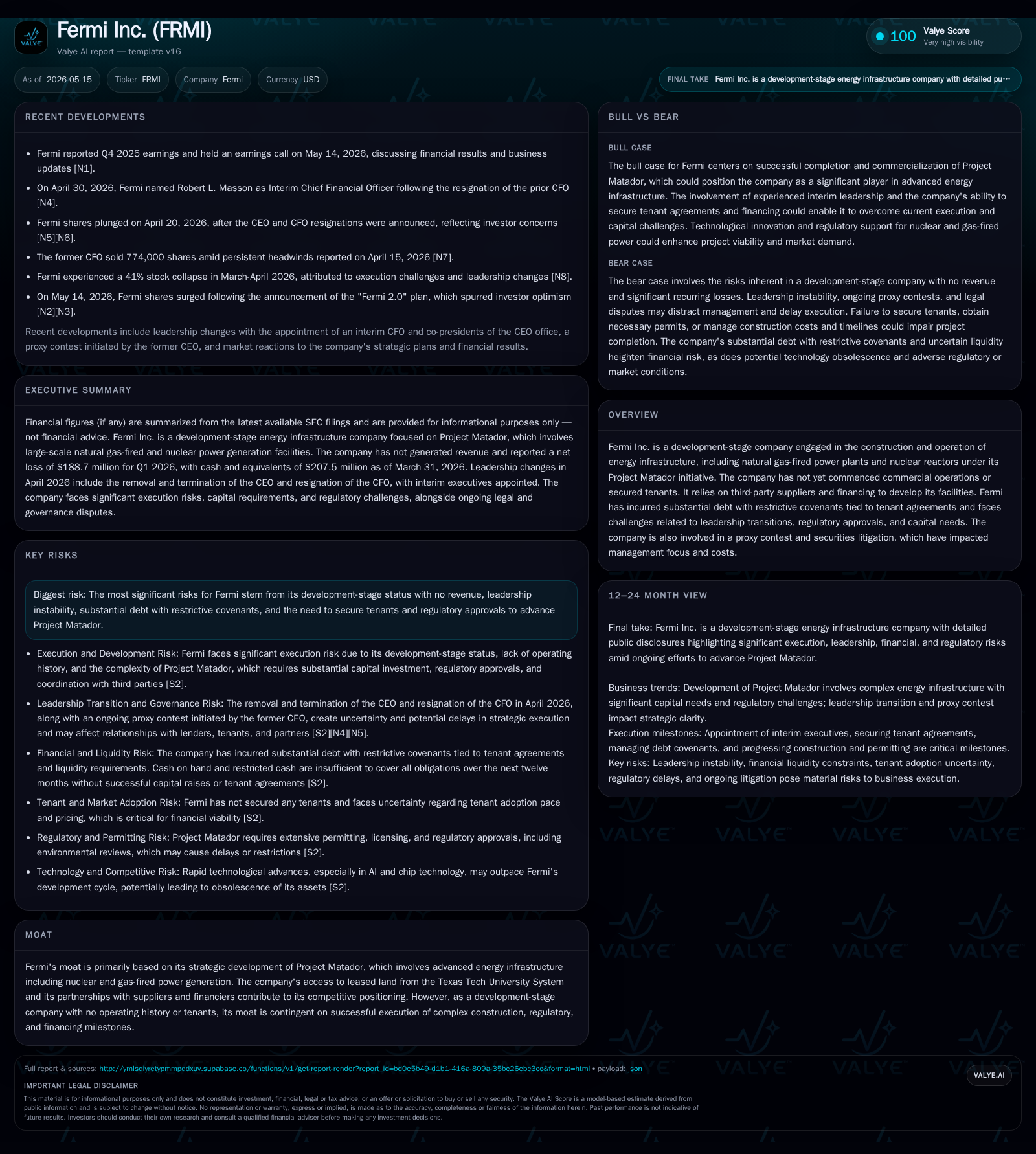
Fermi Inc., a development-stage energy infrastructure company, reported continued advancement on its flagship Project Matador in Q1 2026 but faces significant execution risks due to recent CEO and CFO departures, heavy debt burden with restrictive covenants, and absence of tenant agreements. The company's business model hinges on constructing and leasing advanced gas-fired power plants and nuclear reactors, primarily developed on land leased from Texas Tech University System. Their path to commercial operations remains tied to regulatory approvals, tenant acquisition, and financing execution. While management has alleviated some going concern doubts through planned financing actions, the leadership transition and contract uncertainties present notable constraints that must be closely monitored.
Latest Quarterly Operating Update: Execution and Leadership Shifts
Fermi Inc.’s Q1 2026 10-Q filing dated May 15 reveals ongoing development of its ambitious Project Matador energy infrastructure initiative but underscores substantial operational challenges. No commercial operations or tenant agreements have been secured as of quarter-end, with the company continuing to rely heavily on third-party suppliers and financiers for project construction [S2]. The report highlights critical leadership upheaval: former CEO Toby Neugebauer was terminated for cause effective late April 2026 following conduct violations per his employment agreement; concurrently CFO Miles Everson resigned [S28]. The Board has appointed an Interim Office of the CEO comprising COO Jacobo Ortiz and board observer Anna Bofa while actively searching for permanent replacements [S18], [S3].
In parallel, ongoing proxy contests initiated by the former CEO alongside related securities litigation impose further drag through increased legal costs and management distraction [S19], [S22].
Fermi's Business Model: Project Matador and Infrastructure Strategy
Fermi operates as a development-stage energy infrastructure company focused on constructing and leasing large power generation assets — specifically natural gas-fired power plants utilizing industrial Siemens SGT-800 turbines and nuclear reactors licensed through Westinghouse's advanced Small Modular Reactor (SMR) technology under the umbrella of Project Matador [S1]. The company currently holds leasehold interests for its project site land from the Texas Tech University System in Texas — a strategic asset supporting facility development scale.
Revenue generation is anticipated from tenants who will lease constructed energy infrastructure assets; however, as of Q1 2026 Fermi has not executed any binding tenant contracts nor commenced commercial operations [S2]. The company's business model thus depends on several contingent steps:
- Securing tenants willing to sign definitive agreements committing to lease capacity.
- Managing extensive third-party engagements across equipment suppliers (notably Siemens Energy for turbines), engineering contractors, and financiers including multiple equipment-backed credit facilities.
- Navigating complex regulatory environments involving licensing for nuclear SMRs as well as interconnection permits for power plants.
This creates significant execution exposure given no historical operating revenues or track record exist. The reliance on third parties exposes Fermi to supply chain disruptions or cost inflation which could escalate project capital expenditures beyond initial projections [S2]. Furthermore, tenant adoption is critical because debt covenants across recently incurred equipment financing require approved customer agreements by specified deadlines — if unmet may accelerate loan repayments or cause defaults [S4], [S5].
Competitive Environment: Positioning in Energy Infrastructure Development
Within the broader energy infrastructure sector in the U.S., Fermi occupies a challenging niche targeting advanced gas turbine combined cycle projects alongside cutting-edge nuclear SMRs. Competitors include traditional power plant developers engaged in gas-fired generation who benefit from established revenue streams through contracted power purchase agreements.
Fermi’s competitive moat rests primarily on its strategic location with leased land access at Texas Tech University System holdings and relationships with technology partners such as Westinghouse for nuclear components [S1]. However,
- Its lack of operating history leaves it vulnerable relative to companies with operational assets generating stable cash flows.
- Pricing power is currently limited given no binding tenant contracts exist that would underpin predictable revenue streams.
- Regulatory approvals necessary for nuclear projects impose long lead times with potential for costly delays or overruns.
Financial market appetite for lending into nascent energy infrastructure without tenant credit commitments is constrained; thus Fermi faces elevated capital costs relative to peers posting ramped commercial traction [S1], [S20]. Such agreements provide assured cash flow streams vital for equipment financing facilities requiring minimum liquidity levels until repayment or customer approval events occur by year-end 2026 [S4], [S5], [S20]. Tenant commitments also catalyze construction draw schedules enabling project cost efficiency gains from volume procurement.
- Financing Execution: Recent draws on multiple specialized equipment-backed financing facilities ($500 million MUFG facility partially drawn ~$397 million; Keystone Facility ~$39.5 million drawn against $120 million cap; Beal Equipment Financing ~$3 million drawn) illustrate progress raising capital needed for turbine purchases and progressing site work despite uncertainty about final term adherence [S5], [F1]. Proxy contest actions initiated by the former CEO add governance distraction diverting senior management focus from core operational priorities [S19], [S22].
- Debt Covenant Vulnerabilities: Multiple equipment finance agreements embed strict loan-to-value thresholds based upon asset appraisals updated regularly; exceeding limits triggers defaults potentially cascading across instruments creating cross-default risk clustering exposure.[S4] Additionally tenant execution clauses mandating signed customer agreements before year-end expose Fermi to enforced mandatory prepayments impairing liquidity if unmet.[S5] Liquidity requirements under Keystone Facility demand maintaining minimum $20 million cash balances until repayment—stretching resources considering substantial near-term capital obligations.[S20]
- Execution Risks: Reliance on unproven supply chains paired with the nascent stage of nuclear SMR deployment entails technical complexity contributing to time/cost overruns.[S20] Failure to hire calibrated skill sets mitigating operation scale-up issues exacerbates developmental delays.[S2] External legal proceedings including securities class actions increase potential financial drains beyond budgeted estimates hampering capital allocation flexibility.[S19]
- Going Concern Doubt: Despite management asserting alleviation plans involving borrowings under committed facilities plus asset monetizations,[S16] they acknowledge substantial doubt regarding the company’s ability to continue without successful execution of these contingencies over the subsequent twelve months.[S16]
Thus operational agility amidst financial discipline coupled with governance stabilization are prerequisites to contain downside risk.
Upcoming Catalysts: Milestones to Monitor in Construction and Financing
Several near-term developments serve as critical barometers for assessing Fermi’s momentum:
- Definitive Tenant Agreements: Announcements confirming binding commercial leases or power purchase arrangements remain prerequisite events likely determining lender confidence resumption of draw schedules avoiding default triggers.[S3],[N5]
- Construction Commencement: Noticeable progress commencing turbine installation or reactor site preparation marks tangible de-risking transitioning from pure development phase towards operation readiness.[N5],[S2]
- Leadership Appointments: Selection of permanent CEO/CFO capable of navigating complex regulatory, financial structuring and stakeholder relations will signal strengthened governance reducing proxy contest volatility risks.[N2],[N6]
- Additional Capital Raise: Execution of equity or subordinated debt financings securing a liquidity buffer aligned with phased capital expenditure needs will help ease covenant pressures.[N5]
Market reaction around these catalysts can materially revalue perceived prospects given their deterministic influence on milestone certainty underpinning valuation assumptions.[N6]
Financial Overview: Capital Structure, Liquidity, and Debt Profile as of Q1 2026
Latest financial snapshot
| Metric | Value | Period |
|---|---|---|
| Cash & equivalents | $208mm | |
| 2026-03-31 | ||
| Total debt | $439mm | |
| 2026-03-31 | ||
| Net debt | $232mm | |
| 2026-03-31 |
Source: SEC companyfacts cache [F1].
The company's balance sheet snapshot from Q1 2026 highlights significant leverage reflecting aggressive upfront capital deployment consistent with early-stage project builds:
| Metric | Value (USD millions) | Period End |
|---|---|---|
| Cash & Equivalents | 207.5 | |
| 2026-03-31 | ||
| Total Debt | 439.1 | |
| 2026-03-31 | ||
| Net Debt | 231.6 | |
| 2026-03-31 |
[F1]
This debt load primarily reflects drawdowns on specialized equipment finance facilities critical for securing Siemens SGT-800 turbines — accounting for roughly $400 million drawn under MUFG Equipment Financing alone—and other active credit arrangements with Keystone Facility ($39.5 million drawn vs $120 million capacity) plus new Beal Equipment Financing at $3 million draw level [S5]. One notable feature includes mandatory monthly amortizations beginning shortly after first advances requiring partial satisfaction through common stock issuance potentially diluting equity holders while trying to preserve operating liquidity.[S4] The necessity of maintaining minimum liquidity requirements associated with these facilities imposes constraints on discretionary spending risking forced cutbacks absent new capital infusion or covenant relaxation negotiations.[S20],[S16]
Management reports no revenues yet; recurring operating losses are expected since inception reflecting intense upfront investment phase typical in large-scale infrastructure developments without commercial operation or tenant inflows so far.[F1],[S2] Continued negative cash flow dynamics underscore need for disciplined liquidity management aligned timely milestone achievement.
This analysis incorporates examined SEC filings from April–May 2026 quarters alongside contemporaneous news commentary. It avoids speculative forecasts unsupported by documented disclosure. Readers should consult official company releases and filings directly before making any assessment.
Disclaimer: This is research-only, informational analysis and not investment advice. It may include AI-generated interpretation and general industry context. Always verify important details using primary sources.

Comments