
Canada Goose Expands Direct-to-Consumer Reach Amid Evolving Retail Dynamics
The latest quarterly report highlights Canada Goose’s ongoing shift to direct-to-consumer sales and expansion of retail footprint, underpinning strategic efforts to deepen brand engagement amid competitive pressures.
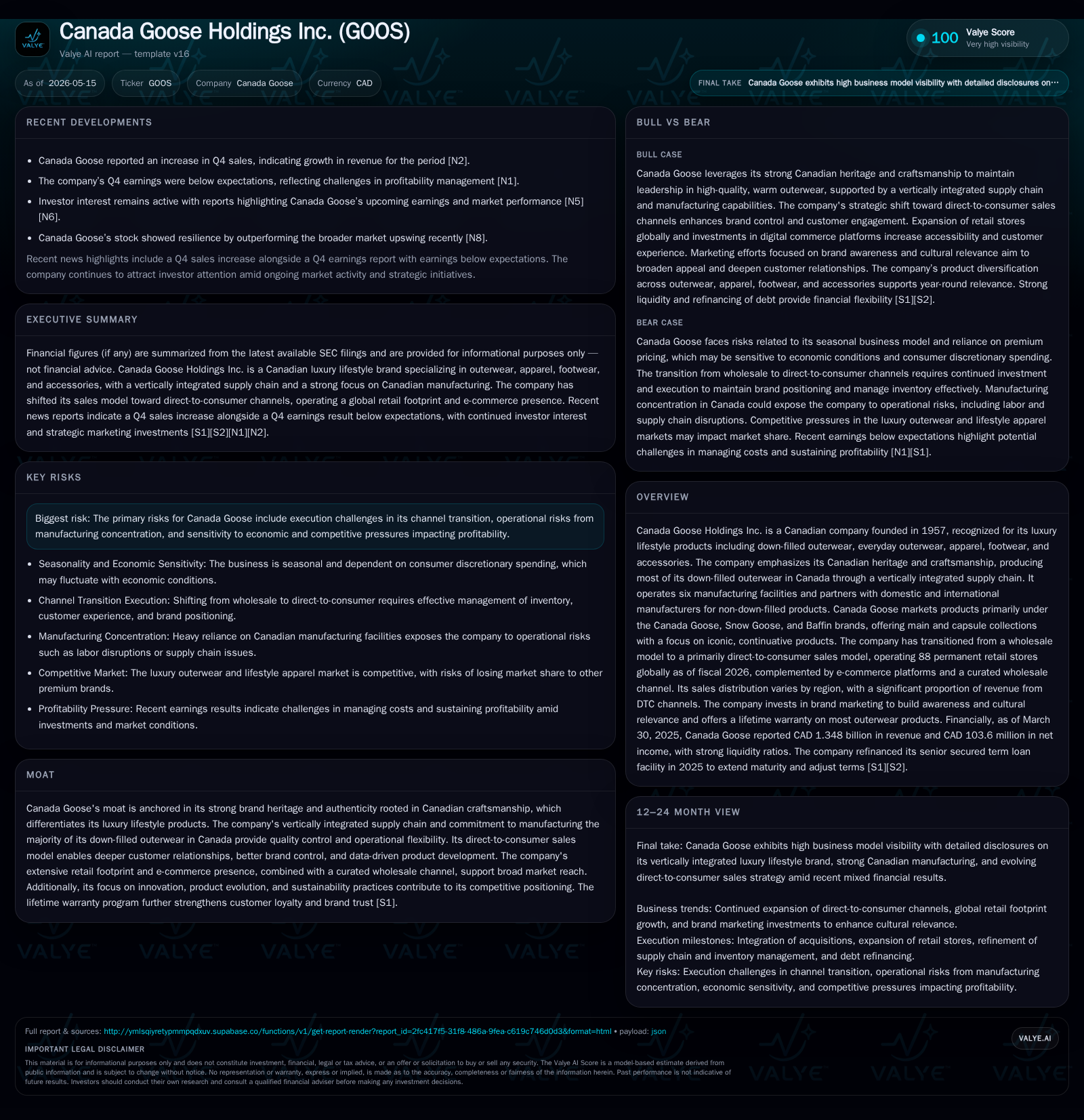
Canada Goose’s Q4 2026 results reveal continued top-line growth fueled by its expanding direct-to-consumer (DTC) channel and robust retail execution. Leveraging a vertically integrated Canadian manufacturing base ensures product quality and margin control while supporting a premium luxury positioning. The company’s portfolio growth into apparel, footwear, and accessories complements its core down-filled outerwear, enhancing year-round relevance. Facing near-term margin pressure from channel transition and macroeconomic factors, Canada Goose is focused on sustainable long-term growth through strategic retail expansion and innovation. Its healthy balance sheet underpins operational agility as it navigates execution risks and a shifting luxury market landscape.
Q4 and Latest Operating Highlights: What Changed
Canada Goose's most recent quarter ending March 29, 2026, as reported in its May 14, 2026 Form 6-K [S2], revealed continuing revenue growth albeit with an earnings miss flagged by market commentary [N1]. The quarter underscored the dynamic tensions inherent in the company’s ongoing transition toward a predominantly direct-to-consumer (DTC) model. While total sales expanded supported by organic gains in retail store performance—both physical locations and e-commerce—the company noted pressures on margins tied to elevated marketing spend aimed at brand elevation and inventory costs associated with channel rebalancing. This reflects the market recalibration period where Canada Goose shifts away from wholesale reliance toward deepening customer engagement via its owned stores and online platforms.
This transformation also involved expanding retail square footage globally to approximately 217,000 sq ft across 88 permanent stores—a notable increase from prior years—illustrating strong confidence in physical retail as a brand-building touchpoint paired seamlessly with omnichannel innovations such as buy-online-return-in-store [S3]. The quarter positioned Canada Goose at a critical inflection whereby top-line momentum intersects with short-term profitability impacts driven by strategic reinvestment into both consumer-facing assets and elevated brand marketing.
Vertical Integration and Supply Chain: Made in Canada Advantage
At the heart of Canada Goose’s product quality and margin discipline lies its vertically integrated supply chain anchored primarily in Canada. According to the latest annual filing [S1],[S16], more than 80% of its down-filled outerwear production occurs within six dedicated manufacturing facilities—five located in Canada and one in Romania—with Canadian operations handling nearly all down-filled items.
This high level of control supports strict quality assurance protocols essential for maintaining the brand's authentic luxury positioning centered on warmth, craftsmanship, and functional performance. Moreover, vertical integration allows operational flexibility to adjust production volumes based on demand signals—mitigating risks seen in traditional outsourced models. The acquisition of Paola Confectii Manufacturing Limited in late 2023 further bolstered in-house capabilities specifically for knitwear production, aiming to enhance margins through closer control over design, fabrication processes, and inventory management [S4].
The supply network is supplemented by trusted domestic and international contract partners specializing in non-down categories like windwear, rainwear, footwear under the Baffin brand (acquired in 2018), accessories, and knitwear. This hybrid model permits scaling while preserving the core ‘Made in Canada’ heritage viewed as an irreplaceable moat that strengthens consumer trust internationally.
Product Portfolio and Customer Experience: Luxury Outerwear and Beyond
Canada Goose’s product ecosystem extends from its flagship down-filled outerwear— iconic parkas engineered for extreme weather protection—to a growing range of complementary categories including apparel (knitwear, fleece), rainwear, windwear, footwear (Baffin), accessories (hats, scarves), and eyewear [S11]. This diversification supports enhancing year-round relevance beyond just winter outerwear.
The company focuses on a distinctive collection architecture combining core continuative styles with periodic capsule collections designed for cultural resonance. The Thermal Experience Index frameworks design variations addressing diverse climates broadening addressable use cases. Additionally, lifetime warranty programs reinforce customer satisfaction post-sale—a differentiator underpinning reputation for quality.
In-store experiences emphasize storytelling rooted in Canadian heritage combined with expert service delivered by branded ambassadors who personalize interactions ensuring alignment between product benefits and customer needs [S19]. Omnichannel capabilities integrate digital ease such as endless aisle access providing full assortment availability online even within physical stores bolstering retention metrics.
Industry Positioning: Competitive Set and Channel Shift Dynamics
Canada Goose positions itself distinctively within the luxury lifestyle outdoor apparel segment competing against brands focusing on heritage authenticity or innovation-led technical wear. Its commanding niche derives from combining genuine craftsmanship with distinct Canadian provenance—a narrative hard for entrants or peers to easily replicate due to manufacturing concentration plus longstanding expertise.
The shift away from traditional wholesale channels toward a primarily DTC model is a structural change that improves gross margins but introduces complexity managing inventory flow across channels [S3],[S6]. Wholesale operations remain significant mainly through partnerships concentrated geographically in EMEA but continue to be tightly curated to maintain brand exclusivity.
Regional variations exist where North America DTC sales represent approximately 76% of regional revenue while Asia Pacific DTC share exceeds 80%, reflecting successful penetration through own retail stores plus expanded e-commerce reach [S3]. In EMEA regions DTC has grown to about 55%, signaling an ongoing channel realignment.
Price positioning remains premium with high barriers to entry including tension between protecting exclusivity via limited production runs versus scaling for growth—a balance managed through operational discipline enabled by vertical integration.
Growth Drivers: Direct-to-Consumer Expansion, New Categories, and Market Penetration
Several key structural levers support Canada Goose’s growth outlook:
- Retail Store Expansion: Growing from single-digit stores less than a decade ago to 88 global permanent locations spanning premier malls, flagship flagship formats emphasizing immersive brand storytelling [S25]. Incremental store openings target key metros leveraging data-driven site selection optimizing sales per square foot (reported at $4,089 annually).
- Digital Commerce: Enhanced e-commerce platforms now cover over 50 markets delivering around one-quarter of total DTC revenue [S9]. Investments focus on user personalization algorithms coupled with streamlined omnichannel fulfilment capabilities fueling conversion rates.
- Category Diversification: Increasing offerings beyond iconic parkas into everyday outerwear like rain/wind jackets plus complementary apparel knitwear lines supported by new manufacturing acquisitions (Paola Confectii) extend seasonal relevance driving repeat purchases [S24]. Footwear under Baffin expands addressable markets towards outdoor performance niches.
- International Market Development: Joint ventures such as CG Japan accelerate local market penetration with dedicated retail footprint plus regional digital presence allowing tailored assortments responsive to local tastes [S4].
- Brand Heat Through Marketing: Amplified upper-funnel marketing spend targeting aspirational consumers elevates cultural relevance anchored on authentic storytelling featuring celebrity collaborations aligned with brand values [S12].
Each lever corresponds with measurable KPIs such as increasing DTC revenue percentages by region (~76% NA; ~84% APAC), store count growth (+14 net permanent stores FY26), improved average sales/sq ft metrics, elevated brand awareness scores from market research programs.
Risks and Watchpoints: Execution, Manufacturing Concentration, Economic Sensitivity
Canada Goose faces several structural risks:
- Channel Execution Risks: Transitioning significant revenue streams from wholesale to direct sales requires precise inventory management; missteps can generate excess stock or stockouts impacting margins adversely [S2]. Monitoring inventory turnover ratios alongside evolving channel mix is critical.
- Manufacturing Concentration: Heavy reliance on Canadian facilities for core down-filled products entails operational risk exposure should disruptions occur (labor issues, regulatory changes). Geographic concentration limits supply chain redundancy though partially mitigated by contract partners abroad [S16].
- Macroeconomic Sensitivity: As a premium luxury lifestyle brand reliant on discretionary spending patterns vulnerable globally during downturns or geopolitical tensions where currency & trade dynamics may pressure costs or demand elasticity.
- Competitive Pressures: Niche rivals or mass-market brands entering insulated outerwear segments could erode pricing power if perceived value differentiation wanes.
- Brand Authenticity Risks: Over-extension into non-core categories without maintaining stringent quality standards threatens dilution of premium perception needed for sustained pricing power.
What to Watch Next: Guidance, Retail Expansion, Innovation Milestones
Future milestones include:
- Updated quarterly guidance reflecting channel mix adjustment progress plus anticipated margin trajectories informed by recent near-term headwinds reported in Q4 results [S2].
- Further retail expansion announcements especially within North American major metros plus intensified pent-up rollout plans across Asia-Pacific markets nurturing localized demand responsiveness [S25].
- Innovations anticipated around next-generation materials blending enhanced warmth/lightness aligned with sustainability goals linked to Science Based Targets program commitments announced broadly [S5],[S12].
- Progress on sustainability initiatives including circularity programs such as repair services and resale platforms supporting environmental stewardship while enhancing customer lifecycle engagement.
Monitoring statements related to these milestones will provide signals regarding execution discipline adherence alongside evolving market receptions influencing longer-term growth trajectory clarity.
Summary: Strategic Outlook Supported by Financial Strength
Canada Goose exemplifies a luxury lifestyle brand successfully capitalizing on authentic heritage backed by operational excellence rooted in vertical integration primarily executed within Canada. The transition towards an overwhelmingly direct-to-consumer focused business strategy enhances both margin potential via superior control over inventory/distribution while deepening customer relationships essential for long-term loyalty amid volatile discretionary consumption climates.
Financially, the company remains well positioned; latest available metrics indicate cash & equivalents totaling CAD 334 million alongside robust current assets relative to liabilities yielding a current ratio near 2.67 at fiscal year-end March 2025 providing ample liquidity buffer facilitating ongoing capital investments into retail infrastructure expansion, digital platform enhancements, product innovation pipelines plus acquisitions such as Paola Confectii SRL manufacturing consolidation efforts [F1],[S2].
Execution risks linked mostly to channel realignment dynamics warrant close observation; however, embedded sustainability commitments aligned with measured marketing investments aim at maintaining cultural relevance underpinning pricing power resilience amidst intensifying sector competition. Continued emphasis on incremental geographically nuanced store openings coupled with category breadth expansions should support revenue diversification mitigating seasonality inherent within historically winter-centric down outerwear categories.
Overall outlook reflects disciplined navigation of near-term operational complexity balanced against structurally advantageous brand equity foundations supported by financial flexibility enabling sustained innovation leadership within premium cold weather lifestyle segment.
Disclaimer: This is research-only, informational analysis and not investment advice. It may include AI-generated interpretation and general industry context. Always verify important details using primary sources.

Comments