
National Bankshares Advances Virginia Market Leadership with Solid Q1 and Strategic Asset Sale
NKSH's Q1 2026 reveals strong liquidity, stable credit risk management, and strategic refocus following asset divestiture.
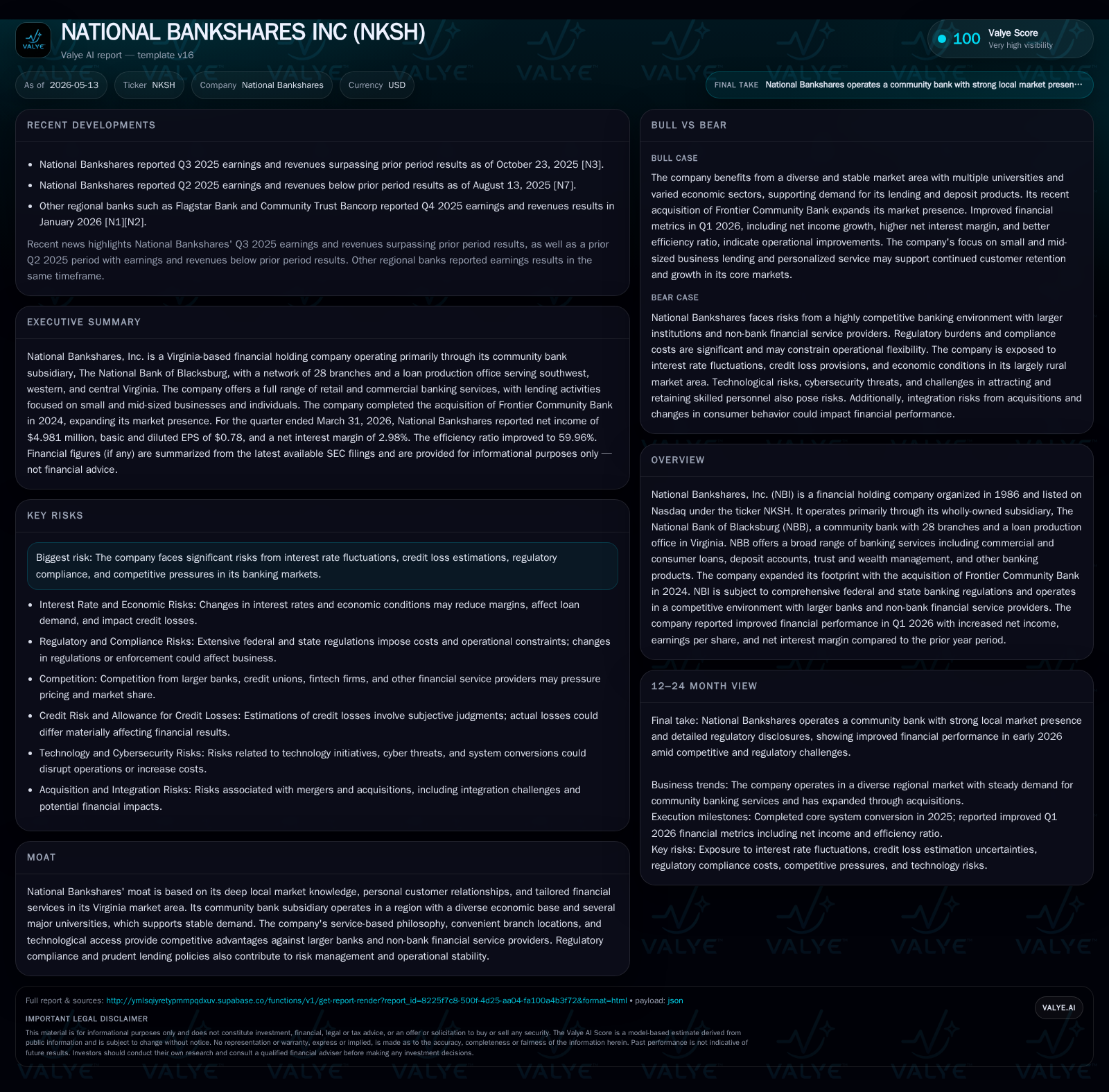
National Bankshares, Inc. reported steady operating results in Q1 2026 highlighted by robust liquidity reserves and a maintained allowance for credit losses amidst elevated local unemployment indicators. The May 2026 sale of its interest in Bearing Insurance Group signals a strategic focus on core community banking operations in Virginia, where it leverages deep local market expertise through The National Bank of Blacksburg. Growth is driven by branch expansion, digital adoption, and acquisition integration while risks center on credit quality in commercial real estate, interest rate volatility, and regulatory demands. NKSH’s financial flexibility is underpinned by substantial borrowing capacity from FHLB and the Federal Reserve alongside a conservative loan-to-deposit ratio.
Latest Quarterly Operational Update: Strengthening Liquidity and Credit Metrics
National Bankshares' latest quarterly filing dated May 13, 2026 [S2] underscores a stable liquidity profile bolstered by diversified funding channels. The company reported $303 million borrowing capacity with the Federal Home Loan Bank (FHLB) and $184 million at the Federal Reserve discount window as of March 31, 2026. Notably, despite ample capacity, NKSH had no outstanding borrowings from these sources at quarter-end—a sign of operational cash sufficiency. The company's loan-to-deposit ratio was managed prudently at roughly 61%, aligning with internal policy to ensure liquidity buffers during periods of market stress or elevated withdrawal activity [S2][S7].
From a credit risk perspective, NKSH maintained an allowance for credit losses (ACLL) of $9.7 million representing 0.98% of loans net of fees—nearly unchanged since December 31, 2025 [S2]. Management’s deliberate judgment accounts for rising local unemployment data and collection trends but reflects a conservative posture amidst early signs of economic softness in its Virginia footprint [S26]. The recovery provision recorded during Q1 indicates improving loan loss expectations consistent with measured economic conditions.
Complementing these operating metrics is the May 1, 2026 completion of the sale of Bearing Insurance Group membership interests for which the company anticipates recognizing a pre-tax gain close to $6.57 million [S3]. This divestiture refocuses NKSH towards its core community banking operations while unlocking shareholder value and simplifying its business model.
Community Banking DNA: Business Model and Product Suite
NKSH functions primarily through its wholly-owned subsidiary The National Bank of Blacksburg (NBB), a well-established community bank rooted deeply in southwest to central Virginia markets [S1]. With origins dating back to 1891 and a network expanded via acquisitions including Frontier Community Bank in mid-2024 [S25], NBB wields significant local knowledge enabling tailored loan underwriting practices sensitive to regional economic drivers.
Loan products skew heavily toward commercial real estate financing—accounting for approximately 83.7% of total loans secured by property within their geographic market—a segment that requires careful scrutiny given its sensitivity to vacancy rates and local economic cycles [S1][S22]. Lending also extends into consumer mortgages, construction financing, small business loans, and home equity lines offering portfolio diversification.
Deposits encompass broad retail and commercial offerings inclusive of checking accounts (interest-bearing or not), savings vehicles including money market accounts and CDs, plus municipal deposits that add stability via pledged bonds securing approximately 22% of total deposits [S11]. Importantly, NKSH avoids brokered deposits entirely, enhancing funding stability against sudden outflows common with noncore sources.
The bank supplements traditional offerings with wealth management through trust services targeting individual and institutional clients within its footprint, underscoring its commitment to full-service community banking. Recent completions such as core system conversion enhancements now support advanced treasury management services rolled out early this year to commercial customers—reflecting deliberate investments into technology-driven client enablement [S11].
Competitive Environment and Regional Industry Dynamics
NKSH's competitive mooring lies in its ability to cultivate longstanding customer relationships grounded in personal service—a cornerstone advantage against larger regional banks or non-bank fintech firms encroaching into community segments. This niche is reinforced by servicing a diverse economic base inclusive of university towns like Blacksburg known for tech innovation clusters alongside traditional industrial sectors.
Pricing power in this environment is tempered by abundant alternative credit sources necessitating disciplined underwriting standards and relationship-focused retention strategies [S1]. Regulatory oversight also acts as a structural barrier limiting rapid scale expansions common among competitors lacking comparable capitalization or compliance infrastructure.
However, concentrated exposure to Virginia's local real estate markets introduces correlation risk; downturns here can depress collateral values affecting loan recoveries materially as most collateralized assets reside within the bank's own service area [S1][S22]. Consequently, NKSH’s operational emphasis on detailed local market intelligence is critical both for risk mitigation and opportunity identification.
Growth Drivers: Market Expansion, Digital Adoption, and Loan Portfolio Development
Growth initiatives rest on prudent geographic expansion exemplified by opening a new branch in Roanoke in late 2025 coupled with modernization efforts upgrading existing branches such as Lynchburg [S1]. These moves broaden NKSH’s physical presence complementing existing digital access points offering mobile and online banking functionalities essential for broader customer engagement.
Acquisition integration remains a medium-term growth catalyst post-Frontier Community Bank buyout which brings incremental deposit bases and incremental lending capacity into NKSH’s fold [S25]. Additionally, shedding ancillary businesses like Bearing Insurance Group allows management to concentrate resources on scalable core products improving overall franchise profitability metrics [S3].
Digital channel advances are also accelerating commercial deposit product offerings; notably treasury management solutions launched will likely drive higher fee income while reducing operational friction points for business clients [S11]. Given broader industry trends where fintech competition pressures margins particularly among smaller banks lacking scale benefits, NKSH’s blend of localized relationship-based service fortified by key technology upgrades appears well poised.
Risk Overview: Interest Rate Exposure, Credit Quality, and Regulatory Compliance
Credit concentration stands as the dominant vulnerability with nearly half the loan book tied to commercial real estate collateralized largely by multi-family housing or non-owner-occupied properties susceptible to adverse occupancy trends or regional economic slowdowns [S22]. Elevated levels of high-risk loans have incrementally increased since prior years warranting careful ACLL monitoring leveraged through qualitative overlays capturing loan officers’ assessments plus external macro factors [S26][S27].
Interest rate risk remains an intrinsic challenge given potential rapid shifts can compress net interest margins if liabilities reprice faster than assets—a classic community bank dilemma particularly acute under volatile Federal Reserve policies [S12]. NKSH addresses this via conservative asset-liability management but is not immune especially since pricing competition limits outright passing-through increases fully.
Regulatory burden continues evolving with compliance costs tied to risk governance frameworks such as incentive compensation guidelines linked tightly to risk profiles [S13][S16]. Climate-related credit risk considerations are emerging given possible physical damage to collateral from severe weather events common in Southeastern US regions adding latent uncertainty [S16]. Failure to maintain adherence could expose NKSH both to material fines but equally damaging reputational harm.
Key Milestones Ahead: Capital Deployment, Loan Demand Trends, and Deposit Growth
Upcoming milestones hinge on tracking sustained deposit retention particularly given ~20% uninsured deposits balance presenting potential withdrawal pressures during systemic shocks [S11]. Loan demand trends should be monitored especially in light of macroeconomic developments influencing small business growth within Virginia locales served.
Capital deployment decisions are expected to balance organic portfolio growth against opportunistic acquisitions or infrastructure investments while maintaining regulatory capital buffers comfortably above minimums reflective of sound prudential practice indicated by CET1 ratios exceeding 16% currently [S10].
Technological rollout pacing around digital product completions including additional treasury services slated for release will serve as operational barometers moving forward alongside any formal guidance updates management elects to communicate regarding strategic priorities or expected earnings trajectories.
Financial Snapshot and Balance Sheet Analysis
As evidenced from March-end figures supported by SEC disclosures [F1][S2], NKSH holds $62.15 million in cash and equivalents reinforcing operational liquidity strength accommodating normal fluctuations without recourse borrowing necessity despite substantially available facilities ($303M FHLB + $184M Fed discount window) remaining untapped as backup sources.
The loan-to-deposit ratio near 61% signals conservative funding aligned with sector norms reducing susceptibility to forced asset sales under stress scenarios while providing runway for measured loan growth consistent with strategic objectives [S7]. Equity components edged slightly higher driven by retained earnings accumulation supporting capital adequacy metrics well above regulatory minima ensuring resilience against potential unexpected credit stresses or macroeconomic headwinds.
The recognition of a significant pre-tax gain from asset sale ($6.57 million) improves near-term profitability profiles allowing potentially enhanced reinvestments within the core business without levering balance sheet further thus preserving financial health fundamentals heading into subsequent quarters [S3].
Disclaimer
This analysis is based solely on publicly available filings sourced directly from SEC documents dated through May 13, 2026. It does not constitute investment advice or recommendations but serves as an independent industry-focused evaluation grounded strictly on provided disclosures without extrapolation beyond cited facts.
Disclaimer: This is research-only, informational analysis and not investment advice. It may include AI-generated interpretation and general industry context. Always verify important details using primary sources.

Comments