
Leapfrog Acquisition Corp's SPAC Strategy Focuses on Strategic Energy and Critical Minerals Markets
Recent quarterly filings highlight Leapfrog’s focus on executing a business combination in international energy supply chains and critical minerals sectors.
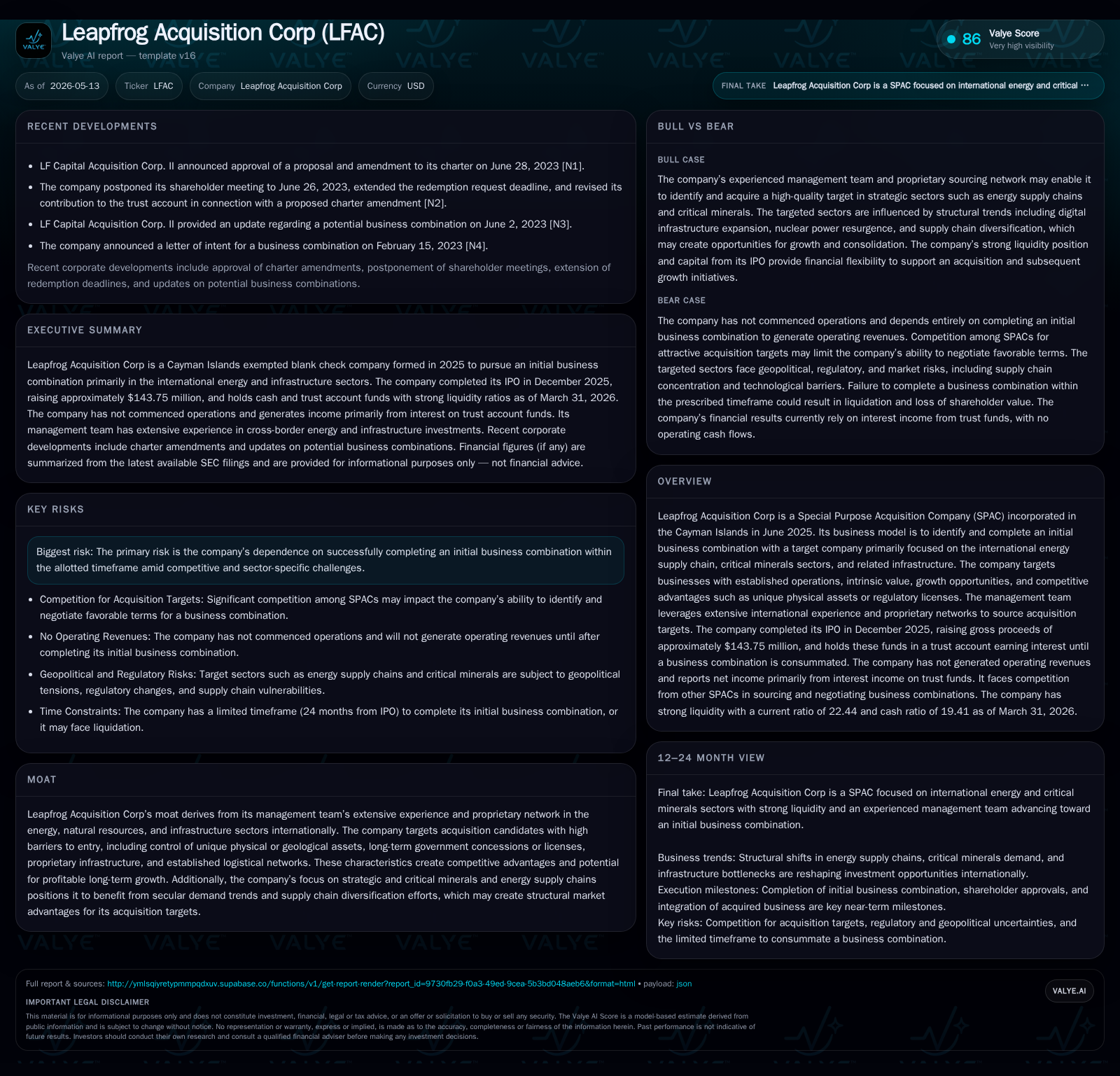
Leapfrog Acquisition Corp (LFAC) remains in its pre-combination phase, holding $1.01 million in cash and continuing to seek a target with strategic assets in global energy and critical minerals. The company's moat is rooted in its management’s international experience and focus on assets with high barriers to entry, targeting markets poised for secular growth amid geopolitical realignments. Competition among SPACs and the need to complete a combination within regulatory timelines remain material risks. Monitoring target diligence progress and capital raising efforts will be key milestones going forward.
Recent Operating Update
Leapfrog Acquisition Corp’s latest quarterly filing as of May 13, 2026 [S2] reveals no deviation from previously disclosed risk factors or strategic objectives. The company continues to operate as a Special Purpose Acquisition Company (SPAC) without revenues or ongoing operations beyond maintaining funds raised from its December 2025 IPO. It holds approximately $1.01 million cash as of March 31, 2026 [F1], reflecting typical trust-account management and limited administrative expenses.
This update is important because it validates continuity in Leapfrog’s operational posture: it remains fully focused on completing its initial business combination target without altering risk profiles or expanding operational scope prematurely.
Business Model
Leapfrog Acquisition Corp generates value for shareholders by serving as a publicly traded acquisition vehicle designed to merge with an operating business that aligns with its strategic positioning. Unlike traditional operating companies, it does not generate revenues or profits before the business combination. Instead, its value creation depends on identifying an attractive acquisition candidate whose inherent strengths align with trending global market dynamics.
The company targets firms primarily within the international energy supply chain and critical minerals sectors—both crucial components underpinning contemporary industrial activity and next-generation infrastructure development [S1]. Specifically, it seeks established companies controlling hard-to-replicate physical assets such as rare earth element mines, energy infrastructure facilities, or fleets with government-backed concessions/licenses.
Revenue generation post-acquisition will derive from the target’s existing operating income streams augmented by Leapfrog’s strategic capital deployment aimed at unlocking growth via expansion of capacity, operational improvements, or consolidation opportunities in these fragmented sectors [S11]. The SPAC structure offers flexibility in transaction consideration—allowing payment via cash, equity rollovers by incumbent owners, or structured debt financing—tailored to optimize alignment of interests.
Industry Structure and Competitive Position
The critical minerals and energy infrastructure ecosystem targeted by Leapfrog is characterized by high capital intensity, pronounced regulatory oversight, and significant geopolitical influence impacting supply chain configurations [S1]. These factors create substantial entry barriers—specifically through control over unique geological sites, government concessions, proprietary processing technologies, or integrated logistical networks.
Leapfrog’s competitive advantage lies in its management team which boasts extensive international transaction experience across multiple geographies and economic cycles [S10]. This experiential moat enables access to proprietary deal flow often less accessible to other SPACs or financial sponsors lacking sector focus or cross-border capabilities.
However, the competitive landscape is crowded with other SPACs, private equity groups, and strategic acquirers vying for similar target companies amid increased market attention on supply chain resilience driven by current geopolitical realignments [S14]. These competitors may have larger financial resources or more established relationships within local markets. Leapfrog must therefore leverage both its network advantages and compelling value proposition to secure favorable deals.
Growth Drivers
Several structural forces underpin the growth thesis for Leapfrog Acquisition Corp’s targeted sectors:
Secular Demand Expansion: The International Energy Agency projects data center electricity consumption will more than double by 2030 due to artificial intelligence proliferation and cloud computing needs [S1]. This intensifies demand for baseload power sources such as nuclear small modular reactors and advanced geothermal systems—which align closely with Leapfrog’s target industries.
Supply Chain Realignment: Geopolitical pressures are accelerating diversification away from concentrated production regions toward more resilient supply chains emphasizing sustainability criteria enforced through government policies [S4]. This favors entities positioned within regions benefiting from strategic partnership incentives or standards-based market access requirements.
Infrastructure Bottlenecks: Existing infrastructure constraints across mining, processing, and distribution are catalyzing investment opportunities for asset owners who can unlock new capacity or improve logistics efficiency [S4].
Capital Market Access: Post-business combination entities benefit from access to U.S. equity and debt markets facilitating facility expansions or acquisitions not possible under prior local financing limitations [S11].
These factors suggest that successful target companies acquired by Leapfrog will likely see durable volume growth supported by favorable pricing leverage amid constrained supply conditions.
Risks and Constraints
Primary risks revolve around execution uncertainties inherent to all SPAC structures:
Time Constrained Combination Window: Leapfrog must consummate a merger within mandated regulatory timelines (generally two years post-IPO) or return funds to investors; failure invites liquidation events severely limiting shareholder value creation [S2].
Competitive Deal Environment: Many SPACs pursue similar acquisition candidates emphasizing high-barrier assets; resultant bidding pressures may erode attractive valuation thresholds or induce aggressive deal structures unfavorable post-close [S14].
Dilution & Redemption Dynamics: Investor rights permitting redemption of shares before combination can reduce deal proceeds available for investment while outstanding warrants may pressure stock valuations post-combination [S24].
Financing Uncertainty: If target enterprise values exceed trust account amounts net of redemptions, additional fundraising is required which entails execution risk plus possible adverse cost implications [S22].
Target Compliance & Audit Requirements: Delay or failure in acquiring audited financial statements compliant with SEC proxy standards may narrow feasible deal targets [S26].
These factors combine to create significant hurdles that require disciplined sourcing rigor alongside fluid capital management strategies.
What to Watch Next
Key forthcoming milestones include:
- Identification of a definitive acquisition candidate that fits Leapfrog’s strategic framework,
- Completion of exhaustive due diligence validating operational quality and growth prospects,
- Announcement of a definitive business combination agreement,
- Execution of equityholder vote soliciting approval of the proposed transaction,
- Capital raising transactions complementing funds in trust where necessary,
- Regulatory filings including proxy statements disclosing detailed financials of the combined entity.
Progress along these milestones will materially influence Leapfrog’s trajectory from a blank-check status toward an operational public enterprise benefitting from rising secular trends across energy and critical mineral supply chains.
Financial Profile Summary
Latest financial snapshot
| Metric | Value | Period |
|---|---|---|
| Cash & equivalents | $1,010,279 | |
| 2026-03-31 | ||
| Current assets | $1,167,811 | |
| 2026-03-31 | ||
| Current liabilities | $52,039 | |
| 2026-03-31 | ||
| Current ratio | 22.44x | |
| 2026-03-31 |
Source: SEC companyfacts cache [F1].
As of March 31, 2026, Leapfrog Acquisition Corp maintained strong liquidity metrics appropriate for a pre-acquisition SPAC:
- Cash & equivalents stood at approximately $1.01 million,
- Current assets totaled about $1.17 million against current liabilities near $52 thousand,
- Resulting in an unusually high current ratio near 22x reflecting minimal liabilities beyond administrative costs [F1].
Operating income prior to any acquisition was negative due primarily to administrative overhead incurred during formation (-$132k ending December 2025) while net income was modestly positive driven by interest income earned on trust funds ($205k) [F1].
These numbers confirm that Leapfrog operates conservatively at this stage while preserving capital to fund eventual acquisition activities.
Disclaimer: This report is prepared solely for informational purposes based on publicly available SEC filings as of May 13, 2026. It does not constitute investment advice or recommendations regarding Leapfrog Acquisition Corp securities.
Disclaimer: This is research-only, informational analysis and not investment advice. It may include AI-generated interpretation and general industry context. Always verify important details using primary sources.

Comments