
Nucor's Record Quarter Drives Steel Leadership and Strategic Investment Momentum
Nucor’s Q1 2026 results showcase robust volume growth, pricing power, and margin expansion in an integrated steel business backed by strategic capital investments.
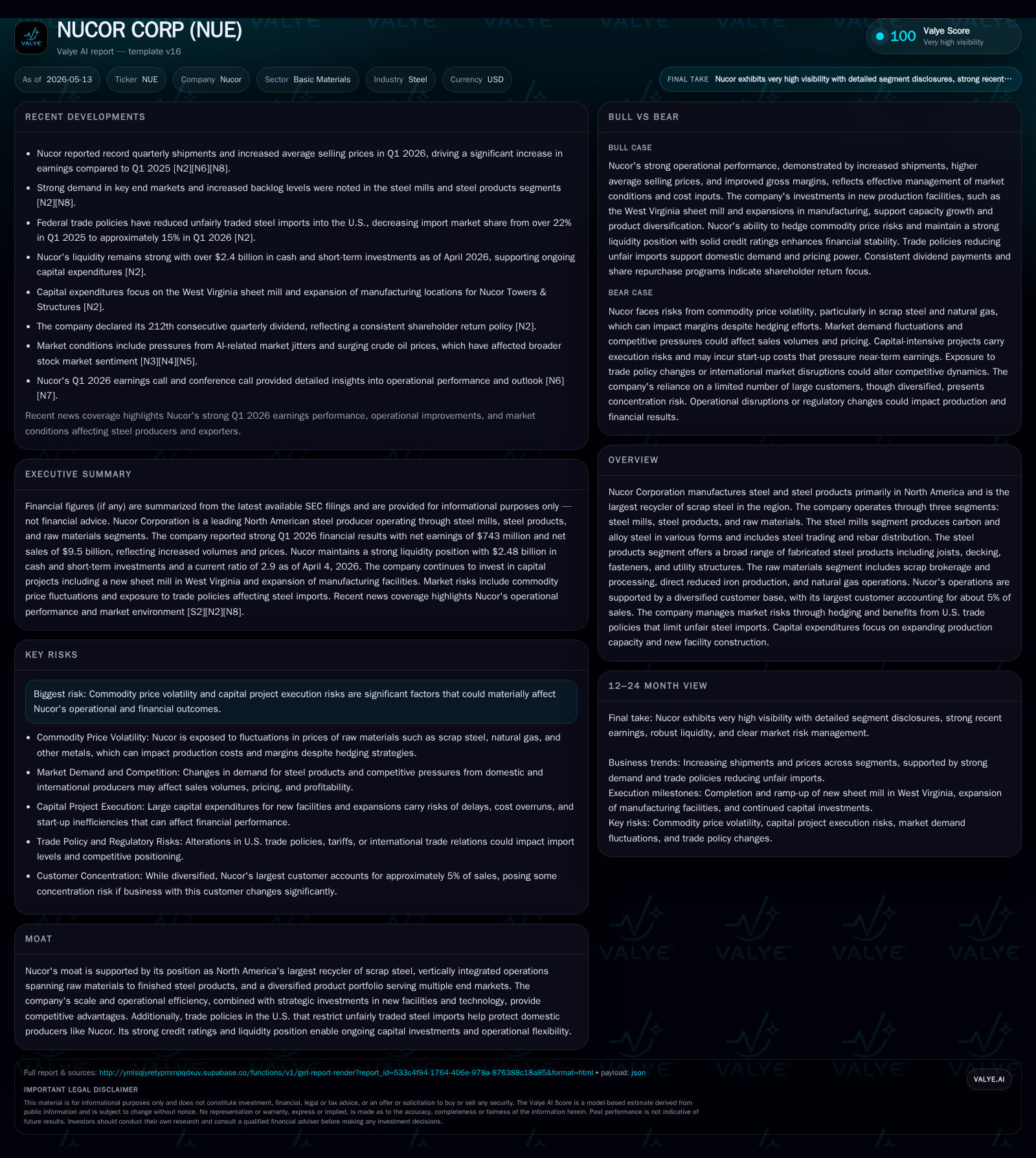
Nucor Corporation reported a marked improvement in first quarter 2026 earnings driven primarily by record shipments and higher average selling prices in its steel mills segment. Utilization rates across segments increased, supporting strong backlog growth amid resilient demand in key end markets. The company’s vertically integrated operations, including its dominant scrap recycling position and direct reduced iron production, underpin its competitive moat further reinforced by U.S. trade policies limiting unfair imports. Capital expenditures remain focused on expanding sheet mill capacity and enhancing steel products manufacturing to sustain long-term growth despite commodity price volatility risks.
Quarterly Operating Breakthrough: Volume, Prices, and Margins
Nucor reported a standout first quarter ending April 4, 2026, posting net earnings attributable to stockholders of $743 million or $3.23 per diluted share — a sharp increase from just $156 million ($0.67 per share) in the corresponding quarter a year earlier [S2]. This leap was predominantly driven by the steel mills segment that achieved record shipments alongside elevated average selling prices and expanded metal margins. Demand strength persisted across all key end markets with backlogs increasing through the quarter.
Utilization rates improved across segments: steel mills operated at approximately 86% capacity compared to about 80% a year prior; steel products utilization climbed to about 60% from 55%; raw materials usage rose modestly to around 76% versus 73% previously [S2]. The sheet mills especially contributed heavily to earnings growth within the mills segment due to both volume gains and favorable price realization sustained by ongoing enforcement of U.S. trade protections.
These results highlight operational momentum amidst a defensive domestic market shaped by trade policies that curtail flooding from unfairly traded imports, reinforcing Nucor’s pricing environment [S2][N5].
Nucor’s Business Model: Integration and Product Breadth Power Margins
Nucor operates through three core segments: steel mills producing carbon and alloy steel in forms including sheet, bars, structural sections; steel products fabricating joists, decking systems, fasteners; and raw materials encompassing scrap brokerage (via David J. Joseph Company), direct reduced iron (DRI) production facilities in Louisiana and Trinidad, plus natural gas operations [S1][S2].
This vertical integration ensures control over primary feedstocks—particularly scrap steel recycling which positions Nucor as North America’s largest recycler—and offers strategic insulation against commodity input volatility inherent in steel manufacturing supply chains [S1][F1]. Furthermore, the DRI plants provide operational flexibility enabling incremental cost control when scrap supply tightens or prices climb.
The extensive product portfolio spanning basic steel forms through fabricated components caters to diversified downstream end markets such as construction, automotive assembly, infrastructure projects and manufacturing sectors. This breadth helps mitigate cyclical risks localized in any single end-use industry while creating cross-selling opportunities within existing customer relationships.
Customer concentration remains low with no single customer contributing more than ~5% of sales; this diversified base supports stable revenue streams aligned with broad economic activity across North America [S1][F1].
Competitive Edge: Recycling Scale, Trade Protections, and Efficiency
Nucor’s moat rests significantly on its scale as the largest scrap recycler on the continent combined with state-of-the-art melting facilities that drive operational efficiency—a crucial metric in an industry pressured by commodity cycles. Its investments in modern electric arc furnace (EAF) based sheet mills enhance energy efficiency relative to traditional blast furnace capacities common elsewhere.
Critically, federal trade instruments including anti-dumping measures and countervailing duty laws plus Section 232 national security tariffs have restricted influxes of lower-cost foreign steel imports that previously eroded domestic producers’ price power [S1][S2]. These barriers level the competitive playing field domestically enabling Nucor to better capture value through pricing rather than volume alone.
Moreover, newer DRI plants offer an additional layer of feedstock cost management rarely matched by competitors reliant solely on purchased scrap or iron ore inputs.
Growth Catalysts: Capacity Expansions, Technology Investments, and Market Dynamics
Capital expenditures remain substantial but well-directed toward expanding capacity where demand appears sustainable or accelerating. In Q1 2026 alone, CapEx totaled approximately $661 million primarily dedicated to advancing construction of a new high-efficiency sheet mill located in West Virginia—a key strategic enhancement expected to bolster flattening product output in coming years—as well as augmenting fabrication capabilities within Nucor Towers & Structures operations [S2].
The company forecasts full-year capital spend near $2.5 billion versus $3.42 billion deployed last year reflecting both timing shifts and maturation of several large scale projects.
Further growth drivers include anticipated infrastructural spending programs anticipated by government authorities along with renewed automotive production needs increasing flat-rolled steel consumption levels. Technological upgrades aimed at productivity enhancement or galvanizing capabilities also underpin resilience against commodity price perturbations while improving product quality metrics respected by downstream customers.
Importantly Nucor’s flexible internal DRI production capability mitigates scrap supply imbalances—allowing smoothing of upstream material cost fluctuations without sole dependence on volatile external scrap procurement markets [S3][N1].
Risks and Constraints: Commodity Volatility and Execution Challenges
While hedging strategies moderate risk exposures from raw material price swings—especially scrap metals—the company acknowledges inherent unpredictability that can pressure margins if market conditions shift unfavorably or lag times widen between input cost rises and output price adjustments [S1].
Execution risk accompanies major capital projects such as the West Virginia sheet mill due both to scale complexity and potential regulatory hurdles including environmental scrutiny notably around Clean Air Act allegations received at the Louisiana DRI facility currently under negotiation but expected to be immaterial monetarily [S1]. Delays or cost overruns could deflate return profiles.
Additionally unforeseen changes in U.S. trade policy or diminished enforcement action against unfairly traded imports pose downside margin pressure risks due to renewed competitive supply from lower-cost global sources.
Investor Focus: Key Upcoming Catalysts and Performance Indicators
Market observers should track near-term developments around commissioning timelines for the West Virginia sheet mill project alongside throughput volumes reported each quarter within the steel mills segment which directly correspond with margin manifestation.
Backlog levels remain a sentinel indicator of demand durability warranting continuous monitoring alongside pricing trends reflective of trade law enforcement vigor. Any modifications or extensions in tariff frameworks could materially influence downstream demand dynamics.
Regulatory outcomes relating to environmental matters at DRI operations will also present key milestones affecting operational continuity or potential remediation costs.[S2][S3][N2]
Latest Financial Snapshot: Strong Liquidity and Balanced Leverage
Latest financial snapshot
| Metric | Value | Period |
|---|---|---|
| Cash & equivalents | $2.2bn | |
| 2026-04-04 | ||
| Total debt | $6.9bn | |
| 2026-04-04 | ||
| Net debt | $4.7bn | |
| 2026-04-04 | ||
| Current assets | $12.1bn | |
| 2026-04-04 | ||
| Current liabilities | $4.2bn | |
| 2026-04-04 | ||
| Current ratio | 2.9x | |
| 2026-04-04 |
Source: SEC companyfacts cache [F1].
As of April 4, 2026, Nucor held cash & equivalents totaling approximately $2.23 billion paired against total debt near $6.88 billion yielding net debt close to $4.65 billion with a comfortable current ratio around 2.9 highlighting robust short-term liquidity positioning able to sustain working capital needs alongside large-scale capital outlays [F1][S7].
The company maintains compliance with revolving credit facility covenants featuring a funded debt-to-total capital limitation set at 60%; funded debt-to-capital stood at roughly 24%, well within acceptable boundaries according to recent filings [S7]. Dividend continuity remains intact with issuance now exceeding two centuries of consecutive quarterly payments reinforcing financial discipline aligned with shareholder returns even amidst capex-heavy periods.
These financial characteristics support Nucor’s ability to execute long-term strategic initiatives without compromising balance-sheet flexibility or credit standing critical for downcycle resilience.
This analysis synthesizes information from Nucor Corporation’s SEC filings through May 2026 supplemented with domain-context insights relevant to steel industry dynamics and integrated manufacturing models. It does not constitute investment advice but aims to provide a thorough understanding founded on factual disclosure.
Disclaimer: This is research-only, informational analysis and not investment advice. It may include AI-generated interpretation and general industry context. Always verify important details using primary sources.

Comments