
Guerrilla RF Strengthens Position in Underserved RF Markets Amid 5G and Automotive Growth
The company’s latest quarter underscores ongoing investment in R&D and expanding product offerings supporting wireless infrastructure and automotive connectivity.
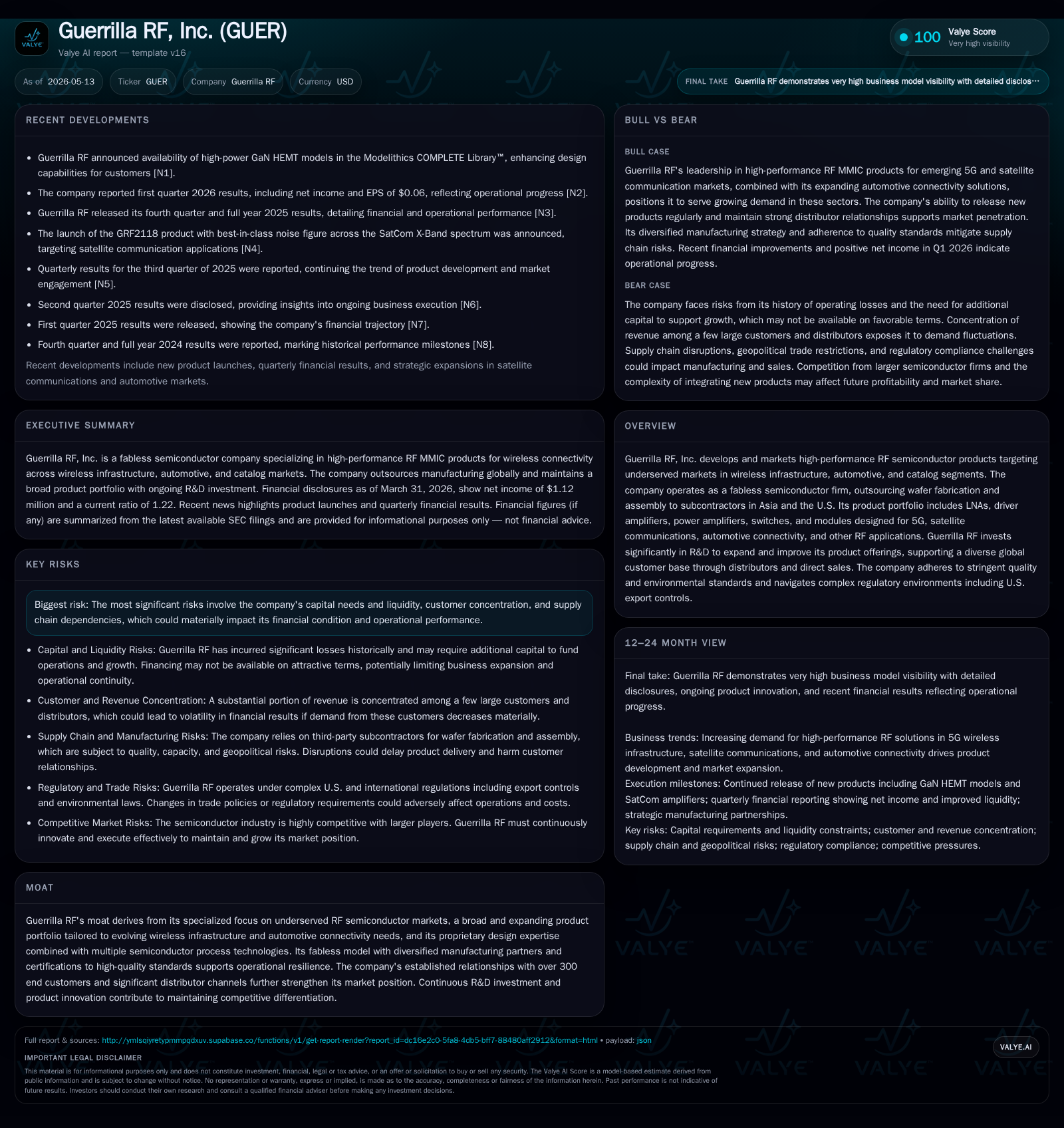
Guerrilla RF's May 2026 quarterly filing reflects continued focus on high-performance RF semiconductors catering to underserved markets, notably 5G infrastructure and automotive segments. Operating as a fabless semiconductor firm, they maintain resilience through diversified manufacturing partnerships while investing heavily in R&D to fuel new product development. Despite customer concentration and supply chain risks, Guerrilla RF fortifies its competitive moat with proprietary designs spanning multiple semiconductor technologies and broad market penetration via distributors. Key growth drivers include 5G deployment, rising automotive RF content from EV and autonomous vehicle trends, and the expansion of their catalog offerings.
Recent Operating Update
The latest quarterly filing from May 13, 2026 [S2] underscores Guerrilla RF’s continued commitment to innovation and market expansion as it closes Q1 FY2026. The company released its first-quarter results on May 6 [S3][N1], reiterating its fabless semiconductor business model that is anchored on high-performance MMIC (Monolithic Microwave Integrated Circuit) products suited for underserved market niches. Notably, the company expanded its product catalog to 183 distinct offerings by the end of 2025 through the release of more than 20 new products focused on wireless infrastructure and automotive applications [S1][S9]. These developments are pivotal given ongoing multi-year upgrade cycles driven by global demand for reliable connectivity.
While not disclosing explicit revenue figures for Q1 within these filings or releases, Guerrilla RF stresses a business trajectory rooted in accelerating design wins for its RF components used in 5G sub-7 GHz networks and emerging mid-band applications. The firm also highlighted recent inclusion of high-power GaN HEMT models into the Modelithics COMPLETE Library™ as of May 13th [N2], reflecting proactive outreach to engineering ecosystems critical for design adoption.
Business Model
Guerrilla RF operates as a fabless semiconductor company headquartered in Greensboro, North Carolina [S1]. Its revenue model is primarily driven by licensing its proprietary designs which are then manufactured—and later assembled and tested—via outsourced foundry partners mainly located across Taiwan, Singapore, Malaysia, and select U.S.-based fabs [S1][S24]. This approach allows Guerrilla RF to avoid capital-intensive fabrication facilities while focusing heavily on R&D (which cost $8.6 million in FY2025) centered around developing ultra-low noise amplifiers (Ultra-LNAs), power amplifiers (PAs), switches, mixers, digital step attenuators, and related modules tailored for modern wireless communication needs [S1][S20].
Revenue is chiefly generated through sales via both direct customer relationships and an extensive network of distributors accounting for about 93% of total revenues in 2025 [S19]. Among distribution routes, one dominant distributor channels approximately two-thirds of the company’s shipments [S23]. The end customers span over 300 entities worldwide including major players in the automotive and wireless infrastructure industries known for stringent volume schedules and performance requirements [S4][S26].
The company's product portfolio targets communication frequencies across low-, mid-, and high-band spectrums especially relevant to multi-frequency 5G deployment strategies involving massive MIMO antenna arrays. Complementing this wireless infrastructure focus is significant content aimed at automotive connectivity—EVs and autonomous vehicle technologies drive demand for increasingly sophisticated RF front-end components embedded within vehicles' communication systems [S1][S24].
Industry Structure and Competitive Position
Operating within a highly cyclical semiconductor sector fraught with supply constraints and volatile demand patterns [S10], Guerrilla RF differentiates itself by focusing on underserved niche markets where performance demands surpass mainstream commodity levels. The company’s use of multiple semiconductor process technologies—GaAs (Gallium Arsenide), GaN (Gallium Nitride), and SOI CMOS—enables versatile product solutions addressing diverse integration needs from discrete amplifiers to integrated modules [S20]. This versatility combined with accelerated R&D secures design wins vital for market traction.
The firm faces significant competition from larger incumbent players possessing broader scale; however, its moat derives from agility in tailoring high-performing MMICs aligned with specific customer applications often overlooked by bigger competitors focused on mass markets. Relationships with a diverse network of distributors amplify Guerrilla’s market reach while spreading risk; still the concentration among top customers—top three yield up to ~36%-43% revenue share—poses notable dependency challenges [S23][S26].
Importantly, Guerrilla RF maintains ISO9001-compliant manufacturing partners ensuring quality standards crucial to automotive-grade reliability—a nontrivial barrier given the exacting demands of that sector [S4]. Moreover, geopolitical tensions necessitate careful navigation of export controls especially under evolving U.S.-China trade dynamics potentially affecting component sourcing or market access [S1][S25].
Growth Drivers
Guerrilla RF’s future growth trajectory is supported by several structural industry trends:
- 5G Technology Migration: Multi-band spectrum deployments (low-, mid-, high-band) continue globally as cellular operators seek improved data throughput and reduced latency supporting massive IoT ecosystems. The co-existence with legacy cellular standards further enlarges addressable content per infrastructure node using Guerrilla's extensive portfolio [S1][S24].
- Automotive Connectivity Expansion: Uptakes in electric vehicles with enhanced infotainment systems plus driver assistance features create demand for ruggedized, reliable RF components. Autonomous vehicle developments amplify this trend requiring robust communication integrity at scalable volumes [S1][S24].
- Catalog Market Diversification: RF semiconductors deployed in RFID systems, IoT devices, satellite communications (SatCom), GPS modules expand Guerrilla’s sales avenues beyond primary infrastructure/automotive verticals sustaining revenue streams amid cyclical variations.
- Product Innovation & Design Wins: Continuous release of differentiated products leveraging GaAs/GaN/SOI technologies enhances Guerrilla’s pipeline enabling capture of new customer slots essential for recurring revenue generation [S20].[N2]
- Distributor Channel Leverage: Deepened partnerships with key distributors enable faster fulfillment cycles internationally boosting penetration particularly among industrial clients dependent on rapid prototyping [S19].
Risks / Watchpoints / Growth Constraints
Despite positive vectors, Guerrilla RF faces material risks:
- Customer Concentration: Dependence on a limited set of large customers (~50% revenue from top five end users in FY2025) increases vulnerability should any contract losses or volume reductions occur unexpectedly [S23][S26].
- Supply Chain Dependencies: Outsourcing manufacturing brings exposure to third-party constraints including possible control issues over yields/quality delays impacting deliveries; recent semiconductor supply tightness exemplifies this challenge [S4].
- Capital Intensity & Liquidity: Persistent operating losses (~$4.7M operating loss FY2025) necessitate capital raises or cash flow improvements; financing restrictions tied to preferred stock covenants constrain flexibility around debt issuance or equity dilution terms [S21].
- Regulatory Complexity: Export/import controls alongside trade tariff volatility can disrupt global sourcing/manufacturing processes or restrict access to critical raw materials or markets given escalating geopolitical frictions [S25][S10].
- Competitive Dynamics: Larger rivals may leverage scale or customer lock-in strategies making design wins more difficult while innovations by others could render some GUER products less competitive.
- Internal Controls & Execution Risks: Past remediation efforts indicate vigilance required over financial reporting accuracy; operational execution missteps could affect reputation particularly given quality expectations in automotive markets [S1].
What to Watch Next
Critical upcoming markers include:
- Quarterly performance updates focusing on revenue growth trends linked explicitly to new design wins announced or reported.
- Progress in expanding GaN HEMT-based product uptake evidenced through industry collaborations or distributor stocking arrangements (noted May model library addition) [N2].
- Supply chain stability reports—especially wafer fabrication yields or lead-time improvements—as these will underpin order fulfillment capability.
- Capital structure changes or financing announcements especially if addressing liquidity constraints highlighted by current loss profile.
- Any shifts in regulatory environments or export licensing that could materially impact international sales channels.
- End-market technology adoption rates particularly within wireless infrastructure transition milestones (e.g., major carrier rollouts targeting new frequency bands).
Financial Profile Snapshot
Latest financial snapshot
| Metric | Value | Period |
|---|---|---|
| Current assets | $10mm | |
| 2026-03-31 | ||
| Current liabilities | $8mm | |
| 2026-03-31 | ||
| Current ratio | 1.22x | |
| 2026-03-31 |
Source: SEC companyfacts cache [F1].
The firm maintains a current ratio above unity indicating adequate short-term liquidity though absolute cash reserves are minimal as per last available figure from early 2021. Total debt approximating $1.88 million suggests moderate leverage which is mitigated somewhat by working capital excesses but constrained by covenant restrictions tied to preferred equity holders requiring prior consent for additional indebtedness beyond $10 million threshold [F1][S21]. The negative net income reflects ongoing investments into product development consistent with a growth-phase fabless semiconductor profile.
This analysis synthesizes publicly filed disclosures up through May 13, 2026 without extrapolation beyond documented financial or operational evidence. No forward-looking investment recommendations are provided herein.
Disclaimer: This is research-only, informational analysis and not investment advice. It may include AI-generated interpretation and general industry context. Always verify important details using primary sources.

Comments