
Rocket Companies Boosts Q1 2026 Revenue with Acquisitions and AI-Driven Mortgage Platform Scale
Rocket Companies' latest quarter shows significant revenue growth fueled by higher mortgage origination volumes and strategic acquisitions, highlighting its leadership in a complex homeownership ecosystem.
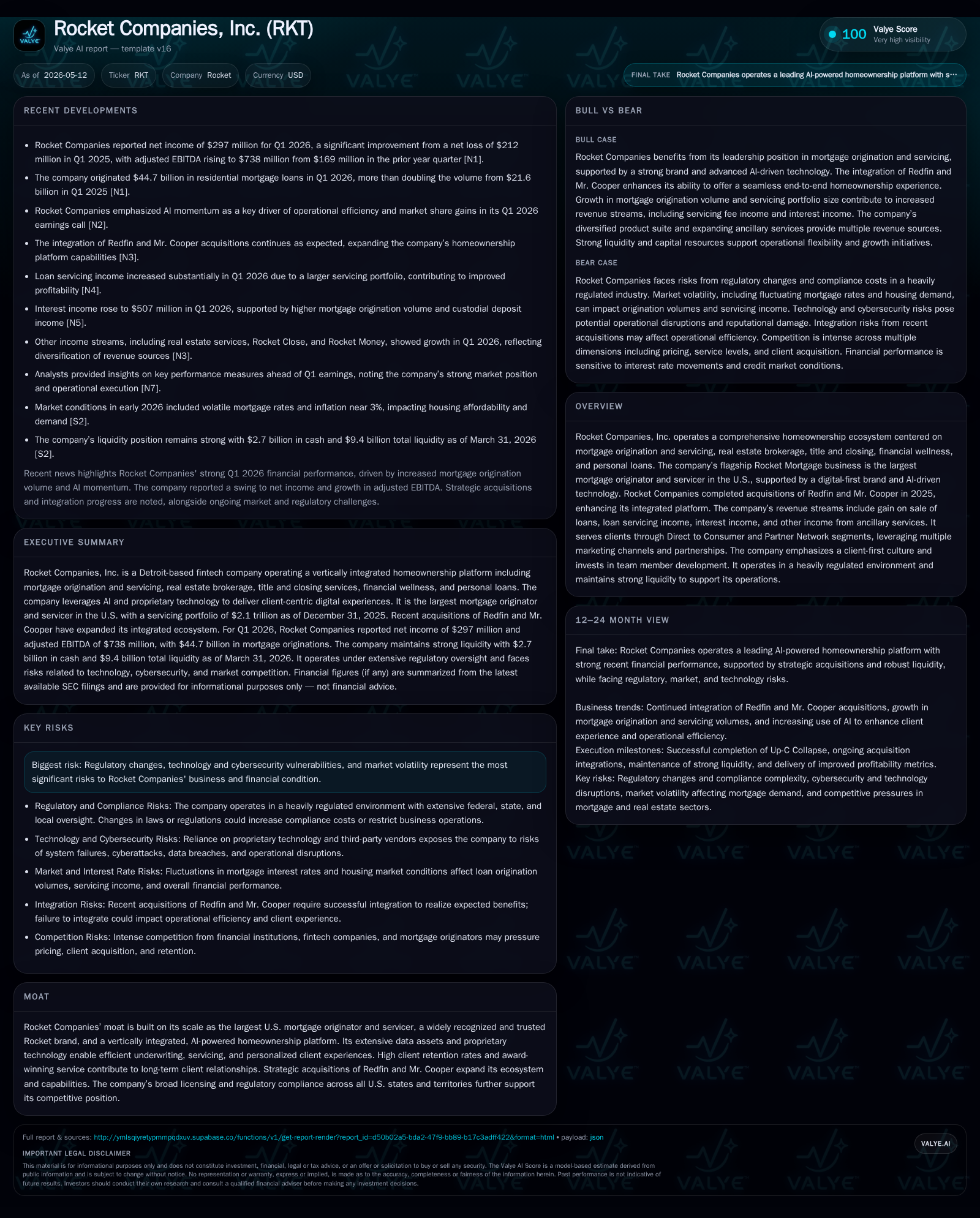
Rocket Companies reported a robust first quarter of 2026 driven by increased mortgage origination volume and integration of recent acquisitions Redfin and Mr. Cooper. The company’s vertically integrated, AI-powered homeownership platform leverages scale as the largest U.S. mortgage originator and servicer to maintain competitive advantage. Growth is supported by diversified revenue streams spanning loan sales, servicing, interest income, and ancillary real estate services. Regulatory compliance and refinancing risks remain key watchpoints as the company navigates volatile interest rates and market dynamics.
Recent Operating Update
Rocket Companies’ first quarter 2026 results reveal a pronounced step-up in business activity anchored by surging mortgage origination volumes and successful integration of large strategic acquisitions completed in 2025. The Company’s Partner Network segment nearly doubled its Adjusted revenue to $300 million compared to $143 million in the year-ago period, driven primarily by a significant increase in gain on sale of loans ($187 million vs. $96 million) and interest income ($104 million vs. $42 million), reflecting elevated loan production volume [S2]. Across all channels, Rocket originated $44.7 billion in residential mortgages in Q1 — more than doubling compared with prior-year levels — marking notable growth momentum amid a volatile macroeconomic backdrop that included fluctuating mortgage rates averaging around 6% [S11].
Rocket held cash and equivalents of approximately $2.7 billion as of March quarter-end, supporting its capital-intensive model that requires significant working capital to fund loan originations prior to sale into the secondary market [S2], [F1]. Acquisition-related cash inflows from Redfin and Mr. Cooper continue to enhance the balance sheet alongside improved adjusted EBITDA generation.
Business Model Overview
Rocket Companies operates a comprehensive homeownership platform encompassing mortgage origination and servicing (Rocket Mortgage), real estate brokerage (Redfin), title/closing services (Rocket Close), financial wellness tools (Rocket Money), and personal loans. Its core revenue streams are:
- Gain on Sale of Loans: Earnings upon selling originated loans into secondary markets.
- Loan Servicing Income: Recurring fees earned over the life of serviced mortgages.
- Interest Income: Net spread earned by funding loans pending sale.
- Other Income: Ancillary fees from real estate services including title insurance, closing services, brokerage commissions via Redfin, and financial wellness offerings.
This vertically integrated model enables cross-selling across product lines while Rocket’s digital-first brand combined with AI-based underwriting technology lowers processing costs and time-to-close relative to traditional lenders [S19], [S1]. The firm's origination process harnesses automation for rapid document retrieval and underwriting decisions—improving conversion rates and customer satisfaction measured by a high Net Promoter Score (~70 for origination) [S1].
Mortgage servicing represents a durable cash flow base given contractual payments on a portfolio exceeding $2 trillion unpaid principal balance as of end-2025; maintaining a stellar annual net client retention rate near 97%, substantially above industry peers [S1].
Industry Structure & Competitive Position
Rocket Companies holds dominant scale as the largest U.S. mortgage originator by unit volume and largest servicer nationally. This scale underpins its competitive moat by enabling investment in proprietary AI models that optimize risk assessment, tailor pricing dynamically, streamline closing workflows, and enhance post-origination client engagement through digital servicing portals.
Its broad licensing enables operation across all states complying with extensive regulatory regimes including CFPB oversight—a non-trivial barrier for many competitors lacking Rocket’s infrastructure or capital base [S15]. The acquisitions of Redfin diversified entry points into homebuyers’ journeys while Mr. Cooper acquisition added servicing scale that expands fee revenue opportunities.
Competitive pressures arise from both fintech entrants focused solely on online experience improvements as well as legacy banks with deep balance sheets; however Rocket’s blend of technology-led efficiencies coupled with comprehensive service remains differentiated versus either siloed brokers or incumbent lenders lacking seamless digital ecosystems.
Growth Drivers
AI-Powered Client Acquisition & Servicing Efficiency
By embedding artificial intelligence throughout the mortgage lifecycle—from application intake through risk underwriting to servicing—Rocket enhances throughput capacity while maintaining tight control over default risk profiles. AI-driven personalization also boosts client engagement leading to higher retention supporting sustainable lifetime value growth.
Ecosystem Expansion Through Strategic Acquisitions
Incorporating Redfin adds an upstream customer acquisition channel via real estate listings and brokerage services unlocking cross-sale synergies within home financing solutions. The Mr. Cooper addition bolsters service scale generating recurring servicing fees aligned with Rocket’s core competency.
Market Uptake & Product Diversification
Beyond mortgages—offering personal loans via Rocket Money along with financial wellness platforms introduces new revenue levers mitigating concentration risk tied solely to interest rate cycles or housing market softness. Title insurance & closing fees further contribute ancillary revenues tied closely to transaction volumes.
Regulatory Compliance Excellence
Robust compliance programs across jurisdictions fortify operational continuity amidst intensifying regulatory scrutiny especially from CFPB enforcement which impacts lending practices broadly.
Risks & Watchpoints
Regulatory & Compliance Exposure
Heightened CFPB enforcement actions elevate compliance costs materially; non-compliance risks carry financial penalties plus reputational harm potentially detrimental in this trust-sensitive industry segment [S15].
Interest Rate Volatility & Housing Market Sensitivity
Mortgage demand is highly cyclical influenced by prevailing rates impacting affordability; spikes can suppress purchase volumes compressing gain margins while accelerating prepayments could reduce servicing duration downwards impacting fee income stability.
Funding & Liquidity Constraints
Dependence on secured repurchase agreements backed by loan collateral creates refinancing risk if counterparties tighten advance rates or curtail facility availability particularly if collateral values deteriorate during downturns [S9], [S21].
Integration Execution Risk from Acquisitions
Successful melding of Redfin’s brokerage business model with Rocket’s tech-enabled mortgage platform along with folding Mr. Cooper’s servicing operations represents ongoing operational challenges requiring cultural alignment without service disruptions.
What To Watch Next
- Progress metrics on integration timelines for Redfin & Mr. Cooper indicating realization of expected synergies.
- Trends in mortgage origination volumes especially amid fluctuating rates signaling demand strength or softness.
- MSR portfolio growth or attrition impacting recurring servicing revenues.
- Regulatory developments including CFPB rulemaking or enforcement trends affecting operational costs or product offerings.
- Updates on AI deployment effectiveness in increasing pipeline conversion rates or lowering operating expenses.
- Quarterly guidance updates for adjusted EBITDA margins reflecting scale benefits offsetting cost inflation pressures.
Financial Profile Brief Summary
Latest financial snapshot
| Metric | Value | Period |
|---|---|---|
| Cash & equivalents | $2.7bn | |
| 2026-03-31 | ||
| Total debt | $10.4bn | |
| 2026-03-31 | ||
| Net debt | $7.7bn | |
| 2026-03-31 |
Source: SEC companyfacts cache [F1].
As of March 31, 2026, Rocket maintained $2.7 billion in cash & equivalents [F1]. Total debt stood at approximately $10.4 billion resulting in net debt around $7.7 billion consistent with business scale after acquisitions [F1]. The company swung to net income of $297 million in Q1 from a prior-year loss impacted partly by higher production volumes driving improved contribution margins despite rising variable compensation costs aligned with growth [S11].
This analysis draws exclusively on publicly available SEC filings and corroborated news sources up to May 12, 2026. It aims to provide an informed business overview without any forward-looking investment recommendations.
Disclaimer: This is research-only, informational analysis and not investment advice. It may include AI-generated interpretation and general industry context. Always verify important details using primary sources.

Comments