
Ducommun Inc. Boosts Q1 Profit on Restructuring and Aerospace Demand Resilience
First quarter 2026 profit uplift signals operational progress despite aerospace market cyclicality.
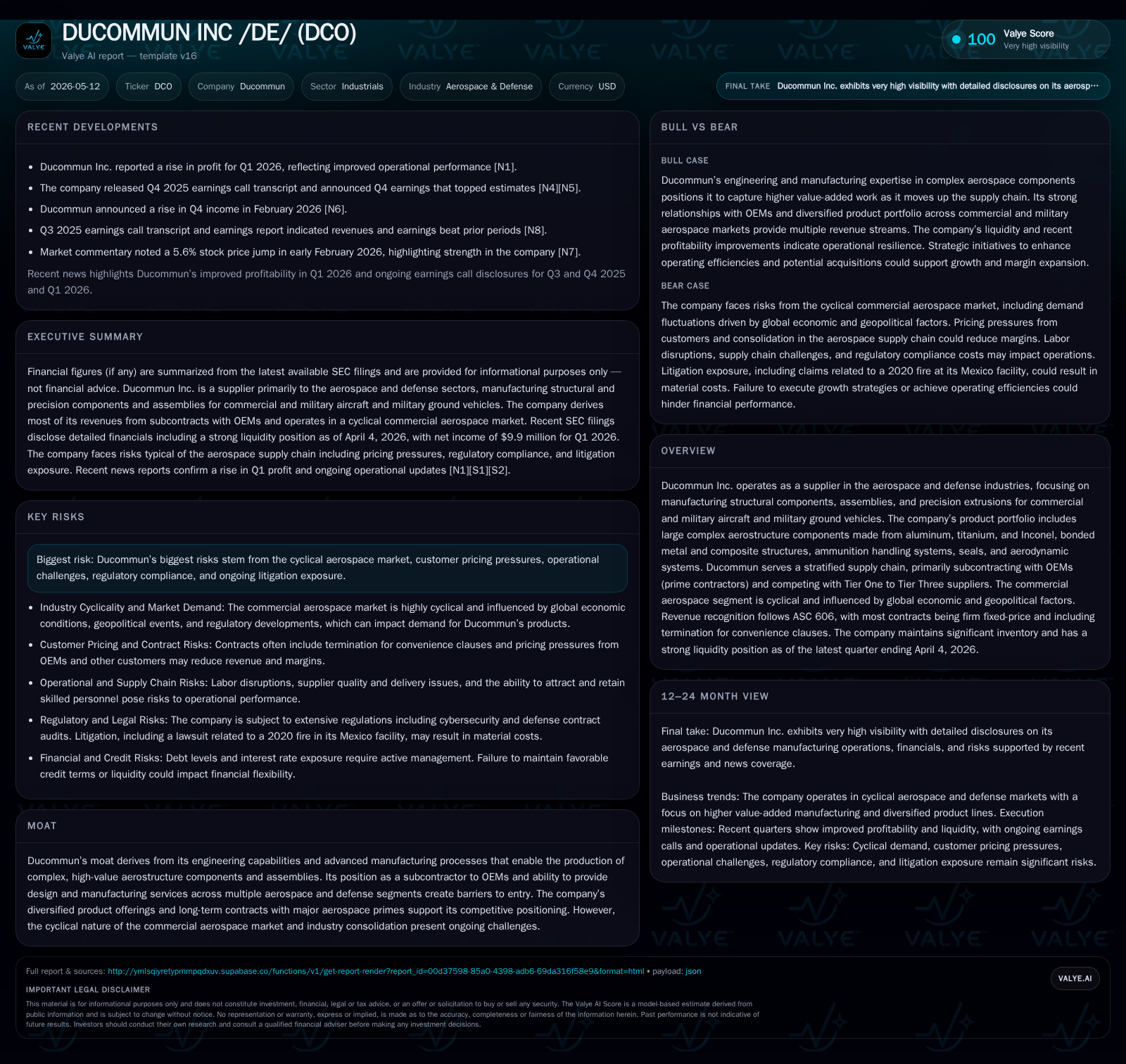
Ducommun Inc. reported a significant increase in net income for Q1 2026, driven largely by restructuring benefits and steady aerospace demand, according to the company’s latest 10-Q filed May 12, 2026 [S2]. The firm continues to focus on its core aerospace and defense manufacturing segments, leveraging advanced engineering capabilities to serve OEMs with precision structural components. While the commercial aerospace segment remains cyclical and sensitive to geopolitical factors, Ducommun’s diversified product portfolio and defense contracts provide some revenue stability. Key risks include debt leverage, pricing pressures, and operational challenges, but the company maintains ample liquidity and a strong current ratio supporting near-term flexibility.
Recent Operating Update
Ducommun Incorporated released its Q1 fiscal 2026 results on May 12, 2026 ([S2]). The company reported net income of $9.9 million for the quarter ended April 4, 2026, up significantly from $1.4 million in the equivalent prior-year period. This leap reflects operational stabilization following headwinds associated with restructuring actions initiated in prior years. Restructuring-related charges are declining after accumulating over $31 million through December 2025, indicating that major cost savings programs are materially impacting the profitability profile.
Simultaneously, Ducommun disclosed ongoing evaluation of new accounting guidance that will take effect fiscal year 2027 (ASU 2025-06 related to internal-use software capitalization), signaling an adherence to evolving financial reporting frameworks that may slightly affect expense recognition patterns going forward ([S2]).
Liquidity remains robust entering mid-2026: cash on hand stood at roughly $39 million against total debt near $304 million ([F1],[S2]).
An event filing on May 12 confirmed no significant changes in corporate structure or material adverse developments beyond routine quarterly disclosures ([S3]).
Business Model Overview
Ducommun Inc operates as a specialized manufacturer within aerospace and defense sectors focusing on structural components — the backbone elements of aircraft airframes and military ground vehicles. Its product suite encompasses large complex aerostructure assemblies fabricated predominantly from aluminum alloys, titanium, Inconel superalloys; bonded composites; precision extrusions; plus ammunition handling and sealing systems tailored for stringent military specifications ([S1]).
The company primarily acts as a subcontractor tier supplier within OEM supply chains where it delivers engineered manufacturing solutions under firm fixed-price contracts encompassing design assistance through delivery. Contracts frequently incorporate termination for convenience clauses imposing demand variability risk primarily on Ducommun ([S1],[S2]). Revenue is recognized principally over time per ASC 606 standards reflective of contract progression metrics.
Two segments dominate revenues: Structural Systems contribute from complex metal/composite airframe parts while Electronic Systems support avionics integration — although the latter shows lower restructuring charges indicating variability in contribution ([S2],[S1]). Industrial end markets constitute only a minor fraction (~4%) with management pursuing further divestitures to sharpen focus ([S1]). Sales depend heavily on airframe production schedules dictated by OEM build rates influenced by macroeconomic cycles.
Industry Structure and Competitive Position
The aerospace supply landscape features significant stratification: Ducommun operates as a trusted Tier One/Tier Two supplier providing critical assemblies downstream from prime contractors (OEMs). This hierarchy demands high engineering competence combined with precision manufacturing capabilities — constituting notable entry barriers.
Ducommun’s ability to handle exotic metals like titanium/Inconel combined with composite bonding expertise distinguishes it from many competitors focused solely on conventional aluminum parts or electronics alone ([S1]). Long-term relationships spanning decades underpin stability alongside long-dated contracts embedded in prime programs.
Nonetheless, consolidation among OEMs pressures supplier pricing power while elevating quality assurance burdens amid increasingly complex certification environments including DCAA oversight for defense programs ([S1],[S11]). Technology evolution requires ongoing investment in advanced automation and metrology.
Growth Drivers
Key growth engines rest upon multiple intertwined factors:
- Aerospace Production Recovery: Airline fleets are renewing post-pandemic demand disruptions; rising build rates by leading OEMs lift order books sequentially.
- Defense Spending Stability: Military fixed-wing/rotary-wing platforms maintain steady budgeted program flow providing counter-cyclic revenue buffer.
- Restructuring Benefits: Facility consolidations and workforce optimization yield operating expense reductions enhancing margins ([S2],[S7],[S25]).
- Product Mix Advancement: Moving up value chains into higher complexity aerostructures with integrated engineering design services garners enhanced margins.
- Selective Acquisitions: Management’s stated intent includes bolt-on acquisitions enhancing capacity/capability aligned with core aerospace/defense focus ([S21]).
KPIs such as backlog levels from major contracts, production schedule confirmations by customers like Boeing or Lockheed Martin primes, along with margin expansion metrics provide measurable indicators of trajectory.
Risks & Watchpoints
Despite improvements, Ducommun faces notable headwinds:
- Cyclical Commercial Aerospace Exposure: Dependency on airframe production is vulnerable to global economic shocks or geopolitical tensions disrupting supply/demand equilibrium.
- Pricing Pressure & Contract Terms: Fixed-price contracts combined with customers' termination flexibility limit upside pricing opportunities while transferring volume risks downstream ([S22]).
- Operational Challenges: Complex supply chain management amid raw material price inflation and quality/delivery mandates create execution risk.
- Regulatory & Litigation Exposure: Compliance frameworks span export controls particularly for Mexican operations; ongoing arbitration linked to a previous Guaymas performance center fire poses contingent liabilities ([S11],[S21]).
- Leverage Position: Net debt approximates $265 million against cash reserves near $39 million representing moderate leverage requiring careful servicing especially under possible interest rate volatility ([F1],[S2]).
Monitoring how these risks evolve relative to order inflows, contract renewals, working capital efficiency improvements and macro policy shifts will be critical.
What to Watch Next
Stakeholders should track several key developments:
- Quarterly backlog updates signaling stability or growth in aerospace/defense order visibility.
- Progression on remaining restructuring charge realizations and their tangible impact on margins.
- Adoption effects of ASU updates effective in fiscal year 2027 impacting internal-use software capitalization policies ([S2]).
- Developments around any resolution or escalation of legal claims tied to prior operational incidents especially Mexico facility arbitration cases ([S21]).
- Federal government defense budget decisions influencing new program awards or modifications.
- Management commentary regarding future acquisitions strategy or major capital investment plans.
Financial Profile Summary
Latest financial snapshot
| Metric | Value | Period |
|---|---|---|
| Cash & equivalents | $39mm | |
| 2026-04-04 | ||
| Total debt | $304mm | |
| 2026-04-04 | ||
| Net debt | $265mm | |
| 2026-04-04 | ||
| Current assets | $634mm | |
| 2026-04-04 | ||
| Current liabilities | $173mm | |
| 2026-04-04 |
Source: SEC companyfacts cache [F1].
As of April 4, 2026 ([F1],[S2]): The financial position supports ongoing organic investments while affording flexibility for bolt-on deals or opportunistic capital expenditures required for advanced manufacturing capability enhancements. Operating cash flows are benefiting from reduced restructuring outlays juxtaposed against steady revenue streams predominantly earned under fixed-price arrangements requiring vigilant cost controls for margin preservation.
This analysis synthesizes Ducommun’s recent operating disclosures grounded primarily in their May 12, 2026 quarterly filing supplemented by annual context disclosed earlier that month. The outlook combines structural growth trends tied closely to aerospace/defense cycles tempered by a strategic push toward operational streamlining amid evolving regulatory challenges.
Disclaimer: This report is for informational purposes only and does not constitute investment advice.
Disclaimer: This is research-only, informational analysis and not investment advice. It may include AI-generated interpretation and general industry context. Always verify important details using primary sources.

Comments