
AlTi Global Focuses Growth After International Real Estate Exit
AlTi Global’s latest quarterly filing confirms its strategic pivot to wealth and capital solutions, emphasizing alternative investments as the core future growth engine.
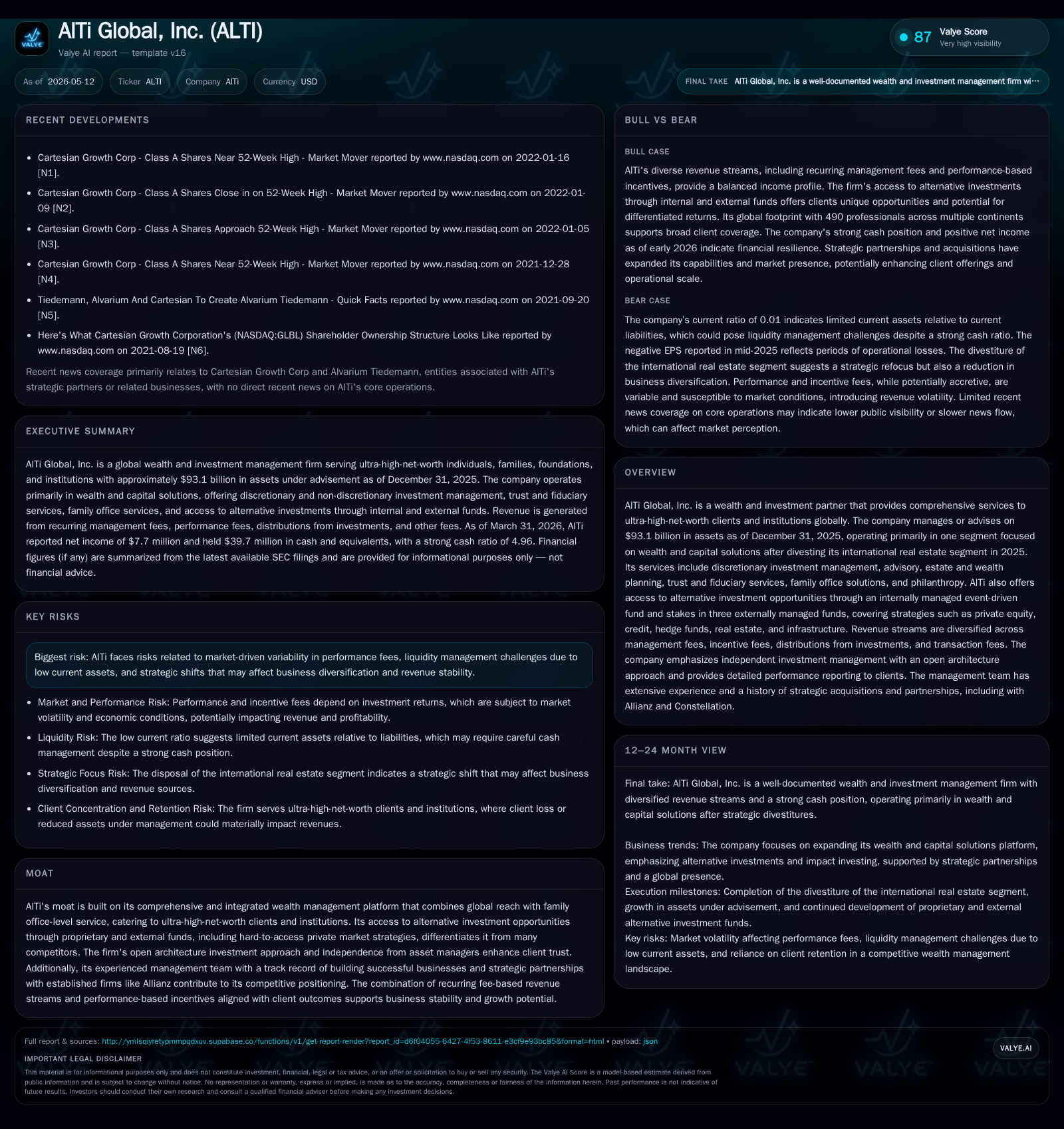
In its Q1 2026 10-Q, AlTi Global finalized the transition to a streamlined business model, completing its International Real Estate segment exit in Q3 2025 and now operating solely within Wealth & Capital Solutions with $93.1 billion assets under management. This consolidation sharpens strategic focus on ultra-high-net-worth clients through an integrated, multi-jurisdictional platform featuring discretionary management, advisory services, and differentiated access to alternative investments. The company’s competitive edge is bolstered by high client retention and proprietary as well as external alternative funds which provide recurring and performance-linked revenues. Financially, AlTi maintains a strong cash position despite recent operating losses linked to transformation costs, while liquidity constraints and performance fee volatility remain watchpoints. Upcoming milestones will center on alternative fund performance updates and execution on continued client engagement.
Recent Operating Update: Quarterly Filing Insights
AlTi Global's May 11, 2026 Form 10-Q reiterates the completion of its strategic divestiture of the International Real Estate segment in Q3 2025, consolidating operations into a single Wealth & Capital Solutions reportable segment [S2][S1]. This move aligns the firm squarely on its core competency: serving ultra-high-net-worth (UHNW) clients worldwide with integrated wealth management solutions. The firm reported no material changes in risk factors from its prior annual report [S2], signaling operational stability despite the organizational shift.
The latest event filings dated May 11 also confirm leadership continuity with Nancy Curtin appointed as Interim CEO—a key factor during this transitional phase maintaining confidence among clients and stakeholders alike [S3]. As of December 31, 2025, AlTi manages or advises approximately $93.1 billion in assets distributed across families, foundations, single-family offices, and institutional clients globally [S1], anchoring the significant scale underpinning its service platform.
Business Model and Service Offering Breakdown
AlTi operates an integrated wealth management model designed distinctly for UHNW clientele who require complex cross-border wealth planning coupled with direct investment access not easily replicable by standard private banks or wealth firms. Revenue primarily flows from management/advisory fees that constituted roughly 82% of total revenue in the year ended December 31, 2025—reflecting a stable recurring revenue base insulated from short-term market fluctuations [S1].
Complementing this steady fee income are incentive fees tied to performance within their Alternatives Platform—comprising one internally managed event-driven fund plus equity stakes in three external funds focusing on private equity, credit markets, hedge fund strategies, real estate investments, and infrastructure assets [S1]. This dual revenue stream mixes predictability with upside aligned to client outcomes.
The service spectrum extends beyond traditional asset management to include trust and fiduciary services, estate planning advisory, family office capabilities distributed across multiple jurisdictions (with nineteen offices spanning nine countries), philanthropy consulting, governance services, and education for multi-generational client stewardship [S1]. This breadth supports a high-touch approach akin to family office standards while leveraging scale efficiencies.
Competitive Landscape and Industry Positioning
AlTi occupies a distinct niche within global wealth management by combining broad geographic reach with boutique-level service tailored expressly for UHNW families requiring sophisticated estate planning and alternatives access across borders. Its collaboration with Allianz Group entities such as PIMCO injects strategic depth and broader asset management expertise without diluting independence—an important differentiation compared to conglomerate-owned competitors whose product biases can erode client trust [S1].
Furthermore, AlTi’s open architecture philosophy enables it to curate best-in-class external strategies alongside proprietary offerings without conflicts of interest typical in vertically integrated models. This approach reinforces stickiness via alignment of incentives while delivering differentiated performance opportunities hard to replicate by peers reliant solely on internal products.
Growth Drivers: Alternative Investments and Client Retention
The firm’s growth thesis centers on tapping increasing UHNW interest in alternatives investments driven by clients seeking diversification beyond public markets amidst persistent low yields and macro uncertainties. The internal event-driven fund paired with stakes across diversified external strategies—encompassing private equity buyouts to infrastructure assets—addresses this demand directly within a trusted ecosystem overseen by AlTi experts [S1].
Client retention rates exceeding 96% since at least 2021 underscore deeply embedded relationships that underpin highly predictable fee income streams through sticky AUM bases over long horizons—noteworthy given the multi-generational clientele served [S1].
Moreover, AlTi benefits structurally from secular trends towards globalization of wealth requiring cross-jurisdictional advisory capabilities; its presence in multiple financial hubs allows it to provide seamless advice addressing complex tax/estate issues across geographies—a critical value add beyond capital allocation alone.
Risk Factors and Growth Constraints
The key risks confronting AlTi hinge firstly on performance fee variability intrinsic to alternatives investing which can fluctuate materially based on market cycles or specific fund outcomes; though representing a minority portion compared to base fees, these impact earnings volatility [S1][S2].
Secondly, liquidity constraints represent a concern given current assets relative to liabilities revealed by companyfacts metrics showing a low current ratio around 0.01 due largely to minimal reported current assets (~$85k) against current liabilities exceeding $8 million as of end-2022; offset partially by $39.7 million cash equivalents held at March quarter-end providing operational runway but warranting careful working capital oversight [F1].
Execution risks also persist amid ongoing organizational shifts post international real estate exit including transitions in client servicing models or integration of new alternative strategies requiring sustained delivery quality.
On cybersecurity governance front, no new material developments emerged from recent filings though established board-level oversight remains indicative of robust risk management frameworks appropriate for a firm of this profile [S1][S2].
Key Milestones and What to Watch Next
Investors and observers should monitor upcoming quarterly disclosures for nuanced trends in management fee revenues reflecting AUM growth or attrition alongside incentive fee realizations revealing alternative fund performance trajectories—crucial KPIs linking client outcomes directly back to the firm's economics [S2][S3].
Operational metrics concerning geographic expansion initiatives or new service launches could provide signs of successful execution post-segment consolidation.
Further updates regarding liquidity improvement measures or refinancings would merit attention given constrained working capital buffers evident recently.
Finally, communication around leadership stability subsequent to Interim CEO appointment will influence market perceptions during this critical transformation phase.
Brief Financial Overview
At quarter-end March 31, 2026, AlTi maintained $39.7 million in cash and equivalents—a solid liquidity cushion supporting operations during the ongoing transition period despite reported net losses consolidated through December 31, 2025 (net loss: $119.7 million; operating loss: $73.9 million) reflecting investments into business restructuring and strategic repositioning efforts rather than underlying fundamental contraction [F1][S2].
Total debt last updated at end-2022 stood around $21.2 million with net debt approximately negative $18.5 million after accounting for cash reserves—suggesting manageable leverage albeit requiring monitoring given evolving operating cash flow dynamics [F1].
Disclaimer: This is research-only, informational analysis and not investment advice. It may include AI-generated interpretation and general industry context. Always verify important details using primary sources.

Comments