
Neonode Inc. Boosts Licensing Focus While Managing Customer Concentration Risks
Neonode's latest quarterly filing underscores its exclusive pivot to a licensing model amid concentrated customer dependencies shaping revenue dynamics.
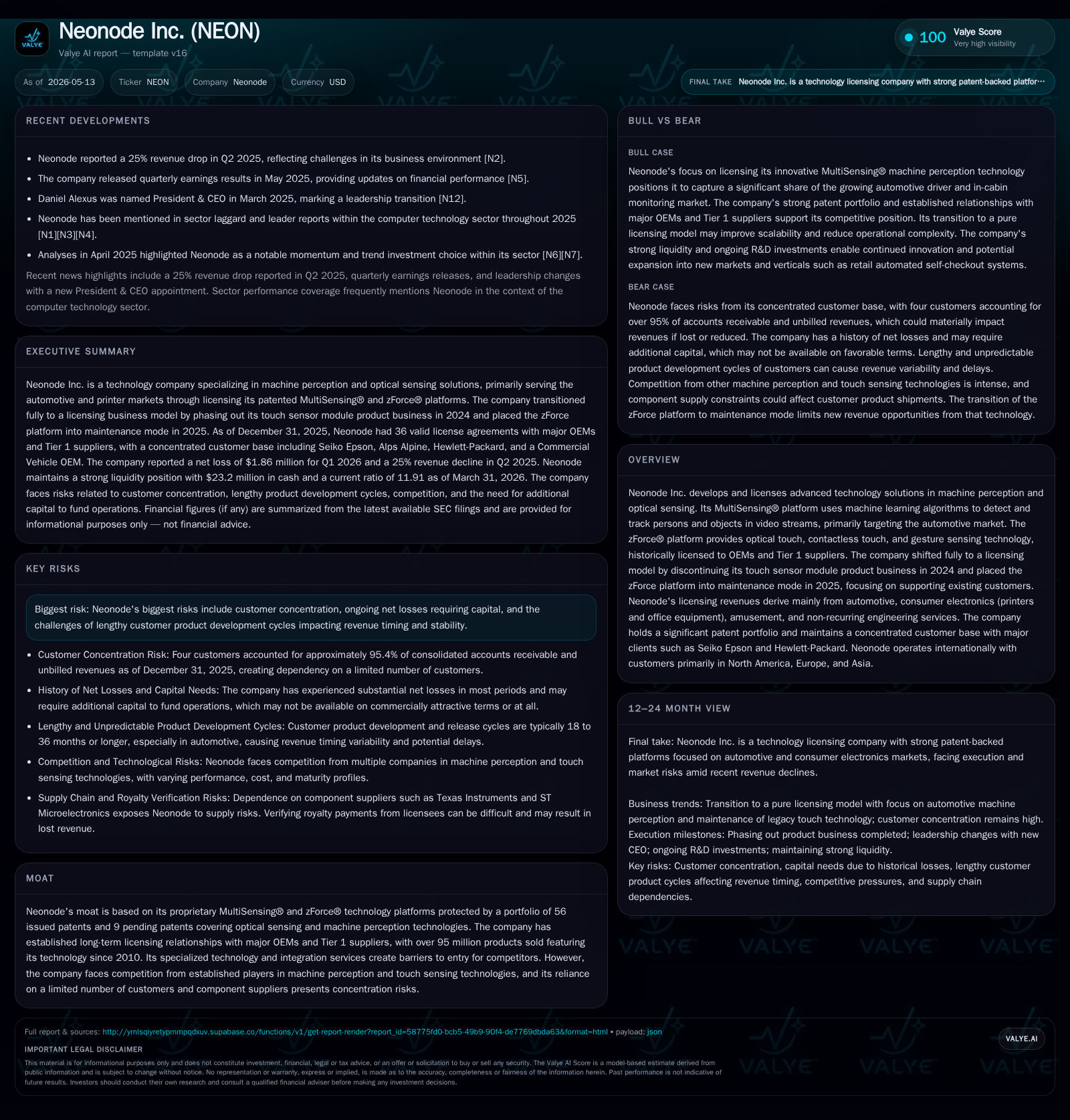
Neonode Inc.'s May 2026 10-Q reveals a decisive shift to focus solely on licensing its intellectual property platforms, having exited hardware product sales and moved legacy zForce technology into maintenance mode. The company's revenues depend heavily on nine licensing customers, primarily automotive and consumer electronics OEMs, with persistent risks arising from customer concentration and extended product development cycles. Neonode’s strong patent portfolio supports its competitive moat, yet near-term revenue visibility reflects structural timing delays. With adequate liquidity and minimal debt as of Q1 2026, the company is positioned to fund operations but faces challenges executing growth amid concentrated accounts.
Latest Operating Update Reflects Strategic Licensing Focus
Neonode Inc.'s most recent quarterly report filed on May 13, 2026 ([S2], [S3]) confirms its continued shift away from hardware product sales towards an exclusive focus on licensing intellectual property. Notably, the company formally placed its longstanding zForce® optical touch technology into maintenance mode starting September 2025, ceasing new customer sales but maintaining support for existing clients across sectors such as office equipment, automotive applications, industrial automation, and avionics ([S1]). This change follows the earlier discontinuation of the touch sensor module (TSM) product business in 2024, which now forms part of discontinued operations. Currently, Neonode states that nine active licensing customers ship products embedding either its MultiSensing® machine perception platform or legacy zForce® technology ([S1],[S2]).
This altered operating landscape affects Neonode's near-term revenue recognition profile—license fees are predominantly earned on a per unit basis when customers ship product incorporating Neonode's technology ([S1]). However, these shipments depend heavily on customers’ extended product development and manufacturing cycles, inherently adding timing uncertainty to revenue streams.
Business Model Centered on Proprietary Optical and Machine Perception Technologies
Historically rooted in proprietary optical sensing technologies and enhanced by recent machine perception capabilities leveraging advanced machine learning algorithms, Neonode generates revenue through licensing agreements primarily with OEMs and Tier 1 automotive suppliers ([S1],[S17]). The MultiSensing® platform focuses on video-based detection and tracking distinct from traditional touch input systems offered via zForce®. Since the company's pivot to licensing in December 2023 ([S1]), it has fully exited direct hardware manufacturing by divesting TSM-related activities in 2024.
License agreements typically stipulate per-unit fees tied to customer shipments—revenue mechanics therefore closely track product volume post-development. Alongside core licensing, Neonode offers specialized non-recurring engineering (NRE) services during integration phases—these optimize device performance but constitute a smaller portion of total revenue ([S21]).
The company’s patent portfolio encompassing 56 granted patents with nine pending applications covering both optical sensing and machine perception domains forms the foundation of pricing power and creates switching costs due to technical integration requirements ([S1]). These IP protections present barriers for competitors seeking commoditized substitution.
Competitive Position and Industry Structure in Optical Sensing and Automotive Markets
Within the broader optical sensing market segment—a space historically dominated by capacitive and resistive touch technologies—Neonode distinguishes itself by targeting niche applications requiring cost-effective contactless interaction or advanced driver/in-cabin monitoring for automotive clients ([S1]). Competition is especially intense in consumer electronics touch solutions where projective capacitive standards dominate smartphones/tablets; here Neonode’s zForce technology competed primarily on cost-effectiveness but eventually ceded new sales as the platform entered maintenance mode ([S1]).
Conversely, the MultiSensing® platform's application within automotive driver assistance systems occupies a higher barrier sector due to regulatory scrutiny, safety certification requirements, and complex integration within vehicle ecosystems ([S19]). This market provides less price-based competition relative to consumer segments.
The company maintains strong defensive positioning through its extensive patent protection portfolio. The continued agreement count (36 valid licenses as of end-2025) signifies entrenched relationships despite competitive pressures ([S21]). However, dependence on a handful of major customers significantly influences market risk profiles.
Growth Drivers: New Customers and MultiSensing Adoption Potential
Neonode anticipates incremental uptake of its MultiSensing® platform as several new customers approach final stages of product design validation ([S1]). Expansion beyond core automotive markets into adjacent verticals such as automated retail check-out systems has been earmarked as a potential growth avenue pending market pull assessment ([S14]).
License fees based on shipped units hinge upon successful customer commercialization. Non-recurring engineering engagements often presage volume license income by reinforcing early stage design wins ([S21]).
Quantitatively, nine customers actively shipping products embed Neonode’s technology today ([S21]), with additional pipeline clients under evaluation. This visibility is constrained by typical extended development-to-market timelines inherent in complex OEM contracts.
Risk Factors: Customer Concentration and Product Development Cycle Challenges
A principal concern underscored by Neonode’s filings is customer concentration risk—four customers accounted for approximately 95% of consolidated revenues in fiscal year 2025 ([S20],[S23]). Top contributors include Seiko Epson (34%), Alps Alpine (19%), Hewlett-Packard (19%), and a commercial vehicle OEM (15%) providing little diversification.
This concentration amplifies exposure to any one client’s procurement shifts or delays. Further compounded by protracted design cycles common in automotive infotainment or industrial sectors, they induce material timing variability impacting reported revenues from period-to-period ([S1],[S20]).
Financially, while a patent assignment gain in FY2025 provided episodic profit improvement, historic recurring net losses continue to strain internal capital sufficiency ([S1],[S25]). Though Neonode does not currently report material debt burdens or covenant concerns as of Q1 2026 (per balance sheet data), ongoing financing needs remain a strategic consideration.
What to Watch Next: Milestones and Revenue Timing Signals
Key near-term indicators for Neonode include monitoring quarterly shipment volumes reported by major licensees since these directly influence per-unit license fees realizations ([S2],[S3]). Progression or announcements regarding new license agreements or entry into emerging verticals like self-checkout automation could signal incremental top-line expansion ([S14],[S21]).
Additionally, industry trends around automotive driver assistance feature adoption rates will materially affect demand elasticity for MultiSensing-based in-cabin monitoring solutions ([S19]). Updates on any shifts toward diversified business models beyond unit-based fees may reveal evolving pricing strategies.
The success rate of converting developmental-stage clients into shipping customers remains integral to assessing future revenue robustness given engineered dependencies.[S2],[S3],[S1]
Financial Snapshot: Liquidity and Capital Structure Support for Execution
Latest financial snapshot
| Metric | Value | Period |
|---|---|---|
| Cash & equivalents | $23mm | |
| 2026-03-31 | ||
| Current assets | $24mm | |
| 2026-03-31 | ||
| Current liabilities | $2mm | |
| 2026-03-31 | ||
| Current ratio | 11.91x | |
| 2026-03-31 |
Source: SEC companyfacts cache [F1].
As of March 31, 2026, Neonode held $23.2 million in cash and equivalents against modest current liabilities totaling approximately $2 million—resulting in an exceptionally strong current ratio close to 12 reflecting solid short-term financial footing ([F1]). Total debt remains negligible relative to cash balances based on best available data ([F1]), implying minimal leverage or refinancing risks.
Disclaimer: This analysis is based solely on publicly available SEC filings as of May 13, 2026. It is intended for informational purposes only to provide insights into Neonode Inc.’s operational developments, business model dynamics, industry position, growth prospects, risks identified by management disclosures, and latest financial status without offering investment advice or recommendations.
Disclaimer: This is research-only, informational analysis and not investment advice. It may include AI-generated interpretation and general industry context. Always verify important details using primary sources.

Comments