
Curis Advances Emavusertib Amid Funding Challenges and Regulatory Risks
Curis focuses on progressing its IRAK4/FLT3 inhibitor through clinical development while managing cash runway and collaboration obligations.
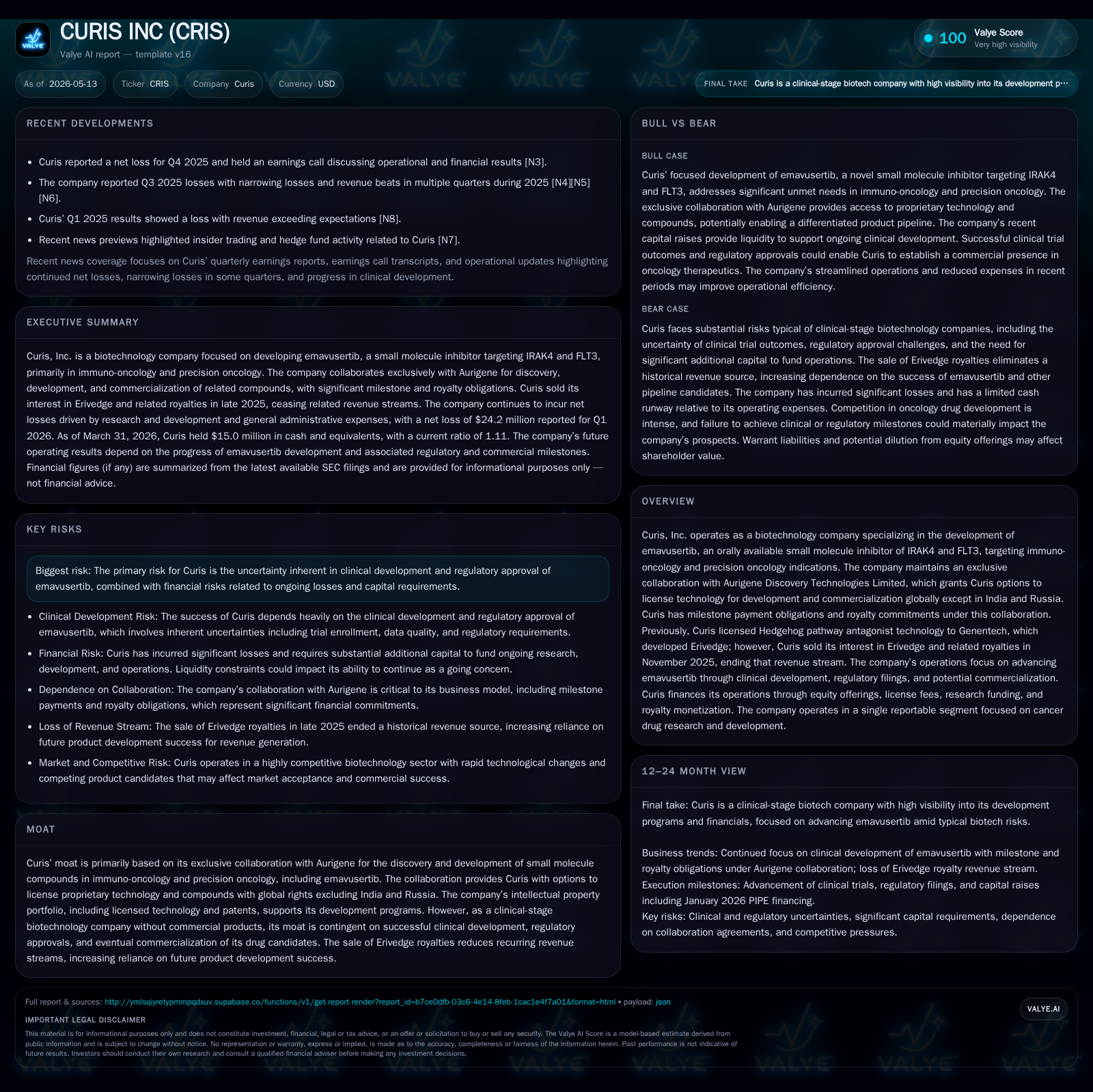
In its latest quarter ending March 31, 2026, Curis, Inc. continues its clinical-stage focus centered on emavusertib, an oral small molecule targeting IRAK4 and FLT3 in oncology. The company’s cash balance of $15 million supports operations for just under a year, highlighting pressing capital-raising needs given ongoing R&D expenses and milestone obligations tied to its Aurigene collaboration. Curis’ competitive position hinges on the exclusive licensing of promising immuno-oncology compounds but remains vulnerable to regulatory hurdles, reimbursement challenges, and the absence of commercial products following the recent sale of Erivedge royalty rights. Execution on late-stage trials and financial robustness will be critical to unlocking value and sustaining operations.
Recent Operating Update
Curis’ most recent quarterly report filed on May 13, 2026 [S2] confirms the company maintains a cash position of approximately $15 million as of March 31, 2026 [F1], with current assets near $16.6 million against liabilities of roughly $14.97 million yielding a current ratio of about 1.11 [F1]. This balance provides limited runway against ongoing research and administrative expenditures.
The company reiterated its exclusive focus on advancing emavusertib (CA-4948), a dual IRAK4/FLT3 inhibitor designed for oral administration targeting immune pathways relevant in oncology treatment contexts [S2]. Notably, the business operates a single segment focused entirely on oncology drug candidate research and development [S2].
A material backdrop to the quarter includes the termination of royalty streams from Erivedge vismodegib following the sale of Genentech license rights in November 2025 [S1]. This divestiture reduces non-dilutive revenue sources, increasing dependence on successful clinical progression of emavusertib and related compounds.
Business Model
As a clinical-stage biotechnology company lacking marketed products, Curis’ revenue generation currently relies primarily on collaborative licensing arrangements rather than product sales. The cornerstone of its pipeline is emavusertib—a small molecule inhibitor discovered under the exclusive collaboration with Aurigene Discovery Technologies Limited [S1].
The Aurigene agreement provides Curis options for exclusive global licenses (outside India and Russia) to develop proprietary immuno-oncology molecules including IRAK4-, PD1/TIM3-targeting agents [S1]. Curis assumes milestone payment obligations estimated at $42.5 million per program linked to regulatory approvals and commercial sales thresholds plus higher-tier royalties projected up to 10% on net sales [S1].
Revenue until recently included royalties from Erivedge licensed under Genentech agreements; however, the sale of these rights has ended this income source, shifting strategic emphasis fully onto internal pipeline maturation [S1]. The company's operating model thus prioritizes R&D expense investment aimed at advancing clinical trials toward regulatory milestones.
Industry Structure & Competitive Position
Curis operates within the highly specialized immuno-oncology drug development sub-sector where competition derives from established biotech firms with approved therapies as well as emerging companies pursuing novel targets like IRAK4 and FLT3. The focus on dual inhibition combined with oral availability gives emavusertib a potentially distinctive profile if ongoing clinical data support efficacy and safety.
The partnership model with Aurigene underscores a common industry approach where innovation stems from early-stage discovery collaborations with technology licensors enabling access to proprietary compounds. Yet this model also introduces dependencies regarding milestone payments impacting cash flow.
Regulatory governance acts as a bottleneck for new therapies especially given recent US Supreme Court rulings limiting deference traditionally afforded to FDA interpretations which may heighten uncertainty around approval timelines or requirements [S4]. Pricing pressure through governmental control remains another structural constraint particularly outside North America where reimbursement negotiations can delay or restrict market entry [S6].
Growth Drivers
Growth prospects for Curis are structurally tied to:
- Clinical Development Progress: Successful interim trial results for emavusertib can validate its mechanism targeting IRAK4/FLT3 pathways critical in certain cancer subtypes. Positive data are prerequisites for filing New Drug Applications (NDAs).
- Regulatory Milestones: Achieving pivotal trial endpoints enabling FDA submissions followed by potential accelerated approvals based on breakthrough therapy designations or surrogate endpoints remains key.
- Licensing & Partnerships: New sublicense agreements or collaborations could provide capital infusions through upfront fees or shared development costs while expanding distribution reach beyond Curis’ capabilities.
- Market Access Strategy: Negotiating favorable reimbursement frameworks internationally post-approval will influence commercial viability amid cost-effectiveness pressures.
Customer demand drivers are inherently linked to unmet clinical needs in resistant or refractory cancers where current therapies falter—conditions targeted by immuno-oncology innovations.
Risks / Constraints
Principal risks include:
- Financial Sustainability: Recurring net losses alongside sizable future milestone payments ($42.5M+ per program) create urgent capital demands. Existing cash offers less than a year’s operational buffer without additional funding secured [F1],[S2].
- Clinical & Regulatory Risk: Failure to demonstrate sufficient safety/efficacy endpoints or regulatory non-approval would materially impair prospects.
- Competitive Pressure: Rapid advancements by competitors with alternative immune checkpoint inhibitors or kinase inhibitors could erode target market share.
- Regulatory & Compliance Environment: Enhanced FDA scrutiny and legal shifts constraining agency enforcement may delay approval timelines; privacy law tightening elevates compliance complexity [S7],[S9],[S21].
- Commercialization Challenges: Post-approval pricing pressures driven by government mandates globally may limit margins and uptake.
- Dependence on Aurigene Collaboration: Licensing terms impose royalty burdens; failure of licensed programs could further deplete resources.
What to Watch Next
Key forthcoming indicators include:
- Updates from ongoing Phase II/III trials evaluating emavusertib efficacy endpoints in various oncology indications.
- Regulatory communications regarding Investigational New Drug (IND) submissions or NDA filings impacting time-to-market assumptions.
- Potential announcements regarding new licensing deals or partnerships aimed at commercialization support or financing enhancements.
- Capital raise developments necessary to fund anticipated R&D expenditures beyond current cash runway illustrated in Q1 filings.
- Shifts in competitive landscape including competitor drug approvals influencing market positioning.
Financial Profile Overview
Latest financial snapshot
| Metric | Value | Period |
|---|---|---|
| Cash & equivalents | $15mm | |
| 2026-03-31 | ||
| Current assets | $17mm | |
| 2026-03-31 | ||
| Current liabilities | $15mm | |
| 2026-03-31 | ||
| Current ratio | 1.11x | |
| 2026-03-31 |
Source: SEC companyfacts cache [F1].
While financials are not the primary driver at this clinical phase, they crystallize operational constraints:
| Metric | Value | Period Ending |
|---|---|---|
| Cash & Equivalents | $15,001,000 | |
| 2026-03-31 | ||
| Current Assets | $16,611,000 | |
| 2026-03-31 | ||
| Current Liabilities | $14,974,000 | |
| 2026-03-31 | ||
| Current Ratio | 1.11 | |
| 2026-03-31 |
Curis faces a net debt position considering longer-term liabilities exceeding cash by approximately $13.7 million based on extrapolated data points [F1],[S2]. The company recognizes substantial doubt about its ability to continue as a going concern absent successful financing events [S1].
Operating losses remain burdensome reflecting continued heavy investment in trial activities without offsetting product revenues [F1]. Cash burn rate suggests limited runway extending less than one year from report date if no alternative funding sources materialize imminently.
This analysis synthesizes public SEC filings as of May 13, 2026 ([S1]-[S27]) together with company fact metrics ([F1]) to provide an informed perspective without investment guidance. Readers should consider clinical trial developments and financing announcements as pivotal short-term catalysts.
Disclaimer: This is research-only, informational analysis and not investment advice. It may include AI-generated interpretation and general industry context. Always verify important details using primary sources.

Comments