
USBC Advances Tokenized Deposits and Digital Asset Strategy Amid Rising Development Costs and Funding Needs
The latest quarter marks a pivotal stage in USBC’s transformation towards blockchain-based financial services as it scales tokenized deposit development while managing intensified SG&A expenses and liquidity constraints.
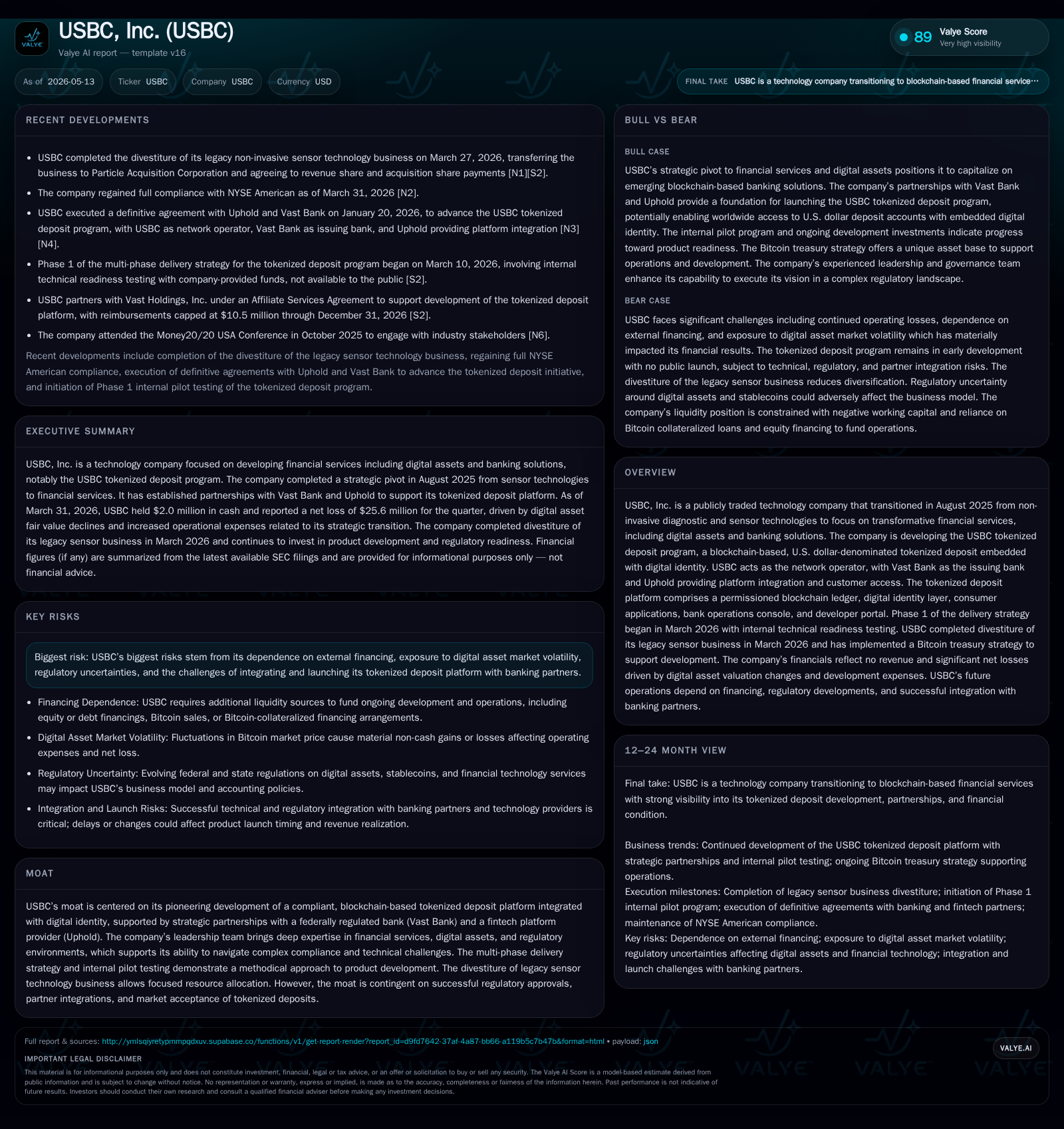
USBC, Inc. has transitioned from sensor technology to pioneering blockchain-enabled financial services, focusing on its US dollar denominated tokenized deposit platform integrated with digital identity. During Q1 2026, the company initiated Phase 1 internal pilot testing of its tokenized deposit offering while completing divestiture of legacy business assets, marking a clear strategic pivot. However, substantial development-related operating expenses and non-cash losses linked to Bitcoin asset valuation have expanded net losses significantly. USBC’s strategic partnerships with Vast Bank and Uphold are central to its value proposition, but execution risks loom amid regulatory uncertainty and tight liquidity, with the company relying on recent equity raises and Bitcoin-collateralized loans for near-term funding.
Recent Operating Update: Q1 2026 Highlights
USBC's Q1 2026 filing reveals a company at the nexus of a strategic evolution with evident shifts in operational focus and financial posture [S2]. The quarter was dominated by intensified investments into the US dollar-denominated tokenized deposit program—an ambitious blockchain-based financial product embedding digital identity features. Operational expenditures surged sharply; Selling, General & Administrative (SG&A) expenses escalated to over $11.4 million from under $1.8 million year-over-year. This jump stems from increased stock-based compensation ($3.3 million), operational expenses tied directly to tokenized deposit development ($4.7 million), and expanded professional fees related to ongoing public company compliance and advisory work ($1.7 million) [S2].
Supporting this fintech push is USBC's digital asset treasury strategy anchored by Bitcoin holdings used both as strategic reserves and potential liquidity sources. However, volatile fair value adjustments exacerbated losses: a $20 million mark-to-market decline contributed heavily to total other expenses net rising from roughly $1.4 million prior year to $20.6 million [S13][S14].
Moreover, March concluded with the divestiture of USBC’s legacy non-invasive sensor technology business—reflecting a clean break from previous industrial roots toward pure-play financial technology ventures [N1][S21]. This divestiture simplifies operations and reallocates capital exclusively toward scaling its core blockchain-enabled banking solutions.
Business Model: Blockchain Financial Services Platform
USBC generates future revenue primarily through financial-technology network services centered on its innovative tokenized deposit offering—a U.S.-dollar denominated account represented by blockchain tokens integrated with digital identity verification layers currently under phased rollout [S2][S19]. The company acts as the network operator overseeing platform governance but relies on Vast Bank as the issuing federally chartered bank for customer accounts and Uphold as the fintech integrator providing consumer access via mobile and web applications.
The product mix includes a permissioned blockchain ledger ensuring transaction integrity, identity management modules preventing fraud, consumer-facing wallets enabling payments and treasury conversions (including ACH funding), a bank operations console for backend management, plus an extensible developer portal fostering third-party innovation [S8][S19]. Revenue drivers will likely hinge on volume growth stimulated by end-user adoption (deposit account openings and transactional activity), pricing embedded in fees for access or platform services, as well as potential licensing models for developer integrations.
Margins here depend critically on scale due to technology infrastructure costs concentrated early while banking partnership arrangements potentially impose fee-sharing or cost obligations. Cash conversion could be impacted initially by upfront R&D investments exceeding near-term revenues.
Industry Structure and Competitive Position
USBC operates within a nascent intersection of blockchain-based banking-as-a-service (BaaS) and tokenization sectors where incumbents include established fintech players working with traditional banks alongside emerging crypto-native platforms seeking regulatory approval. Its competitive moat is anchored in three pillars:
- Regulatory Alignment: Strategic partnering with Vast Bank ensures federally regulated compliance—a critical moat given pervasive regulatory scrutiny over stablecoins and tokenized deposits.
- Integrated Digital Identity: Embedding identity verification within deposits addresses anti-money-laundering (AML) concerns often cited as barriers to adoption in decentralized finance (DeFi).
- Ecosystem Partnerships: Tri-party collaboration with Uphold enables immediate consumer reach leveraging modern infrastructure for on-chain payments.
Operational metrics relevant here include pilot participation rates, system uptime/stability KPIs during tests, partner bank customer pipeline conversion ratios, developer activity/scaling measures, regulatory milestone achievements, and expense ramp alignment with budgeted capital spending ceilings.
Risks / Watchpoints / Growth Constraints
USBC faces considerable uncertainties:
- Funding Dependency: Cash at quarter-end was around $2 million with negative working capital exceeding $7 million; further capital raises or asset monetization remain essential sustained operational runway [S2][F1].
- Digital Asset Volatility: Fair value fluctuations led to large non-cash accounting losses—exposure remains material amid unpredictable Bitcoin markets [S14].
- Regulatory Uncertainty: The evolving legal landscape surrounding stablecoins/tokenized deposits threatens both timeline predictability and compliance cost escalations.
- Execution Complexity: Platform delivery spans multiple software/hardware components using third-party service providers—any integration or vendor issues could delay launch.
- Market Acceptance Risk: Tokenized deposits represent new user paradigms requiring behavior change amid competition from both traditional banks’ digital offerings and other blockchain-based payment systems.
Tracking those risks involves monitoring subsequent funding announcements (equity/debt), regulatory filings/communications, detailed progress reports from pilot phases including operational metrics shared publicly or with regulators, plus macro trends affecting cryptocurrency valuation dynamics.
What to Watch Next
Investors and observers should focus on these upcoming milestones:
- Progression from internal Phase 1 testing toward broader beta deployments available outside internal personnel,
- Any announcements regarding timing or scope of retail product launch availability,
- Updates on regulatory approvals especially relating to bank-partner certifications,
- Financial disclosures outlining further capital raises or debt facility utilizations,
- Metrics concerning platform stability/security vulnerabilities revealed during ongoing development,
- Partner announcements particularly enhancements from Vast Bank or Uphold integrations.
These factors will collectively illuminate whether USBC’s strategic pivot gains traction within a competitive fintech environment characterized by rapidly evolving technology standards and regulatory regimes.
Financial Profile Summary
Latest financial snapshot
| Metric | Value | Period |
|---|---|---|
| Cash & equivalents | $2mm | |
| 2026-03-31 | ||
| Current assets | $3mm | |
| 2026-03-31 | ||
| Current liabilities | $11mm | |
| 2026-03-31 | ||
| Current ratio | 0.32x | |
| 2026-03-31 |
Source: SEC companyfacts cache [F1].
As of March 31, 2026, USBC reported cash and cash equivalents totaling approximately $2.0 million against current liabilities of about $10.7 million resulting in a current ratio near 0.32 highlighting short-term liquidity pressures [F1][S2]. Total loan obligations under the Master Loan Agreement included a one-year fixed-term loan of $5.0 million bearing interest at 8.5% maturing March 18, 2027, reflecting recent financing activity [S2]. Net losses expanded sharply to roughly $25.6 million primarily due to significant unrealized losses on Bitcoin holdings used as treasury reserves supporting development activities [S2]. Despite sizable accumulated deficits exceeding $216 million since inception reflecting prolonged investment cycles characteristic for transformative fintech ventures [S2], management maintains it has sufficient funds alongside planned financing activities to sustain operations over at least the coming twelve months contingent upon continued capital access [S2].
This analysis aggregates publicly available quarterly reports, event filings, and SEC disclosures without offering investment advice or recommendations.
Disclaimer: This is research-only, informational analysis and not investment advice. It may include AI-generated interpretation and general industry context. Always verify important details using primary sources.

Comments