
Unicycive Therapeutics Positions for FDA Approval with Oxylanthanum Carbonate Resubmission
Unicycive’s acceptance of its NDA resubmission brings regulatory clarity as it advances toward commercialization in kidney disease therapeutics.
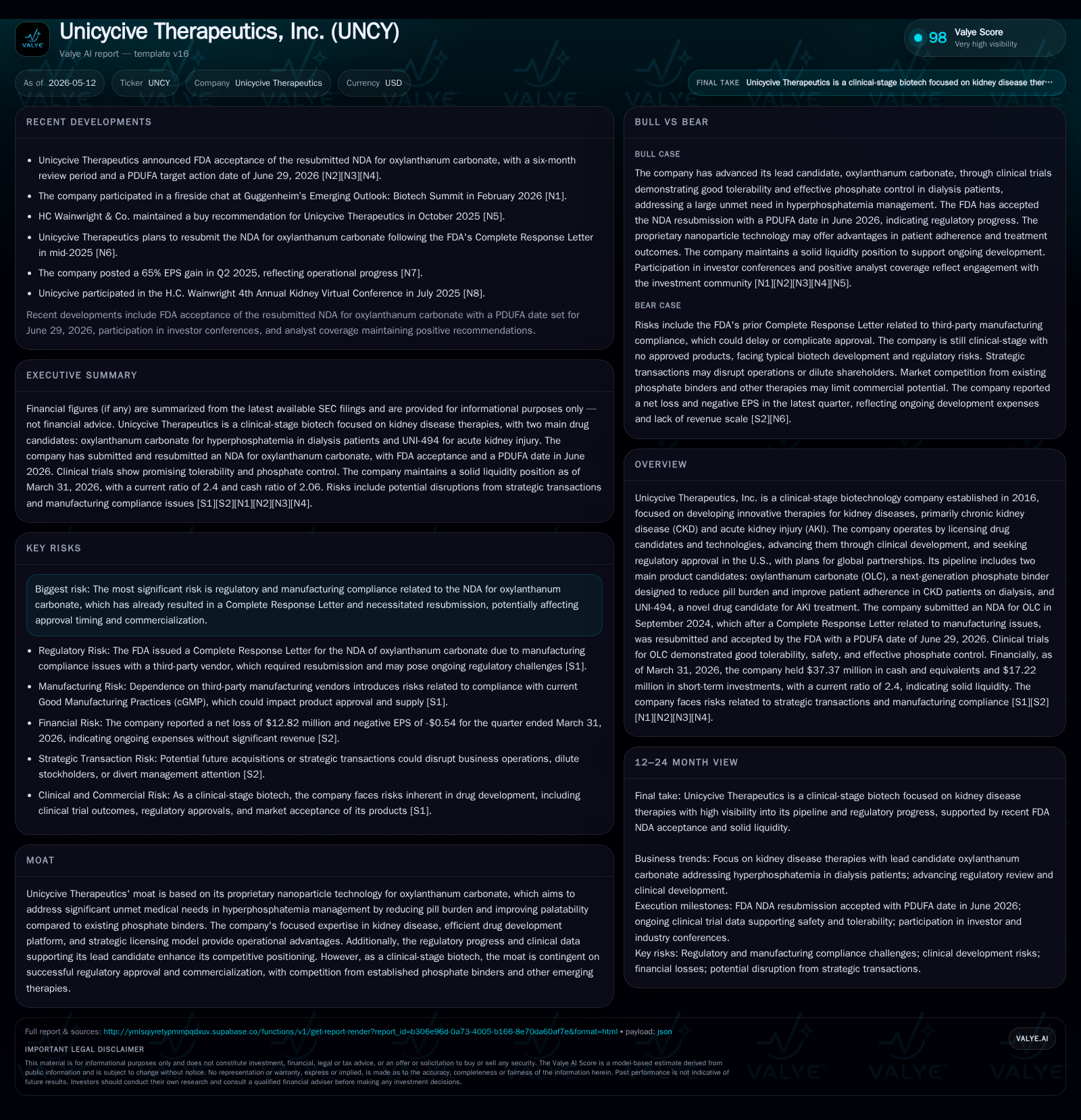
In its May 2026 quarterly filing, Unicycive Therapeutics disclosed FDA acceptance of its resubmitted New Drug Application (NDA) for oxylanthanum carbonate (OLC), setting a pivotal PDUFA date of June 29, 2026. This advancement crystallizes a near-term regulatory catalyst for the clinical-stage biopharma focused on chronic kidney disease (CKD) and acute kidney injury (AKI). The company’s licensing-driven model targets unmet therapeutic needs in hyperphosphatemia management through proprietary nanoparticle technology aimed at improving patient adherence via a reduced pill burden. While securing FDA approval and scaling manufacturing remain crucial hurdles—especially due to prior manufacturing-related Complete Response Letter complications—the upcoming months will be decisive for validating Unicycive’s transition from development risk to commercial opportunity.
Latest Operating Update and Regulatory Milestone
Unicycive Therapeutics’ latest quarterly report filed May 12, 2026 provides important near-term clarity around its regulatory trajectory. The company disclosed that the Food and Drug Administration (FDA) has accepted the resubmitted New Drug Application (NDA) for its lead candidate oxylanthanum carbonate (OLC), establishing a Prescription Drug User Fee Act (PDUFA) target action date of June 29, 2026 [S2]. This follows an earlier Complete Response Letter (CRL) issued due to manufacturing concerns but is a critical step forward signaling resolution progress.
In addition to this regulatory update, the April 6, 2026 current report revealed a minor governance development: director Gaurav Aggarwal resigned from the Board without any related disagreement on operations or strategy [S3]. While largely procedural, this points to ongoing board evolution as the company transitions toward potential commercialization.
Collectively, these filings shift Unicycive’s narrative from prolonged clinical uncertainty into an execution phase oriented around preparing for market entry pending FDA approval.
Business Model: Licensing-Driven Development Focused on Kidney Disease
Unicycive operates primarily as a clinical-stage biotechnology company that licenses promising drug candidates targeting significant medical unmet needs in kidney diseases. Its core focus rests on two main programs: oxylanthanum carbonate (OLC), a next-generation phosphate binder intended for chronic kidney disease (CKD) patients undergoing dialysis who suffer from hyperphosphatemia; and UNI-494, a novel drug candidate developed for acute kidney injury (AKI) [S1].
The company relies on acquiring early-stage assets and advancing them through the costly and complex clinical trial process toward eventual U.S. regulatory approval. For global commercialization beyond the U.S., Unicycive plans to leverage strategic licensing partnerships.
A distinctive strategic strength lies in OLC’s proprietary nanoparticle formulation technology licensed from Spectrum Pharmaceuticals. This platform facilitates enhanced potency that enables significant reductions in pill burden—a well-documented adherence barrier among CKD dialysis patients facing currently available phosphate binders requiring large numbers of tablets administered multiple times daily [S1]. Moreover, OLC’s formulation is designed to be swallowed whole rather than chewed, improving palatability and further supporting patient compliance.
Overall, Unicycive exhibits lean operations focused tightly on specialized renal therapies where its expertise and drug development platform can create differentiated value.
Competitive Positioning in Phosphate Binder and AKI Treatment Markets
Hyperphosphatemia management represents a high unmet need within the CKD community due to morbidity associated with poor phosphate control. Although six phosphate binders are approved and widely used, these existing therapies suffer shortcomings including large pill burdens requiring frequent dosing — often six or more tablets daily — formulation taste issues leading some patients to discontinue therapy, and insufficient efficacy for many patients [S1]. These factors contribute to persistent hyperphosphatemia prevalence despite treatment.
Oxylanthanum carbonate’s nanoparticle technology is strategically positioned to address these limitations by delivering higher binding capacity per tablet. This innovation theoretically allows fewer tablets per day while maintaining or improving phosphate control outcomes. In an industry where patient adherence is directly linked to the tolerability profile driven by pill burden and taste palatability, OLC’s improved formulation aims to lower switching costs for dialysis patients currently stabilized on entrenched products but dissatisfied with side effects or regimen complexity [S1].
While relatively less commercial detail is available about UNI-494 at this stage, the AKI treatment landscape remains nascent with no approved pharmacological standards broadly endorsed beyond supportive care. Successfully advancing UNI-494 through clinical development could position Unicycive as a pioneer in acute treatment options in nephrology.
Growth Drivers: From NDA Acceptance to Commercial Partnerships
The foremost growth driver now centers squarely on FDA’s decision regarding the OLC NDA by June 29, 2026 [S2], representing a binary regulatory event unlocking potential commercialization revenues. Following anticipated approval, scaling manufacturing capability as stipulated under existing amended supply agreements—including binding purchase orders with Shilpa Lifesciences extending through September 2026—is essential for meeting market demand [S1].
Parallel efforts toward commercialization readiness encompass marketing infrastructure build-out and distribution channel development tailored to nephrology specialists and dialysis providers.
Beyond U.S. markets, Unicycive intends to pursue out-licensing partnerships for global territories leveraging established biopharma networks—a common strategy among specialized biotechs facing resource constraints while seeking broad reach.
Meanwhile, UNI-494’s clinical progression post-Phase I healthy volunteer trials completed in 2024 represents another growth lever contingent on advancing into later-stage studies demonstrating safety and efficacy in AKI patients [S1]. Successful pipeline expansion would diversify Unicycive’s portfolio beyond hyperphosphatemia.
Concrete KPIs closely tied to growth prospects include achievement of timely FDA approval without further manufacturing holds, successful fulfillment of scaled tablet deliveries under supply contracts, partner announcement timelines outside North America, and measurable progress along UNI-494’s clinical development pathway.
Risks and Constraints: Manufacturing Compliance and Capital Requirements
The specter of manufacturing compliance issues looms large over Unicycive given their direct link to past delays flagged by the FDA Complete Response Letter attached to OLC’s initial NDA submission [S1]. Any recurrence or lingering quality control deficiencies could substantially derail approval timing or result in costly remediation requirements.
Moreover, the company faces legal headwinds from an ongoing securities class action lawsuit initiated August 2025 alleging material misstatements related to OLC’s approval prospects intertwined with manufacturing concerns [S1]. While early litigation stages preclude definitive outcome predictions, such proceedings enhance uncertainty and raise potential financial exposure.
From a capital standpoint, Unicycive operates pre-commercially without product revenue generation so far—recording net losses exceeding $26 million most recently—and thus depends heavily on external funding. Despite holding $37.4 million cash as of Q1 2026 with a healthy current ratio of 2.4x indicating short-term liquidity sufficiency [F1], sustaining operations through approval milestones and potential launch will likely require additional financing given elevated R&D costs and commercial build investments [S2][F1].
The prospect of future equity dilution or debt raises must be monitored closely alongside any strategic acquisitions flagged as possible but uncertain [S2]. Furthermore, integration risks accompanying inorganic growth strategies add managerial focus demands at this sensitive growth juncture.
What to Monitor Next: FDA Decisions and Strategic Transactions
The immediate focal point is unequivocally FDA's review outcome for oxylanthanum carbonate expected by June 29, 2026 [S2], which will either validate Unicycive's developmental thesis or necessitate further remediation steps.
Subsequent updates from supply chain scaling progress under amended agreements provide insight into readiness for commercial production volume peaks required post-launch [S1].
Additionally, any announcements regarding strategic partnerships beyond the U.S.—critical for accessing broader market share—would substantively shift revenue outlooks.
Pipeline developments related to UNI-494 including trial initiations or data releases will also merit close attention given their potential impact on diversified revenue streams.
Finally, watch for disclosures around acquisition activity or refinancing efforts signaled in pending SEC filings or investor communications as these could reshape capital structure risks or expand product breadth [S2][S3].
Financial Snapshot and Liquidity Profile
Latest financial snapshot
| Metric | Value | Period |
|---|---|---|
| Cash & equivalents | $37mm | |
| 2026-03-31 | ||
| Current assets | $64mm | |
| 2026-03-31 | ||
| Current liabilities | $26mm | |
| 2026-03-31 | ||
| Current ratio | 2.4x | |
| 2026-03-31 |
Source: SEC companyfacts cache [F1].
| Metric | Value (as of Q1 ’26) |
|---|---|
| Cash & Equivalents | $37.4 million |
| Current Assets | $63.5 million |
| Current Liabilities | $26.5 million |
| Current Ratio | 2.4x |
Unicycive maintains a reasonable liquidity position supporting operational runway through near-term milestones including potential FDA approval confirmation [F1]. However, as expected within clinical-stage biotechnology firms devoid of revenues from marketed products yet absorbing substantial R&D expenses (~$26.5 million net loss last reported year-end), continued access to capital markets remains vital [F1][S2]. Cash sufficiency beyond mid-2026 will hinge significantly on timing of regulatory success and efficiency of subsequent commercialization initiatives.
This analysis has synthesized recent SEC disclosures alongside foundational business insights pertinent to Unicycive Therapeutics’ evolving status as it approaches crucial regulatory decision points for its lead renal therapy candidate. It reflects current documented facts without projecting future performance or offering investment advice.
Disclaimer: This is research-only, informational analysis and not investment advice. It may include AI-generated interpretation and general industry context. Always verify important details using primary sources.

Comments