
Esquire Financial’s Q1 Growth Anchored by Litigation Loans and Payment Processing Expansion
First quarter highlights underscore Esquire Financial’s niche strength in litigation-focused lending and scaling payment solutions.
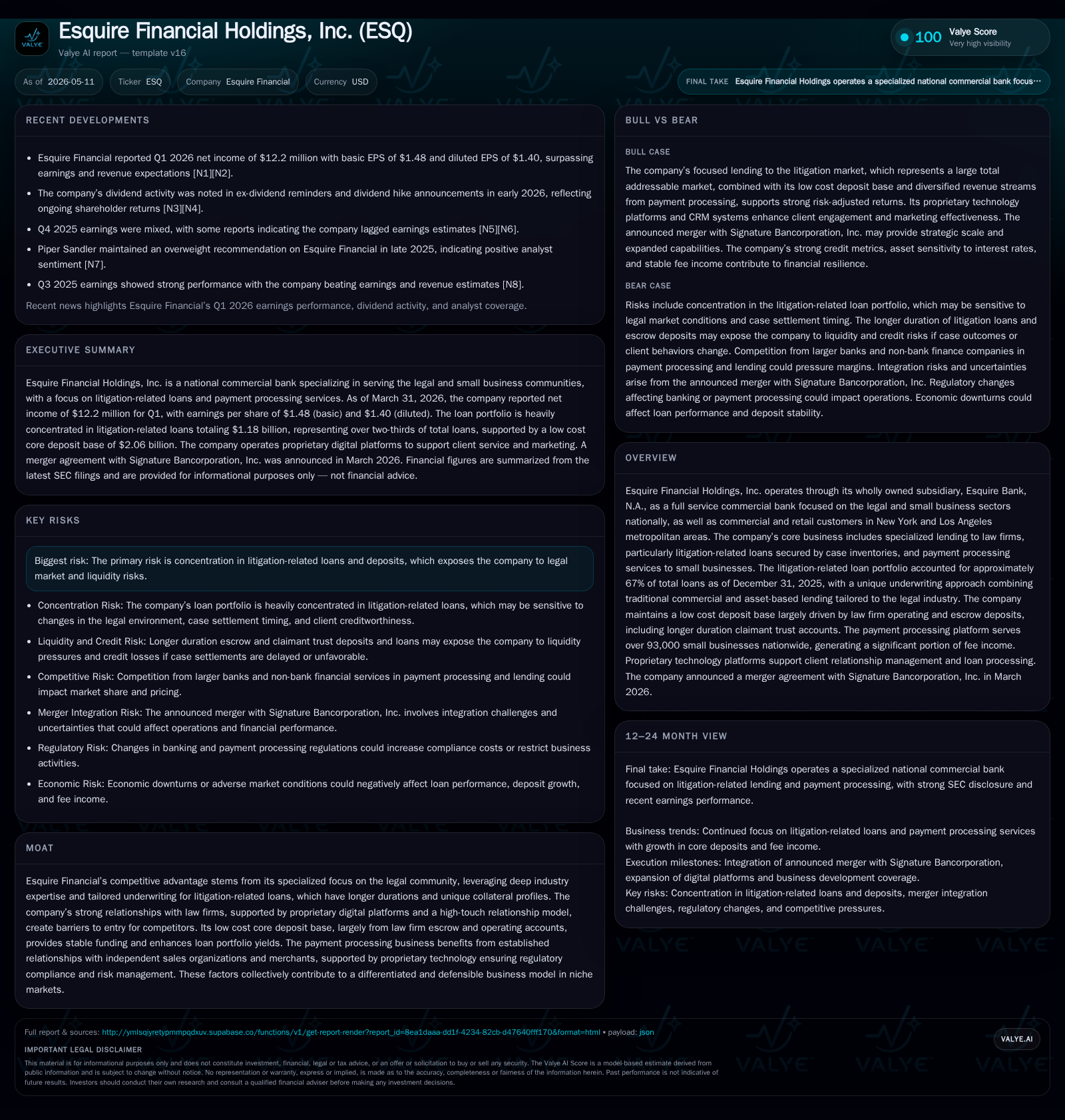
Esquire Financial Holdings delivered robust operating results for Q1 2026, driven by an increase in their litigation-related loan portfolio and expanded payment processing volume. The company leverages its specialized banking model tailored to law firms nationwide, supported by a low cost deposit base primarily composed of law firm escrow accounts. Competitive advantages include deep industry expertise, proprietary underwriting methodologies, and high-touch client engagement. Growth is propelled by the national litigation market’s unique financing demands and expanding payment processing services, though concentrated exposure to legal sector risks remains a watchpoint. The pending merger with Signature Bancorporation represents a strategic milestone with potential for market expansion and operational synergies.
Recent Operating Update: Q1 2026 Performance
Esquire Financial Holdings reported a substantial increase in loans held for investment to $34.3 billion at Q1 end, compared to $26.8 billion one year prior [S2]. This growth predominantly reflects continued expansion in their specialized litigation-related loan portfolio, which remains central to their business model. Total interest income correspondingly grew to $39 million in Q1 2026 from $31.5 million in Q1 2025, evidencing effective yield capture on these loans amidst rising volume.
The company also maintains a significant securities portfolio which remained free from unrealized credit losses as of March 31, 2026, reinforcing asset quality standards [S2]. Cash and equivalents were reported at $222 million as of quarter-end, underscoring liquidity stability [F1]. Moreover, an ongoing increase in deposit balances was noted — a critical factor given reliance on core deposits from law firm operating and escrow accounts.
On April 30, 2026, Esquire declared a regular quarterly dividend of $0.20 per share payable June 1st, signaling confidence in ongoing cash generation [S3]. A separately notable event is the pending merger with Signature Bancorporation agreed upon March 11, set to consolidate respective businesses under Esquire’s holding company structure after closing [S14].
Business Model: Litigation-Centric Lending Coupled With Payment Processing
Esquire operates principally through Esquire Bank as a full-service commercial bank committed to servicing the national legal sector alongside select local retail/commercial markets primarily in New York and Los Angeles [S1]. The core revenue engine is its litigation-related lending segment — approximately two-thirds of total loans at year-end 2025 — focused mainly on financing law firms’ contingent case inventories where cases often entail two-to-four year durations before settlements are realized.
The bank employs a hybrid underwriting methodology combining traditional commercial lending principles with asset-based risk evaluation tailored to law firms’ unique collateral structures like case inventories and receivables [S4]. Advances against a defined borrowing base anchored principally on case inventory volumes constitute typical loan advances. This approach has historically produced impressive yields around 9% annually on these commercial loans while maintaining low delinquency and charge-off rates due to rigorous underwriting expertise.
Complementing this lending franchise is a sizable deposit base predominantly sourced from law firm operating accounts along with longer duration escrow or claimant trust deposits held under fiduciary arrangements that ensure FDIC insurance coverage passes through directly to claimants [S4], [S9]. Such deposits represent a stable low cost funding foundation with approximately 78% of deposits tied to legal market clients as of late-2025 [S5].
Beyond lending/deposits, Esquire also runs an expansive payment processing platform targeting small businesses nationwide across all fifty states through extensive ISO (Independent Sales Organization) partnerships supporting over 93,000 merchant accounts [S5], growing transaction volume by about 9% vs. prior year calendar results. This segment generates steady fee-based income—a diversification benefit relative to interest-earning assets—and leverages proprietary technology ensuring compliance and risk controls.
Industry Structure and Competitive Position
Esquire occupies a distinct niche within the broader commercial banking landscape—specializing in law firm finance nationally while also engaging local metro banking markets. Most commercial banks do not pursue contingent case financing due to its complexity; meanwhile non-bank finance companies dominate some aspects of alternative legal funding but do not offer full-service banking capabilities or deposit gathering powers.
The company’s moat derives not only from its decade-plus track record but also from deep industry relationships cultivated via senior business development officers placed strategically across key national regions complemented by digital marketing tools such as AI-powered CRM systems (Salesforce) and loan platforms (nCino) that enhance client targeting effectiveness [S5], [S6].
Established ISOs provide nationwide distribution for payment processing without capital exposure risks given reserve structures mitigating merchant credit losses—an arrangement insulating Esquire’s balance sheet while allowing scale up of transaction volume substantively.
Competition arises locally from regional banks vying for commercial deposits and lending opportunities; nationally from direct lenders in legal finance; yet barriers persist given sophisticated collateral valuation needs plus regulatory oversight peculiarities around fiduciary escrow deposits that deter new entrants.
Growth Drivers
- Litigation Market Expansion: U.S. tort actions represent a vast total addressable market estimated at over $500 billion annually with demand for litigation-related working capital financing structurally embedded given lengthy case durations requiring law firms’ liquidity support. Esquire aims to extend market penetration via deeper regional BDO deployment leveraging long-term associations with trial lawyer groups.
- Deposit Base Leveraging: Increasing adoption of claimant trust escrow accounts nurtures low cost core funds growth fueling loan originations without expensive wholesale funding dependency.
- Payment Processing Volume: Growing ISO relationships and merchant acquisition enhance fee income streams; leveraging proprietary compliance technology supports scale while managing operational risk.
- Digital Platform Investment: Continued enhancement of CRM tools enable precise marketing outreach improving customer acquisition efficiency across expansion geographies including Los Angeles branch ramp-up.
- Merger Synergies: The planned combination with Signature Bancorporation holds promise for expanded product offerings, geographic reach especially into Illinois via Signature Bank legacy locations, potential economies of scale particularly within operations and compliance functions.
Risks / Watchpoints / Growth Constraints
Concentration risk remains pronounced given approximately two-thirds exposure toward litigation-related loans concentrated geographically in California (20%), New York (17%), and Texas (~14%) though efforts are underway towards geographical diversification within this sector [S23],. Any downturn affecting the legal sector or changes impacting tort litigation dynamics—e.g., tort reform—could adversely affect asset quality or liquidity profile.
Escrow deposit concentrations present counterparty risk mitigated but not eliminated by pass-through FDIC coverage; prolonged settlement timelines elevate liquidity mismatch potential.
Competitive pressures may intensify if larger regional or national banks attempt entries into specialized legal finance segments leveraging fintech innovations; however incumbent relationships create high switching costs.
Operational scalability risks accompany ongoing platform expansion alongside regulatory compliance requirements particularly for fiduciary activities tied to claimant funds.
Uncertainty surrounds consummation timing and integration complexities linked with the Signature Bancorporation merger which inject execution risks albeit strategic opportunities.
What to Watch Next
- Closing progress on the announced Signature Bancorporation merger post-March filing date with attention towards final terms adjustments based on Schedule A Loan dispositions totaling approximately $70 million par value impacting exchange ratios [S14].
- Quarterly updates on litigation-related loan portfolio growth metrics including utilization rates against borrowing bases reflecting demand sustainability.
- Deposit growth trends especially within law firm escrow accounts signaling funding stability.
- Payment processing platform merchant count progression beyond the current ~93K mark alongside transaction volume growth rates validating fee income scalability.
- Credit quality indicators such as delinquency ratios or charge-offs within longer duration loan buckets amid macroeconomic shifts affecting plaintiffs’ ability to settle claims.
- Regulatory developments potentially influencing fiduciary deposit management or bank capital rules impacting niche lender economics.
Financial Profile (Brief)
Esquire reported solid net income generation consistent with prior periods — net income was approximately $50.8 million as of year-end December 31, 2025 according to annual figures used for context rather than latest quarterly snapshot due to policy limits on metric availability [F1].
Liquidity remains robust as evidenced by healthy cash balances ($222 million at Q1 end), absence of unrealized losses on investment securities signaling credit soundness, stable core deposit costs averaging under 1%, coupled with no outstanding borrowings reported recently indicating conservative leverage management [S2], [F1].
In sum, Esquire Financial Holdings continues executing its specialized commercial banking strategy effectively anchored on nationwide legal sector expertise paired with complementary payment processing growth while maintaining prudent credit discipline supported by digital transformation initiatives. The pending merger represents both opportunity and complexity warranting close investor scrutiny going forward.
Disclaimer: This analysis is based solely on publicly available filings and news sources up to May 11, 2026. It does not constitute investment advice or recommendations.
Disclaimer: This is research-only, informational analysis and not investment advice. It may include AI-generated interpretation and general industry context. Always verify important details using primary sources.

Comments