
Magnolia Bancorp Charts Regional Mortgage Focus Amid Profitability Challenges
Recent quarter reveals Magnolia’s steady commitment to regional fixed-rate mortgage lending amid regulatory and financial headwinds.
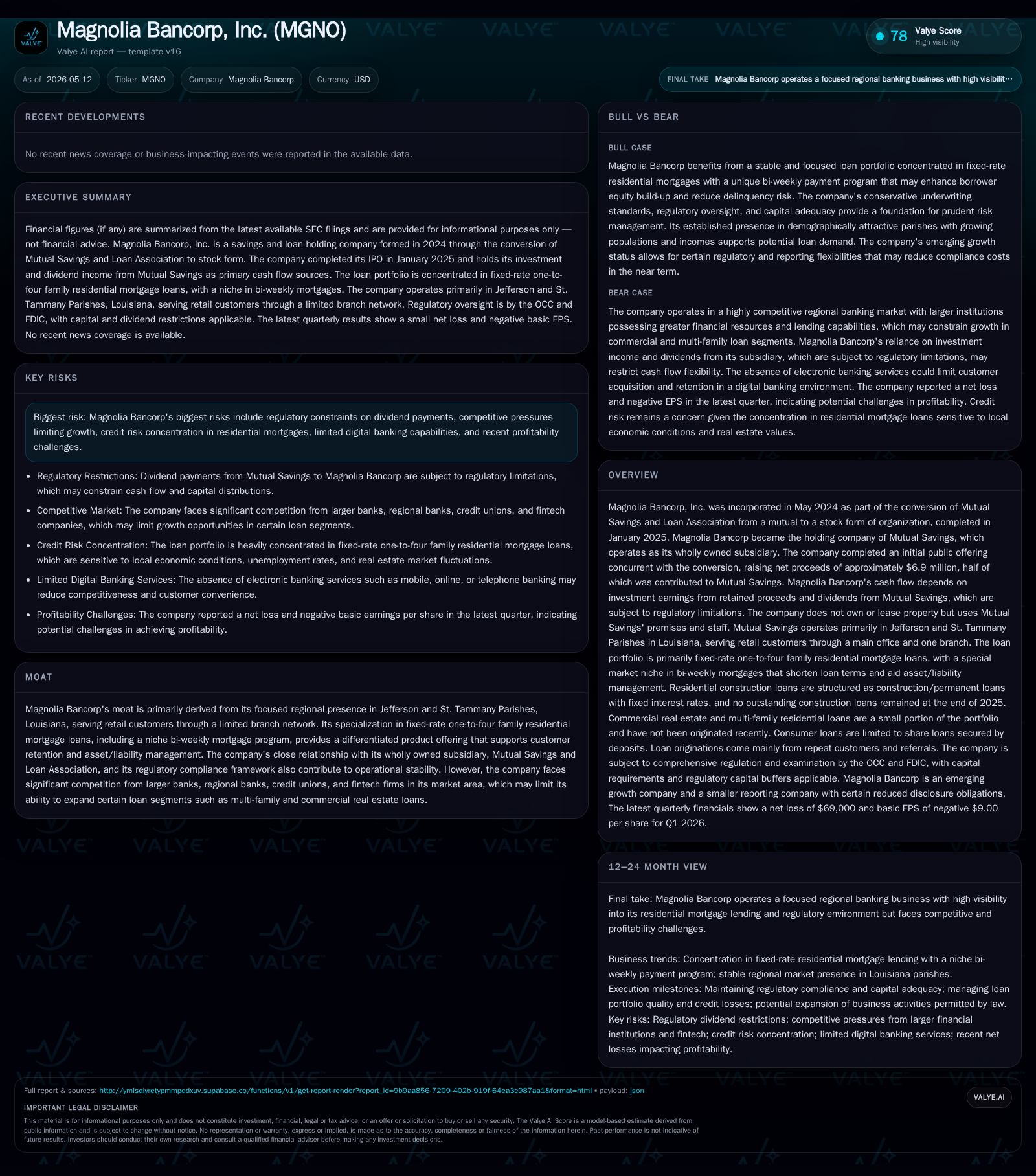
Magnolia Bancorp’s latest quarterly filing confirms ongoing challenges in profitability despite a stable operational base anchored in Jefferson and St. Tammany Parishes, Louisiana. The company’s business model centers on fixed-rate one-to-four family residential mortgages, including a unique bi-weekly payment program that enhances asset-liability management. Regulatory constraints limit dividend payments and growth initiatives, while competitive pressures from larger banks and fintech firms restrict expansion into broader loan segments. Going forward, market penetration remains tied to deepening specialization and maintaining compliance within a tight regulatory framework.
Latest Quarterly Operating Update and Its Significance
Magnolia Bancorp's 10-Q as of May 12, 2026 [S2] underscores a continuation of its modest financial performance profile during stable operational fundamentals. The company reported a net loss on an annualized basis of approximately $170,000 for the year ended December 31, 2025 [F1], reflecting ongoing profitability pressures common in smaller regional thrifts facing competitive and regulatory challenges. There were no indications of significant shifts in asset quality or regulatory compliance issues in the quarter. Dividend policies remain constrained by regulatory limits imposed on Mutual Savings and Loan Association (the subsidiary), consistent with previous periods [S1]. This latest disclosure confirms that Magnolia Bancorp’s near-term operating momentum is steady but constrained by factors beyond immediate management control.
The stability in loan delinquency metrics and allowance for credit losses reported through the last annual filing suggests conservative credit risk management practices remain intact [S1]. Importantly, no material change in capital adequacy or liquidity is indicated, consistent with historical assessments [S3][S5]. Thus, while operational risks are manageable currently, near-term earnings improvements appear limited absent external shifts.
Business Model: Regional Fixed-Rate Mortgage Lending with Distinctive Product Focus
Magnolia Bancorp operates as the holding company for Mutual Savings and Loan Association, following its mutual-to-stock conversion completed in January 2025 [S1]. The business model centers exclusively on residential lending within a focused geographic footprint (Jefferson and St. Tammany Parishes in Louisiana) serviced out of a main office plus a single branch. Magnolia Bancorp itself does not own property or employ staff directly; it leverages Mutual Savings’ infrastructure for operational efficiency.
The core revenue driver is the origination and retention of fixed-rate one-to-four family residential mortgage loans — notably dominated by fixed-rate bi-weekly payment mortgages representing over 70% of total portfolio value [S1]. This specialized product offers strategic benefits such as accelerated principal reduction for borrowers and improved asset/liability dynamics for the institution due to shorter effective loan durations. Loan pricing depends on market conditions but remains competitive within the local retail banking environment.
Secondary products include residential construction loans and home equity lines albeit at much smaller scale. Notably, Magnolia Bancorp’s strategy eschews significant multi-family or commercial real estate lending which is generally high-risk and resource-intensive [S7]. Deposits form the primary funding source alongside scheduled loan repayments; borrowings from Federal Home Loan Bank lines provide supplemental funding as needed [S6][S9].
This concentrated operating model fosters cost containment but limits scaling without geographic or product expansion. This structural dependency creates intrinsic tension between regulatory constraints and shareholder return expectations.
Competitive Landscape and Regulatory Framework Impacting Magnolia Bancorp
Operating within a dense competitive environment, Magnolia Bancorp faces rivalry from national banks with expansive product suites, regionally focused mid-sized banks offering commercial services beyond Magnolia’s scope, credit unions providing attractive rates to consumer segments, and fintech entrants leveraging digital platforms to capture mortgage customers more efficiently. The limited physical footprint reinforces reliance on product differentiation rather than scale advantages.
Regulatory supervision primarily falls under the Office of the Comptroller of the Currency (OCC) with deposit insurance overseen by FDIC protocols [S6][S26]. Capital requirements dictate stringent minimums for Tier 1 and common equity ratios; Magnolia currently meets "well-capitalized" status criteria [S9][S23], conferring some operational flexibility.
Dividend payments from Mutual Savings are restricted under federal regulations requiring adequate capitalization post distribution along with earnings coverage tests [S4][S9]. These rules necessitate prior approval filings for capital distributions exceeding designated thresholds. Consequently, Magnolia Bancorp cannot freely extract holdings dividends without jeopardizing regulatory standing or triggering formal review processes.
This prudential overlay shapes corporate treasury policies tightly balancing liquidity preservation against shareholder distributions. Further complicating this dynamic is emerging supervisory guidance limiting discretionary cash outflows when earnings fall short relative to capital conservation buffers — a notable factor given recent net income results [S4].
Growth Drivers: Leveraging Regional Footprint and Loan Portfolio Specialization
Key growth avenues rest on expanding within Magnolia's core market by deepening penetration of one-to-four family residential mortgages using its unique bi-weekly payment loan product which appeals to owner-occupiers seeking interest savings and faster equity buildup [S1]. Enhanced customer retention through this niche program supports steady portfolio growth while improving prepayment visibility critical for interest rate risk management.
The geographic focus offers both opportunities and limitations: Jefferson Parish's sizable population presents a stable demand base but also capped market share expansion unless additional branches or delivery channels are deployed. St. Tammany Parish enables some diversification but remains geographically limited.
Future investment into digital infrastructure could potentially improve customer acquisition efficiency vis-à-vis fintech rivals; however, current disclosures suggest digitization lags industry leaders creating a clear area for strategic improvement. Meanwhile, disciplined underwriting standards maintain credit quality supporting sustainable originations within localized markets.
Mutual Savings retains discretion over investment securities portfolio deployment though it held no securities at fiscal year-end 2025 — an area where tactical asset allocation might supplement yields if leveraged cautiously under liquidity constraints [S3].
Risks and Constraints: Regulatory Dividend Limits, Credit Concentration, and Digital Gaps
Magnolia Bancorp’s profitably challenges stem partly from regulatory limitations curtailing dividend flow from Mutual Savings—the critical cash source—thus restricting holding company financial flexibility despite steady operating earnings at subsidiary level [F1][S4]. The relatively modest net income loss posted underscores delicate margin environments exacerbated by these payout restrictions.
Concentration risk remains elevated given that over 90% of loans are fixed-rate residential mortgages concentrated within two contiguous Louisiana parishes [S1]. Local economic downturns or housing market softness could disproportionately affect asset performance though conservative underwriting standards mitigate this risk somewhat.
Additionally, although credit quality metrics are stable with allowances established per regulation [S24], any significant uptick in delinquencies would impact both earnings volatility and regulatory capital buffers.
Digital banking capabilities are limited compared to regional peers incorporating advanced fintech solutions; this gap impairs competitiveness for younger or tech-savvy borrowers increasingly expecting online origination and account servicing options. Lastly, stringent OCC oversight on capital distributions can delay responsiveness to changes in capital needs or shareholder return strategies.
Anticipated Milestones and Key Factors to Monitor Next
Going forward, key monitoring points include quarterly earnings updates that can shed light on whether recent profitability shortfalls persist or improve alongside expense control efforts [S2]. Shifts in loan demand within core parishes will indicate market acceptance sustainability.
Further regulatory filings around dividend declarations will clarify if capital conservation buffers ease sufficiently permitting stronger shareholder returns. Progression toward enhanced digital banking services could signal competitive repositioning potential.
Magnolia Bancorp's emerging growth company status will expire upon reaching statutory thresholds around revenue or stock market capitalization expected not before late decade timeframe [S22], which may increase reporting obligations affecting operational transparency.
Capital adequacy ratios remain vital leading indicators given their link to dividend capacity; regulators’ ongoing assessments could influence discretionary capital actions. Close scrutiny of credit metrics against local economic indicators will remain essential given portfolio concentration risks.
Financial Profile Highlights (Brief)
As reported through fiscal year end December 31, 2025, Magnolia Bancorp posted an annualized net loss of $170,000 reflecting thin operating margins typical among smaller regional savings institutions operating within restrictive payout environments [F1]. The loan portfolio measures approximately $30 million predominantly invested in fixed-rate residential mortgages secured largely by owner-occupied properties with impressive weighted average terms supporting predictable cash flows [S1][S27].
Capital levels meet well-capitalized designations under applicable OCC guidelines providing resilience against industry shocks though ongoing profitability pressures necessitate prudent balance sheet management [S9][S23].
Overall operating results reflect evolving challenge balancing regulatory compliance costs alongside competitive demands within a geographically concentrated niche franchise lacking scale economies seen elsewhere in the sector.
This analysis is intended solely for informational purposes reflecting available public disclosures without investment recommendation intent.
Disclaimer: This is research-only, informational analysis and not investment advice. It may include AI-generated interpretation and general industry context. Always verify important details using primary sources.

Comments