
Launch Two Acquisition Corp. Advances Toward Critical Business Combination Deadline
Latest quarterly filings underscore ongoing search and preparatory steps as LPBB approaches its October 2026 SPAC deadline.
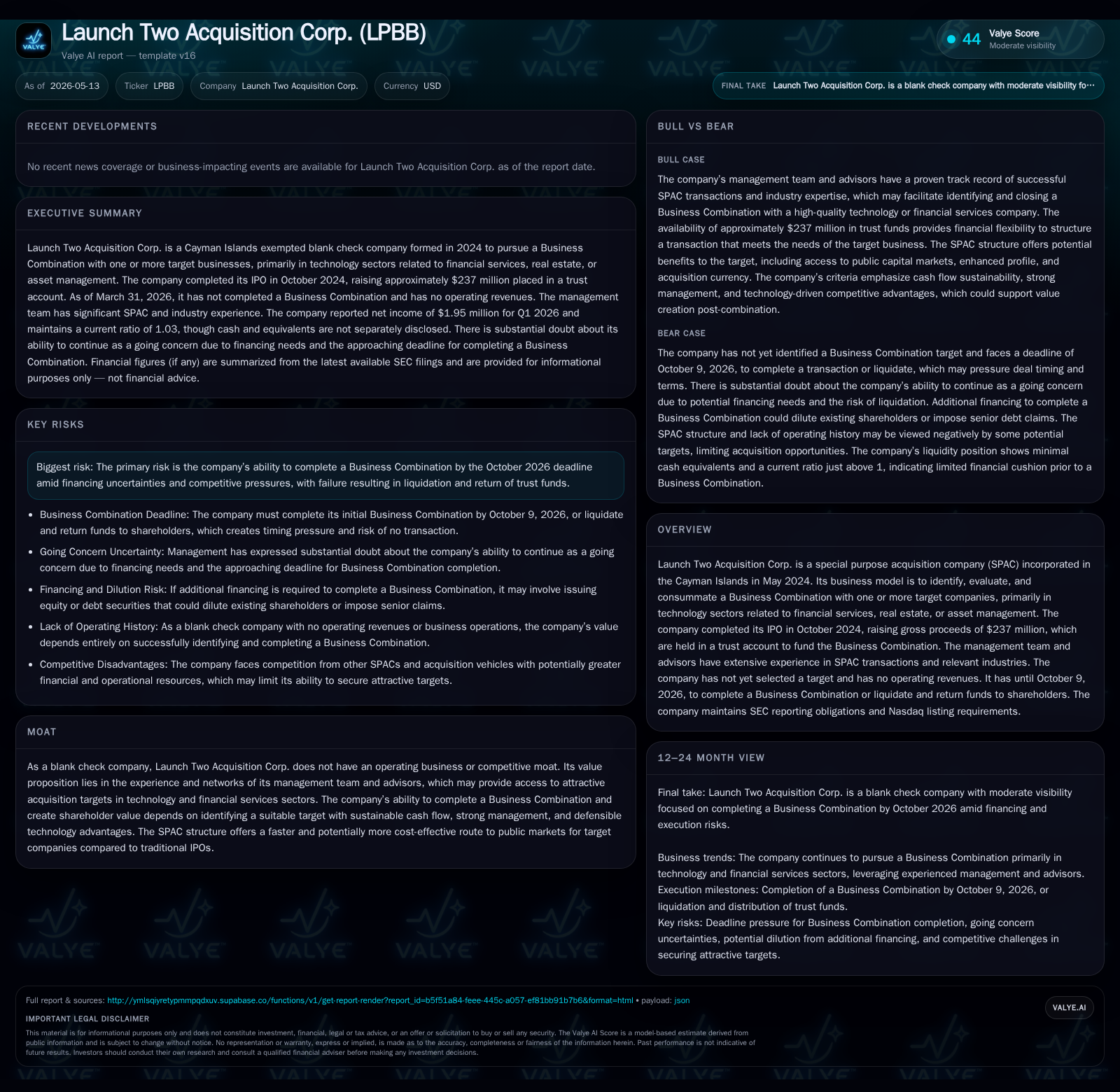
Launch Two Acquisition Corp. (LPBB), a Cayman Islands-based SPAC focused on fintech, real estate technology, and asset management sectors, remains actively engaged in its target search as of its May 13, 2026 quarterly filing. With no revenues and no announced acquisition targets yet, the company faces an increasingly urgent timeline to complete a Business Combination by October 9, 2026, or face liquidation and shareholder refund. LPBB’s business model leverages the experience of its management team and the trust account structure typical of SPACs, but it contends with competitive pressures for high-quality fintech assets and potential financing constraints. Key near-term markers include shareholder votes on deal approvals or possible extension of the combination period.
Quarterly Update Highlights and Implications
The latest quarterly filing dated May 13, 2026, primarily reconfirms Launch Two Acquisition Corp.’s (LPBB) status as an ongoing special purpose acquisition company without any operational revenues or closed business combinations to date [S2]. The company continues to comply fully with SEC reporting obligations and Nasdaq listing standards, affirming its readiness under regulatory frameworks to consummate a Business Combination. This update reflects an unchanged operating picture but sharpens focus on the criticality of LPBB’s timeline: it has until October 9, 2026—essentially five months from the filing date—to close a deal or face mandatory liquidation returning trust funds to shareholders.
No new operating revenues were noted this quarter as LPBB remains pre-combination without direct commercial activities. The urgency imposed by the approaching deadline anchors the near-term outlook for delivery of acquisition progress or decisive corporate action. The continued absence of a selected target highlights persistent challenges faced in securing suitable acquisition candidates that meet LPBB’s strategic benchmarks within its industry focus areas. This dynamic sets a hard constraint on execution risk going forward.
Business Model Overview: The SPAC Structure and Target Focus
LPBB operates as a blank check company incorporated in the Cayman Islands with the principal objective of effecting a Business Combination within two years of its October 2024 IPO closing [S1]. The IPO raised approximately $237 million gross proceeds (including private placement warrants), which are sequestered in a trustee-managed Trust Account as capital reserved exclusively for acquisition funding or shareholder redemptions at deal completion [S1]. This cash collateralizes any redemption rights associated with Public Shares.
SPAC mechanics entail management leveraging their expertise and networks to identify privately-held companies primarily in technology sectors related to financial services, real estate tech, or asset management tech—as explicitly stated in LPBB’s filings and advisor backgrounds—with an aim to take such companies public via merger rather than traditional IPO routes [S1], [S20]. This can deliver accelerated access to capital markets for targets while offering investors liquidity protection through redemption options.
The targeted business profile includes firms demonstrating sustainable free cash flow generation, consistent margin integrity, recurring revenue streams often embedded in platform business models with scalable customer acquisition and cross-selling opportunities. Strong management capable of managing public entity complexities is a necessity. Additionally, defensible technology-based advantages—whether pricing power derived from uniqueness or timing advantages over competitors—are pivotal selection criteria used during due diligence alongside financial assessments [S3], [S6].
Completion flexibility allows LPBB to use cash from the Trust Account alongside potential additional equity or debt financings as part consideration for the target company. However, management has not yet secured third-party financing commitments beyond the Trust Account balance [S22].
Competitive Dynamics in the Fintech-Related SPAC Sector
LPBB competes within a crowded segment where many specialist fintech-focused SPACs pursue deals across blockchain-enabled infrastructure businesses, digital asset enablement companies (e.g., stablecoins), and software platforms targeting financial services modernization [S3], [S25]. Several contemporaneous vehicles led by executives overlapping with LPBB’s advisory team further fragment deal flow.
This competition raises challenges such as upward valuation pressure on attractive targets due to demand intensity; potential investor sensitivity surrounding redemption dilution; limitations posed by founder-share anti-dilution provisions; and heightened SEC/regulatory scrutiny on fintech-related mergers post-market volatility episodes. Pricing premiums commanded by sought-after targets reflect these dynamics. LPBB’s ability to distinguish itself rests heavily on its management team's domain-specific expertise and relationships enabling access to proprietary deal pipelines outside purely auction-driven processes.
Additionally, structural constraints around capital availability may limit LPBB's capacity to pursue larger-scale targets unless supplemental financings are secured concurrently with transactions—an uncertain prospect given no firm commitments disclosed so far [S22]. Investor appetite also hinges on perceived execution risk tied to impending expiration dates which could depress willingness to accept aggressive valuation multiples.
Key Growth Drivers: Identifying and Closing on an Acquisitive Target
The fundamental value uplift driver for LPBB resides in successfully merging with a technology-centric business that meets its stringent profile attributes. These include:
- Strong Recurring Revenue & Margin Profile: Ensuring sustainable cash flows validate post-merger financial stability.
- Defensible Technology Edge: Offering customers differentiated offerings protected by proprietary tech or network effects that mitigate competitive erosion.
- Experienced Management Teams: Critical for navigating public markets’ transparency demands and regulatory compliance while executing growth strategies.
- Public Company Benefits: Entities that stand to gain from access to broader capital pools can leverage market-listed stock for acquisitions or employee retention programs efficiently.
Analogous recent SPAC deals underline benefits realized when combining with scale fintech platforms capable of roll-up strategies or underpinning digital asset enablement infrastructure that can cross-sell across client bases. The convergence of these factors offers durability versus cyclical market shifts; however, achieving alignment among all parameters remains complex given limited candidate universe size.
Risks and Constraints Including Deadline Pressure and Financing Uncertainty
Primary risks confronting LPBB stem from the fixed timeline requiring closure by October 9, 2026—or forced dissolution returning investor capital without premium returns. The window narrowness amplifies execution risks especially amid volatile market conditions affecting target valuations or willingness to go public via SPAC routes [S1], [S2], [S4].
Additional constraints relate to possible financing gaps should redemptions exceed expectations reducing trust account funds available for transaction consideration. While permitted discretion exists to raise supplementary equity or debt financing concurrently with the Business Combination, such moves introduce dilution risk for existing shareholders alongside seniority claims potentially altering ownership structures unfavorably [S22].
Competitive pressures further compound these concerns; multiple SPACs chasing similar assets lead to protracted sourcing cycles and valuation inflation making negotiations more difficult. Also notable are governance issues where conflicts between sponsors involved in multiple vehicles could impact opportunity prioritization [S17], though management states no material conflicts currently exist.
Finally, operational risks exist post-combination as LPBB would effectively transform into a single operating entity dependent on the acquired business’s performance absent broader diversification benefits typical of mature corporates [S15].
Near-Term Catalysts: What Investors Should Monitor Next
Key near-term signals will emerge from any public target announcement by LPBB or formal indications regarding shareholder proposals related to extending the combination period beyond October if imminent closure appears unlikely given market conditions or target negotiation complexity [S7], [S27]. Shareholder votes either confirming approval for proposed deals or amendments enabling life extension carry significant implications for valuation trajectories.
Investor attention should also track redemption rates following deal announcements which determine net capital available post-redemption—a critical factor affecting transaction structures, potential need for backstop financing arrangements, and resultant dilution impacts laid out in proxy materials.
Management commentary across quarterly filings or investor calls may provide qualitative color on pipeline status or shifting sector focus potentially indicating revised strategic intent under evolving economic environments.
Financial Snapshot: Trust Account and Liquidity Status
Latest financial snapshot
| Metric | Value | Period |
|---|---|---|
| Current assets | $290255 | |
| 2026-03-31 | ||
| Current liabilities | $281435 | |
| 2026-03-31 | ||
| Current ratio | 1.03x | |
| 2026-03-31 |
Source: SEC companyfacts cache [F1].
LPBB’s financial position reflects minimal operating expenses consistent with its pre-combination stage existence. The near parity between current assets and liabilities yields a current ratio barely above one highlighting limited working capital buffer but adequate liquidity coverage at present [F1].
More importantly, approximately $231 million raised through IPO proceeds remain secured within the Trust Account awaiting transactional deployment or liquidation refund scenarios per regulatory framework outlined in filings dated March 2026–May 2026 [S1], [S2]. Operating losses reported previously confirm lack of direct commercial activities thus underscoring reliance solely on available trust funds plus any incremental capital raise at deal time.
This analysis synthesizes information solely drawn from Launch Two Acquisition Corp.’s latest SEC filings including its May 13 Q2 report (10-Q) as primary anchor supplemented by March annual disclosures (10-K), per enforced analytic policy prohibiting unwarranted extrapolation beyond cited sources. It aims at providing a thorough assessment grounded strictly in documented evidence without investment recommendation implications.
Disclaimer: This is research-only, informational analysis and not investment advice. It may include AI-generated interpretation and general industry context. Always verify important details using primary sources.

Comments