
Borqs Technologies After Core Asset Divestiture: Evaluating the Strategic Void
Borqs Technologies has divested its principal businesses, transitioning into a non-operating entity with constrained strategic options.
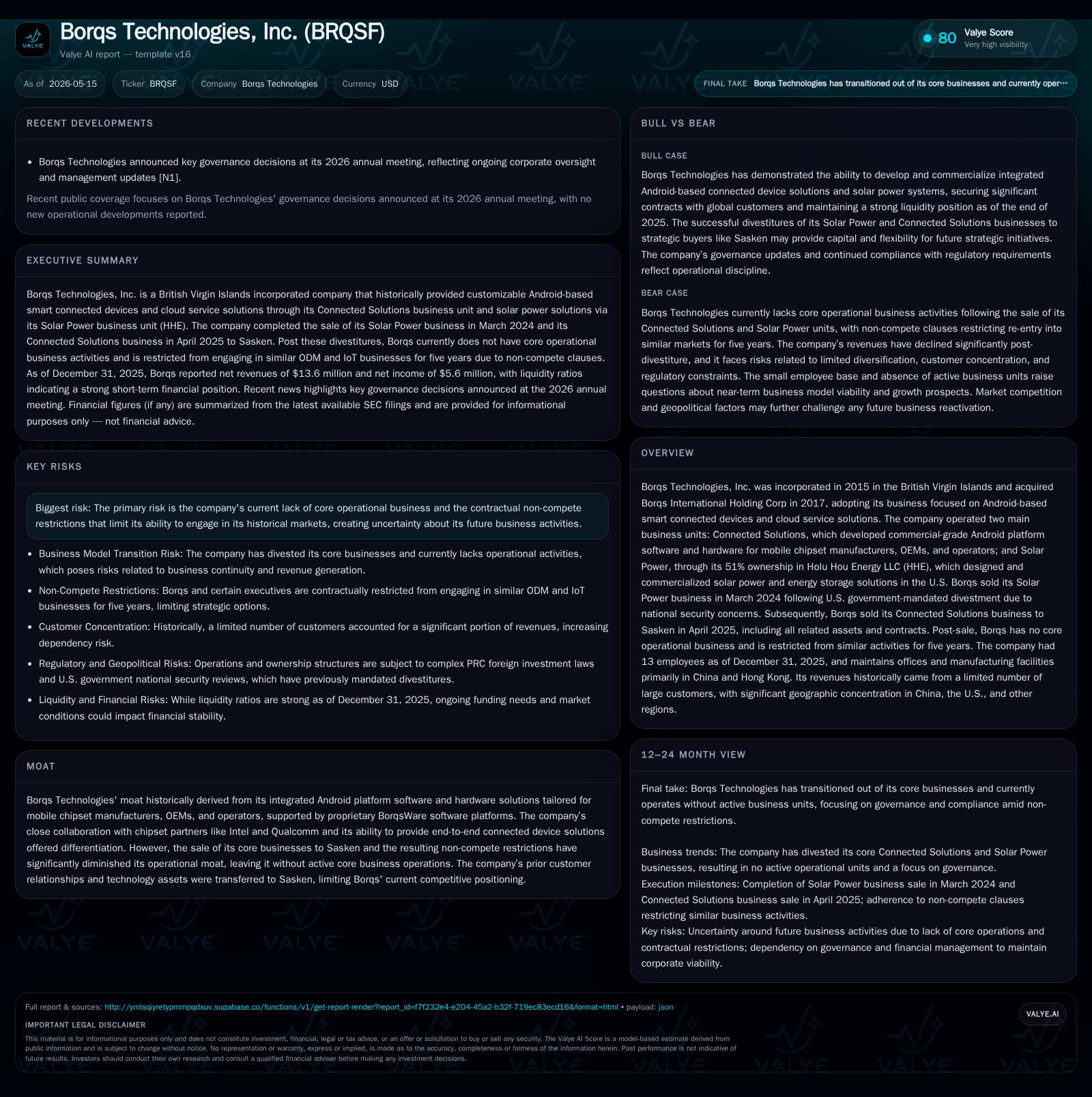
As of its latest quarterly filing in December 2025, Borqs Technologies no longer operates its historical Connected Solutions or Solar Power businesses following mandated divestitures completed by mid-2025. This fundamental shift leaves Borqs without active core operations and bound by non-compete clauses restricting re-entry into prior markets. While its former integrated Android platform and hardware ecosystem once represented a differentiated market position, the transfer of assets and contracts to Sasken erodes its competitive moat. The company’s future trajectory is uncertain, hinging on governance decisions, potential new ventures, and liquidity management amid operational dormancy.
Recent Operating Update: Post-Divestiture Financial Reporting
Borqs Technologies' most recent interim financial statements filed in December 2025 reflect a company fundamentally transformed: it no longer has any core operating revenue as of the first half of 2025 [S2]. This follows the completion of asset sales executed in early 2025, where its Connected Solutions business — traditionally the company's primary revenue engine — was sold to Sasken Design Solutions Pte. Ltd. in April 2025 [S1]. Prior to this, Borqs also exited its Solar Power segment, disposing of its majority ownership in Holu Hou Energy LLC (HHE) due to U.S. government-imposed divestment mandates completed in March 2024 [S1],.
Evolving Business Model: From Commercial Android Solutions to Operational Dormancy
For over nearly a decade, Borqs built its operational foundation around two main units: Connected Solutions and Solar Power [S1]. The Connected Solutions BU provided vertically tailored Android software platforms and complementary hardware to major chipset manufacturers like Intel and Qualcomm, device OEMs, and mobile operators [S1]. Proprietary offerings under the "BorqsWare" brand encompassed client-layer customizations across multiple device categories including phones, tablets, wearables, and IoT endpoints along with server-side cloud capabilities enabling end-to-end service deployment [S1].
Simultaneously, through controlling interest in HHE, Borqs engaged in residential and commercial solar energy storage solutions within the U.S. market until regulatory constraints necessitated divestment.
With both businesses now sold off by early-to-mid 2025, Borqs has exited active operations entirely. It currently holds no ongoing contracts or proprietary technology platforms that define its historic value proposition. The company no longer acts as an integrated connected device systems provider but exists as an asset-light holding entity devoid of operational business lines.
Industry Context: Competitive Pressures and Regulatory Impacts Leading to Divestitures
Borqs’ trajectory was heavily influenced by both market competition and geopolitical regulatory factors. The connected device software/hardware ecosystem is dominated by chipset giants (Qualcomm, MediaTek), OEM incumbents, and cloud service providers which exert scale advantages making differentiation difficult outside niche innovations. Borqs’ integrated approach once added value by providing customizable commercial-grade Android solutions across vertical markets.
However, intensified industry consolidation manifested in Sasken's acquisition of Borqs' Connected Solutions BU in April 2025 highlights the limited scale advantage Borqs could maintain independently [S14]. On a parallel track, national security concerns articulated by U.S. authorities led to Borqs’ mandated divestiture of HHE solar assets by March 2024—underscoring how geopolitical oversight severely constrained Borqs’ ability to operate within sensitive energy infrastructure segments.
These external pressures constricted strategic alternatives for Borqs post-2023.
Growth Opportunities Post-Core Asset Sale: Strategic Scenarios and Constraints
Presently, Borqs faces an uncertain path forward without active revenue-generating operations or proprietary product platforms. Given the binding five-year non-compete clauses restricting ODM (original design manufacturing) and IoT-oriented business activities acquired by Sasken [S14], any return to prior markets would be legally constrained at least until approximately 2030.
Prospective growth avenues must necessarily involve either venturing beyond legacy connected device domains or awaiting expiration of contractual restrictions before re-engaging historical expertise areas. Potential redeployment could target emerging adjacent technologies or cloud services unrelated to current covenants. Nevertheless, such transformation requires substantial capital infusion, talent acquisition, strategic innovation initiatives, and rebuilding customer trust without inherited contracts—a daunting proposition given current asset-light status.
Fundamental structural barriers imposed by lost IP rights and transferred customer relationships create formidable hurdles for sustainable organic growth absent transformative strategy shifts.
Risks and Challenges: Non-Compete Clauses, Moat Erosion, and Execution Uncertainty
Borqs discloses material risks centering on its lack of core business operations coupled with contractual non-compete obligations preventing engagement in key industry verticals for half a decade post-divestiture, [S1], [S14]. This effectively nullifies previously held proprietary moats grounded in integrated platform software-hardware solutions co-developed with major chipset partners.
Operational risk is heightened by management’s admission of material weaknesses in financial controls at year-end 2025 reflecting inadequate skilled staffing for complex U.S. GAAP compliance [S1]. Such issues could impede timely disclosures critical to investor confidence.
Uncertainty reigns concerning management’s execution capability to identify viable alternatives beyond legacy businesses while balancing cash flow constraints amid reduced operational scale.
This transitional limbo constitutes a credibility challenge vis-à-vis potential investors or strategic partners evaluating future prospects.
What Investors Should Monitor Next: Governance Actions, Financial Liquidity, and Potential New Ventures
Recent disclosures include governance decisions announced at the May 2026 annual meeting consistent with potential restructuring or strategic repositioning efforts [N1]. Close attention should be paid to further SEC filings for indications of new business initiatives or partnership formations that might redefine corporate purpose beyond traditional Android-connected device domains.
Financial liquidity metrics reveal adequate short-term capital sufficiency given approximately $2.6 million cash on hand against modest current liabilities totaling roughly $1.58 million as of end-December 2025—yielding a current ratio north of 5x signaling strong working capital coverage despite zero operating revenue [F1], [S2]. Total debt reported at $3.45 million (end-2023) suggests manageable leverage when offset against cash reserves although no fresh debt disclosures exist through year-end 2025.
Monitoring cash burn rates relative to incoming financing or asset monetizations will be crucial signals of survival runway.
Any easing of non-compete constraints through renegotiation or legal amendment would represent a critical catalyst unlocking market participation options.
Financial Snapshot: Current Liquidity and Leverage Overview
Latest financial snapshot
| Metric | Value | Period |
|---|---|---|
| Cash & equivalents | $3mm | |
| 2025-12-31 | ||
| Current assets | $9mm | |
| 2025-12-31 | ||
| Current liabilities | $1578000 | |
| 2025-12-31 | ||
| Current ratio | 5.39x | |
| 2025-12-31 |
Source: SEC companyfacts cache [F1].
| Metric | Amount (USD) |
|---|---|
| Cash & Equivalents | $2,615,000 |
| Total Debt | $3,450,000 |
| Current Assets | $8,506,000 |
| Current Liabilities | $1,578,000 |
On balance-sheet metrics from late-2025 frame a company holding reasonable liquidity cushions relative to near-term liabilities despite having ceased operating activities. The net debt position approximates $835,000 after factoring cash positions against outstanding debt balances previously reported [F1]. No significant long-term liabilities remain reported post-divestitures.
Operating income continues negative pressured primarily due to severance costs related to divisional sales and restructuring; however modest net income accrual reflects gains from subsidiary disposals [F1], [S2].
This financial stance supports ongoing overhead coverage but underscores imperative need for refreshed revenue engines going forward.
Disclaimer: This analysis is based solely on publicly available regulatory filings and news releases as cited; it does not constitute investment advice or recommendations nor does it incorporate any non-public information about Borqs Technologies Inc.
Disclaimer: This is research-only, informational analysis and not investment advice. It may include AI-generated interpretation and general industry context. Always verify important details using primary sources.

Comments