
ENvue Medical Advances Enteral Feeding Innovation While Managing Liquidity Challenges
Recent quarterly disclosures reveal ENvue Medical’s sustained commercialization of its FDA-cleared electromagnetic navigation platform for enteral feeding amid ongoing liquidity pressures.
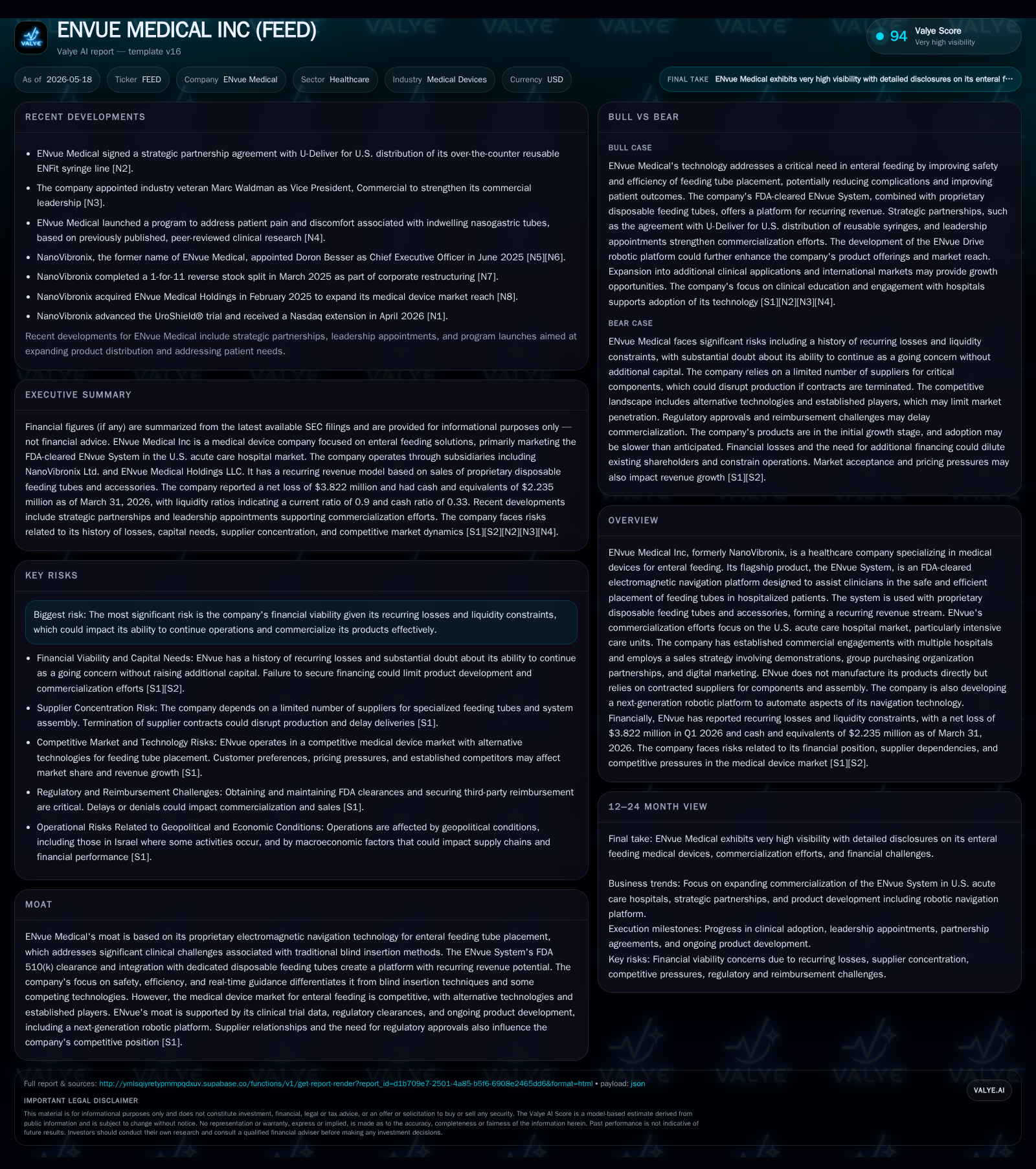
ENvue Medical’s May 2026 quarterly filing highlights continued progress in hospital engagements for its ENvue System, a proprietary electromagnetic feed tube placement technology targeted at ICU patients. While the company extends its commercial footprint with multiple U.S. hospitals and reinforces recurring disposable revenue streams, liquidity constraints persist, reflected in a current ratio below 1. ENvue’s business model leverages FDA clearance and recurring disposables to carve a differentiated niche within the competitive enteral feeding device market, though financial viability and regulatory scrutiny remain key risks. Near-term growth hinges on broader clinical adoption, reimbursement clarity, and advancement of next-gen robotic platforms.
Latest Quarter Signals Focused Progress Despite Lingering Financial Strains
ENvue Medical’s May 18, 2026 Form 10-Q outlines steady advancement in commercializing its ENvue System for enteral feeding tube placement across U.S. acute care hospitals, particularly intensive care units (ICUs) [S2]. The company continues to deepen clinical evaluations and implementations with multiple hospital partners supporting adoption. This indicates traction in a clinically critical segment where feeding tube misplacement risks drive demand for safer guidance technologies.
However, the company's liquidity profile shows pressure: as of March 31, 2026, ENvue held approximately $2.2 million in cash and equivalents against $6.9 million in current liabilities, yielding a current ratio near 0.9 [F1]. This under-1 ratio flags tight short-term financial flexibility amid ongoing investments in commercialization. The imbalance between current assets ($6.2 million) and liabilities underscores a need for capital management or raising to sustain growth ambitions [F1].
Thus, while operational momentum persists through expanded hospital engagements with the ENvue System, financial headwinds temper immediate outlooks.
Business Model and Product Innovation: The ENvue System’s Value Proposition
ENvue Medical derives revenue principally from the sale of its proprietary ENvue System—a Class II medical device cleared via FDA 510(k) process—designed to assist clinicians safely and efficiently place enteral feeding tubes using an electromagnetic navigation platform [S1]. This system provides real-time guidance during tube insertion, distinguishing it from conventional blind insertion techniques that carry higher risk of patient complications.
The product offering includes the navigation system hardware alongside proprietary disposable feeding tubes and associated accessories that are single-use. These disposables generate recurring revenue streams integral to ENvue’s financial model. This integrated hardware-disposable tether creates switching costs and incentivizes hospitals to continue using ENvue consumables once enrolled.
Manufacturing is outsourced to contracted suppliers such as B Star Inc and Plastic One; these relationships lack formal written agreements but allow procurement flexibility for cost competitiveness [S1]. The absence of long-term supplier contracts introduces both supply risk and opportunistic agility.
Commercialization targets U.S. acute care settings with focus on ICUs where enteral feeding is frequent. Sales efforts emphasize group purchasing organization (GPO) partnerships, clinical demonstrations for physicians/nurses, and digital marketing aimed at clinician education [S1]. Training is critical given physician hesitation to switch from standard blind methods.
ENvue’s FDA clearance and its associated clinical data provide a regulatory moat relative to non-navigational alternatives or emerging navigational competitors who lack similar approvals. The system’s focus on procedural safety plus efficiency improvements aligns well with hospital safety initiatives prioritizing risk mitigation.
Competitive Dynamics and Industry Structure in Enteral Feeding Devices
The enteral feeding device landscape remains competitive yet fragmented due to the entrenched nature of blind insertion methods long established as standard care despite their drawbacks. ENvue’s electromagnetic navigation provides a differentiating technological leap but faces adoption barriers intrinsic to hospital procurement cycles and clinical workflow integration.
FDA 510(k) clearance for the ENvue System serves as a noteworthy barrier versus other navigational or placement verification tools under development or marketed without clearance. However, pricing power is limited given hospitals’ budget constraints and competing legacy techniques.
Key competitors include companies offering alternative imaging or directional technologies for feeding tube placement; however many do not match ENvue’s demonstrated clinical efficacy or integration with dedicated disposable products. Peer device providers may wield greater scale or deeper reimbursement networks making incremental penetration challenging.
Industry structure also features stringent regulatory oversight governing market entry, post-market surveillance, manufacturing quality controls compliant with Good Manufacturing Practices (GMP), and compliance with healthcare fraud/abuse laws that impact promotional activities [S3–S13]. These factors collectively temper pricing leverage but reward firms like ENvue able to navigate regulatory landscapes effectively.
Key Growth Drivers: Commercial Expansion and Next-Generation Development
ENvue’s near-term growth drivers hinge primarily on expanding hospital adoption volumes beyond existing partnerships through increased salesforce deployment and intensified clinical education to overcome clinician habituation biases toward blind insertion [S1]. Demonstrations coupled with GPO arrangements aim at accelerating contract wins across ICUs nationally.
Recurring revenues from consumable disposable tubes underpin predictable income streams post-system installation—stabilizing cash flow if broad utilization materializes. This product mix emphasis can improve margin profiles over time given lower variable costs for disposables compared to hardware sales.
Product pipeline initiatives include development of next-generation robotic-assisted platforms designed to enhance precision & automation during tube placement. Such innovations could further differentiate ENvue versus rivals while addressing labor-intensive procedural aspects limiting widespread clinician usage today.
On reimbursement front, CMS approval of Healthcare Common Procedure Coding System (HCPCS) code K1004 since January 2020 facilitates Medicare coverage for the ENvue System [S1][S24], but achieving favorable reimbursement rates remains critical for commercial scaling.
In summary, executing on sales expansion combined with continued R&D breakthrough products comprises the dual pathway toward increasing market penetration and elevating technological leadership within enteral feeding device solutions.
Risks and Constraints: Financial Viability and Regulatory Hurdles
The overwhelmingly dominant risk highlighted in filings stems from ongoing operating losses compounded by liquidity constraints—the company carries substantial accumulated deficits accentuating doubts over sustained operations absent capital injections [S1]. Management explicitly acknowledges “substantial doubt” about going concern status highlighting critical urgency surrounding financing efforts.
Regulatory risk encompasses rigorous FDA post-market reporting obligations plus potential enforcement actions ranging from warning letters to product recalls upon safety incidents [S4–S8]. Failures in compliance or adverse events could materially harm reputation and incur costly liabilities including exposure to product liability claims despite current insurance coverages which may prove insufficient [S4][S6]
Another operational challenge arises from reliance on contract manufacturers lacking long-term supply agreements meaning disruptions could impair production continuity though alternatives exist topically [S17]. Compliance with evolving healthcare fraud & abuse statutes also adds complexity around promotional practices for reimbursement support programs adding litigation risk uncertainty [S11–S13][S19].
Finally, broader macroeconomic volatility exemplified by geopolitical tensions could adversely impact capital access amplifying already tight funding landscape restricting growth investment capacity [S20].[F1]
Upcoming Catalysts and Milestones to Monitor in ENvue’s Commercial Trajectory
Monitoring effective metrics related to increased hospital installations/disposables consumption will serve as primary performance indicators validating commercial traction improvements post Q1 2026 disclosures [S1]
Key regulatory developments including new FDA clearances linked to next-generation products or expanded indications would directly influence competitive positioning [S1]. Likewise progress toward enhanced Medicare reimbursement rates beyond HCPCS code existence constitutes important gating factors enabling wider payer acceptance impacting volume forecasts.
Management communications around expanded salesforce hires or novel GPO contracts likewise represent execution signals worth close scrutiny confirming scaling capability versus clinical inertia barriers.
Technological milestones such as final developmental stages or pilot program outcomes related to robotic-assist systems under research will be pivotal inflection points shaping long-term innovation trajectory and potential market share gains.
In essence, multi-modal catalyst tracking encompassing commercial metrics plus regulatory/technological advances constitutes vital surveillance dimension assessing sustainable growth pathways ahead.
Financial Snapshot: Liquidity Status Reinforces the Need for Capital Management
At quarter-end March 31, 2026 ENvue reported $2.2 million in cash & equivalents alongside $6.9 million in current liabilities yielding a sub-1x current ratio (~0.9), signaling near-term liquidity constraints placing pressure on working capital adequacy [F1]. Total debt stands modestly at approximately $1.25 million recorded in early 2025; net cash position considering debt approximates negative $980k given available data dated then [F1].
The stretched balance sheet demands vigilant capital management contrasted against ongoing cash burn driven by commercialization investments underpinning incremental customer acquisition expenses along with R&D outlays related to next-gen systems development.
Without successful capital raises or margin expansions bolstered by stronger repeat consumable sales volumes borne from broader installed base growth, runway compression risks intensify potentially impeding product rollout pace or necessitating operational cutbacks.
These financial realities underscore core vulnerability delineated repeatedly by management cautioning about future funding dependencies thus framing operational achievements within constrained resource envelope compelling prioritization choices until sustainable profitability approaches emerge reliably.[F1][S2]
This analysis emphasizes documented facts from recent filings alongside sector-specific context integrating competitive dynamics and regulatory frameworks relevant to ENvue Medical's niche. It refrains from speculative projections or investment guidance while flagging key operational themes grounded explicitly in cited sources. Readers should consider this an informed industry evaluation rather than counsel on securities decisions.
Disclaimer: This is research-only, informational analysis and not investment advice. It may include AI-generated interpretation and general industry context. Always verify important details using primary sources.

Comments