
60 Degrees Pharmaceuticals Advances Tafenoquine Trials as Nasdaq Compliance Stabilizes
Regaining Nasdaq compliance through a reverse stock split supports ongoing clinical initiatives and strategic licensing activities for SXTP.
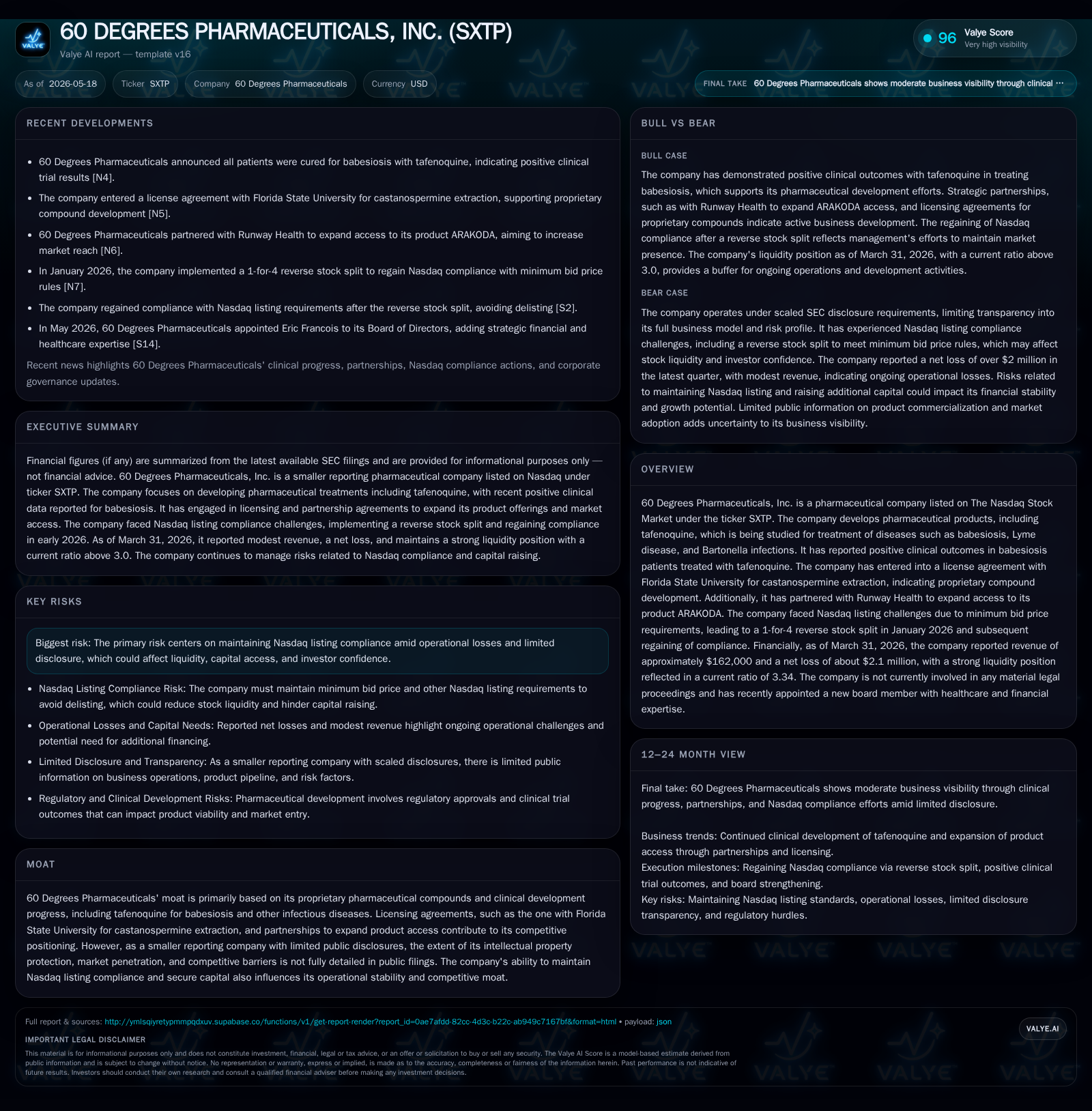
In its latest quarterly filing, 60 Degrees Pharmaceuticals secured Nasdaq listing compliance after executing a 1-for-4 reverse stock split in early 2026, alleviating market liquidity concerns. Concurrently, the company continued advancing tafenoquine clinical trials targeting babesiosis and other infectious diseases, while expanding its intellectual property portfolio via a licensing agreement with Florida State University. The appointment of Eric Francois to the board adds seasoned financial leadership amid ongoing capital needs. These developments collectively underpin operational stability and potential growth catalysts in a challenging biotech environment.
Latest Operational Developments: Quarterly Insights and Board Update
60 Degrees Pharmaceuticals' most recent quarterly filing dated May 15, 2026, anchors the current operational narrative [S2]. The company executed a critical corporate restructuring measure—a 1-for-4 reverse stock split initiated in January 2026—to regain compliance with Nasdaq's minimum bid price rule of $1.00 per share. This maneuver successfully addressed risk of delisting that had emerged due to prior pricing pressures, reinstating confidence in the stock’s tradability and supporting liquidity [S2], [S15]. Maintaining this compliance is vital as delisting could materially compromise investor access and capital raising ability.
Alongside regulatory status management, SXTP is actively progressing its core product development programs. Tafenoquine remains the company’s flagship candidate under clinical evaluation for treatment of emerging tick-borne infectious diseases including babesiosis, Lyme disease, and Bartonella infections. The latest disclosures reiterate positive clinical outcomes in babesiosis patients treated with tafenoquine, suggesting unmet therapeutic needs targeted by an oral drug that has already seen some regulatory approvals under other indications [S1].
Complementing its pharmaceutical pipeline efforts was the announcement of a new licensing agreement with Florida State University for the extraction and use of castanospermine—a proprietary compound potentially augmenting SXTP’s antiviral or antimicrobial assets [S1]. This signals an intent to broaden intellectual property coverage strategically.
Enhancing governance capabilities, 60 Degrees Pharmaceuticals appointed Eric Francois to its Board of Directors effective May 13, 2026. Mr. Francois’ background includes over two decades in healthcare investment banking, equity transactions specific to biotech innovators, and executive finance roles pivotal for commercial-stage life sciences companies [S3], [S24]. His inclusion is expected to bolster strategic financial oversight during SXTP’s growth phase.
Product Portfolio and Business Model Overview
60 Degrees Pharmaceuticals operates primarily within the specialized niche of infectious disease therapeutics leveraging both proprietary drug candidates and licensed compounds. The centerpiece product under clinical development is tafenoquine—an antimalarial drug being repurposed and studied extensively against babesiosis alongside Lyme disease and Bartonella infections. Babesiosis represents a vector-borne parasitic disease with growing epidemiological importance; tafenoquine offers an oral treatment alternative addressing compliance challenges posed by current regimens [S1].
The company’s revenue generation mechanics revolve around sales of commercial products like ARAKODA alongside income from licensing agreements and partnerships. For example, ARAKODA—which is commercially available—benefits from expanded distribution through collaborators such as Runway Health aiming to scale patient access [S1]. Licensing intellectual property rights from Florida State University to utilize castanospermine extraction diversifies early-stage assets feeding into SXTP’s pipeline development.
Customers include healthcare providers treating vector-borne infections who pay through third-party payers or end patients depending on market dynamics. Pricing power is likely limited by generic competition risks inherent in anti-infective markets; thus innovation-driven exclusivity coupled with regulatory approvals are important margin levers [S1]. The patent estate strength from licensed compounds underpins competitive differentiation but remains partially unquantified publicly
Competitive Environment and Industry Context
Operating as a smaller reporting life sciences company focused on infectious diseases positions 60 Degrees Pharmaceuticals within an increasingly crowded therapeutic domain challenged by complex biology and demanding regulatory pathways. Competitors range from well-capitalized biotech firms advancing novel antimicrobial agents to legacy pharmaceutical companies supplying generic treatments.
Differentiation stems from proprietary compounds like tafenoquine that have demonstrated unique efficacy profiles in emerging infectious indications lacking robust alternatives. Licenses such as Florida State University’s castanospermine extraction process add potential antiviral synergies not widely available among peers [S1]. Regulatory approval hurdles are significant; success depends on timely clinical readouts confirming safety/efficacy plus securing appropriate label expansions.
Nasdaq listing fluctuations also amplify perceived risk relative to better-capitalized peers with stable exchange presence. Clinical milestone tracking remains paramount since positive results translate directly into valuation inflections more so than steady revenues at this stage.
Growth Drivers and Development Catalysts
Growth prospects largely depend on near-term clinical data releases validating tafenoquine’s efficacy in babesiosis—an underserved indication where incremental progress can create first-mover advantages. Expansion into related infectious disease areas like Lyme disease represents an adjacent opportunity if clinical endpoints prove favorable.
Commercial traction is boosted by partnerships aiming to enhance distribution networks for marketed products such as ARAKODA; Runway Health collaboration exemplifies extending reach without internal selling infrastructure strain [S1]. Licensing initiatives like castanospermine extraction broaden technology breadth potentially enabling new therapeutic candidates or formulations.
Importantly, governance strengthening via Mr. Francois’ appointment may help tap deeper financing channels or M&A opportunities thanks to his investment banking pedigree focused on midcap biopharma players—critical for navigating development-stage capital demands [S3], [S24].
Overall, tangible catalysts include anticipated trial data releases, licensing milestone achievements, partnership expansion announcements, and maintenance of Nasdaq compliance—all integral to investor sentiment shifts.
Potential Risks and Operational Constraints
NASDAQ listing standards impose recurring pressure: the January reverse split followed a delisting notice triggered by sustained sub-$1 bid prices exacerbated by prior splits restricting grace periods under Nasdaq rules [S2], [S15], [S17]. Repeated necessity for structural share adjustments evidences fragile investor confidence linked closely to operating losses typical for emerging biotech firms.
Clinical advancement risks remain elevated given early-stage trials still require confirmation across larger patient cohorts; failure would stall pipelines severely. Disclosure limits inherent in scaled reporting status constrain transparency contributing to valuation volatility.
Capital access challenges are implicit given net operating losses approaching $7 million annually weighed against finite cash reserves (~$3.3 million) without confirmed revenue scale-up beyond limited licensed product sales [F1]
Market competition intensity from better-funded biotech peers investing aggressively in anti-infective innovation adds another structural constraint requiring continuous innovation velocity.
Key Upcoming Catalysts to Monitor
Attention should center on release schedules for tafenoquine clinical trial data updates that will indicate progression from preliminary positive outcomes toward broader efficacy validation [S2], [S1]. Successful endpoint achievement could unlock regulatory pathways enabling commercialization expansion.
Licensing milestones tied to Florida State University compound utilization may offer near-term news flow dependent on research progress or sublicensing agreements.
Additional partnership announcements aimed at scaling commercial footprint (beyond Runway Health) would signal execution capability improving revenue trajectory.
Finally, monitoring Nasdaq compliance status post-reverse split remains crucial in mitigating delisting risk which directly impacts market liquidity and capital sourcing conditions.
Financial Overview: Positioning Amidst Investment Needs
Financially, as of March 31, 2026, SXTP held approximately $3.3 million in cash and equivalents against current liabilities around $1.9 million yielding a solid current ratio of roughly 3.34—a measure indicating short-term solvency capacity [F1]
Nevertheless, operating losses persist substantially with net income deficits close to $7.4 million per latest annual scope reflecting ongoing investment in clinical development without proportional revenue inflows exceeding about $1 million yearly at present scales [F1]. Hence cash burn remains a salient feature necessitating continued capital injections either via equity raises or strategic collaborations.
Adding experienced financial leadership through Director Francois aligns well with this capital-intensive model requiring disciplined funding strategies informed by nuanced market relationships within healthcare investment sectors [S3], [S24].
This analysis is grounded solely on public filings from the company including its May 2026 quarterly report (10-Q), recent Form 8-K updates regarding governance changes (board appointment), and the annual report (10-K) providing business context combined with verified financial snapshots reflecting balance sheet strength relative to operational expenditure trends. No investment advice is offered herein; readers should perform independent due diligence before engaging financially with securities discussed.
Disclaimer: This is research-only, informational analysis and not investment advice. It may include AI-generated interpretation and general industry context. Always verify important details using primary sources.

Comments