
Bally's Corp Signals Strategic Pivot Amid First Quarter Losses
Q1 2026 results reveal ongoing net losses paired with new secured financing, highlighting a critical juncture for Bally's Corp’s growth and leverage management.
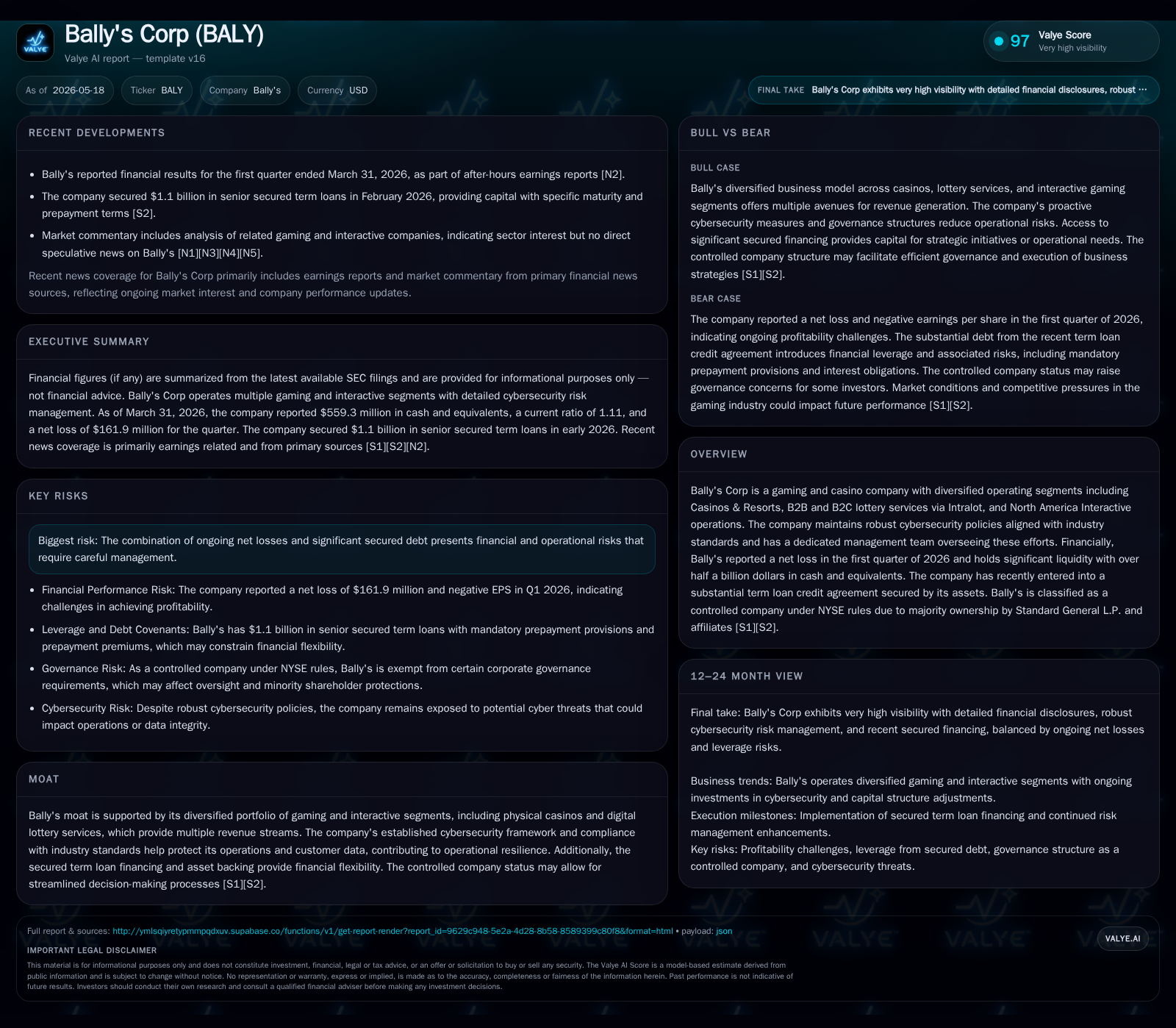
Bally's Corp reported a net loss in Q1 2026 alongside the securing of a substantial $1.1 billion term loan credit facility collateralized by company assets, balancing liquidity needs against high leverage. The company's diversified business model spans physical casinos, B2B/B2C lottery services through Intralot, and growing North American interactive gaming, positioning it with multiple revenue streams but also operational complexity. While cybersecurity and regulatory compliance efforts support operational resilience, Bally's faces significant risks from its elevated debt load, sustained negative operating income, and competitive pressures in digital gaming. Monitoring quarterly margin trends, refinancing steps, and digital user growth will be key to assessing the company's path forward.
Latest Quarterly Operating Update: Losses and New Financing
In its first quarter ending March 31, 2026, Bally’s Corp reported continuing financial headwinds with a net loss that accentuates ongoing operating challenges in its core gaming businesses [S2][S3]. Alongside this operational loss, the company has reinforced its liquidity position through a $1.1 billion term loan credit agreement closed in early 2026. This credit facility comprises a $600 million initial term loan plus a $500 million delayed draw tranche secured by substantially all of Bally’s assets [S3][S19][S27]. The simultaneous occurrence of large net losses with this new secured financing highlights a critical balancing act between sustaining near-term operational funding needs and managing a significant leverage burden.
As of March 31, 2026, Bally’s held approximately $559 million in cash and cash equivalents versus total debt levels nearing $4.83 billion, resulting in an estimated net debt position above $4.26 billion [F1]. The current ratio stood at about 1.11x, signaling only modest short-term liquidity coverage [F1]. This dynamic underscores the imperative for strong cash flow generation or asset monetization strategies to meet forthcoming debt maturities and interest obligations within a challenging macroeconomic backdrop.
Business Model Overview: Casinos, Lottery Services, and Interactive Gaming
Bally’s operates a diversified portfolio across gaming verticals aimed at broadening revenue streams and mitigating single-segment volatility [S1]. Its Casinos & Resorts segment encompasses physical properties offering traditional gaming alongside hospitality services. Complementing this is Bally's integration of B2B and B2C lottery operations through its stake in Intralot, providing recurring revenue from lottery system sales, terminal placement services, and operational management across various jurisdictions.
The North America Interactive business capitalizes on regulated digital betting markets including sports wagering and online casino platforms—a segment experiencing accelerated consumer adoption driven by shifting preferences toward online engagement post-pandemic [S1]. The interplay across these segments creates cross-selling potential while requiring nuanced management of distribution channels, regulatory compliance frameworks for each vertical, and technology investments to sustain competitive differentiation.
Fundamental to the business model is revenue derived primarily from customer wagers (in physical casinos or online platforms) and contractual revenues from lottery services (both hardware/software licensing and service fees). Pricing power varies modestly due to competitive market conditions in physical venues but is enhanced digitally through proprietary platforms driving improved user retention and engagement metrics.
Additionally, Bally’s has embedded mature cybersecurity policies—including adherence to PCI-DSS standards and an ISMS aligned with ISO 27001/27701 frameworks—to safeguard customer data integrity across digital endpoints [S1]. These protocols not only protect operational continuity but also strengthen stakeholder confidence amidst rising cyber threats common to gambling enterprises.
Competitive Position and Industry Structure
Within the broader gaming industry ecosystem dominated by several large regional operators and expanding digital entrants, Bally’s commands a distinctive position owing to its multi-channel presence incorporating brick-and-mortar casinos alongside rapidly scaling interactive offerings [S1]. The company benefits structurally from its controlled status under majority ownership by Standard General L.P., enabling streamlined governance agility potentially advantageous when deploying capital-intensive initiatives or navigating regulatory shifts.
However, the industry environment entails inherent challenges: physical casinos often confront capacity limitations constrained by local regulations or real estate; lottery businesses face competitive licensing renewals amid evolving state policies; and digital gaming players encounter ever-increasing competition from well-funded peers like DraftKings [N1], requiring technological innovation plus aggressive marketing spending.
Price sensitivity remains acute partly due to moderate customer switching costs in gaming entertainment—particularly online—necessitating continual platform enhancements. Moreover, regulatory compliance represents an ongoing overhead impacting margins but also serves as a barrier to entry that restricts some competitive threats.
Key Growth Drivers: Digital Penetration and Portfolio Expansion
Digital expansion forms the cornerstone for Bally's future growth trajectory as interactive betting continues gaining consumer share across North America [S1][S2]. The company leverages established lottery infrastructure through Intralot to diversify geographical footprints while simultaneously developing proprietary platforms enhancing customer engagement metrics such as average revenue per user (ARPU) and repeat visitation online.
Strategic acquisitions complement organic growth; recent asset deals including sale-leaseback transactions provide additional capital flexibility fueling both physical property upgrades and digital product development [S3][S5]. Cross-segment synergies potentially elevate customer lifetime value when users engage across physical casino visits coupled with online wagering activities.
Additionally, recurring revenues from long-term lottery service contracts offer stability amid cyclicality inherent in discretionary spend sectors like gaming. Digital channels also allow more granular pricing strategies via dynamic odds-making tools improving margin profiles over traditional fixed-fee models.
Risks and Strategic Challenges Ahead
Despite strategic diversification benefits, Bally’s carries significant financial risks anchored in its high leverage profile reflected in net debt exceeding $4.2 billion post-cash [F1]. Sustained negative operating income pressures cash flows necessary to service interest expense within the terms of the February 2026 secured term loan credit agreement that includes prepayment premiums and restrictive covenants limiting free cash deployment options [S19][S27]. Refinancing risk intensifies if economic or market conditions hamper access to affordable capital.
Operationally, although cybersecurity frameworks are robust currently with no material breaches reported that impacted financial condition [S1], exposure remains non-negligible given the sensitive data across proprietary interactive systems. Regulatory tightening targeting online gaming or lottery concessions introduces further uncertainty particularly across multiple U.S. states where lotteries function under separate authorities.
Competitive intensity escalates against well-capitalized digital-focused operators such as DraftKings experiencing stock volatility recently that signals sector sentiment challenges [N1]. Margins may continue facing headwinds due to promotional spend requirements needed to sustain user acquisition/retention online.
Monitoring Points and Upcoming Milestones
Investor focus should track sequential quarterly earnings updates assessing whether Bally’s can narrow operating losses either via higher volume scale or improved pricing/mix within interactive segments post-Q1 2026 baseline [S2][S3]. Key metrics for digital growth include active user base changes alongside ARPU trends if reported publicly.
Regulatory news impacting lottery license renewals or extensions likewise remain important given their contribution to stable high-margin recurring revenues.
Physical casino performance amid macroeconomic variability affecting discretionary consumer spending warrants monitoring particularly regarding occupancy rates, average spend per visit, and capacity utilization constraints.
Financial Summary: Liquidity, Debt Profile, and Cash Position
As of the end of Q1 2026, Bally’s held cash reserves approximating $559 million against total reported debt near $4.83 billion leading to net debt around $4.27 billion [F1]. The current ratio approximated 1.11x evidencing only marginal short-term operational liquidity buffer once current liabilities are considered [F1].
This financial posture demands disciplined margin recovery initiatives alongside possible asset monetizations or selective divestitures to improve balance sheet health while maintaining investment capability for growth segments especially digital interactive channels.
Disclaimer: This analysis is intended solely for informational purposes grounded in publicly available filings as of May 18, 2026. It is not investment advice nor does it recommend any particular action regarding securities of Bally's Corp.

Comments