
NutriBand Braces for FDA Filing as CEO Temporarily Steps Back
Leadership transition during a critical regulatory phase underscores operational and strategic challenges ahead for NutriBand.
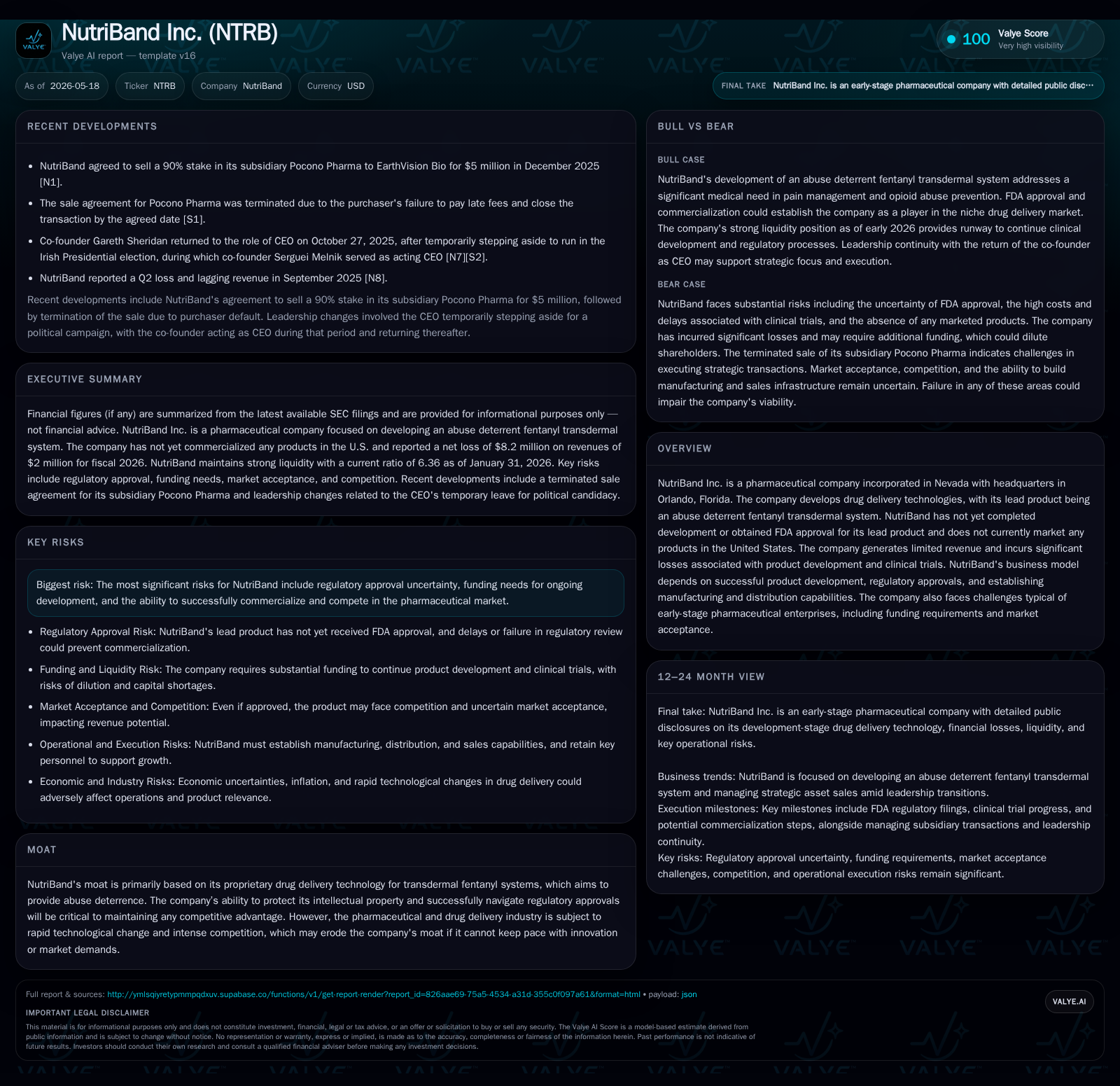
NutriBand Inc. is advancing toward a planned FDA New Drug Application (NDA) filing for its abuse-deterrent fentanyl transdermal system amidst a temporary CEO absence. Co-founder Serguei Melnik has assumed interim CEO duties, focusing on steering the company through its final development and regulatory milestones in 2026. As an early-stage pharmaceutical player with no current marketed products, NutriBand faces typical sector risks including regulatory uncertainties, funding requirements, and the need to establish manufacturing and commercial infrastructure. A recent capital markets-savvy leadership shift may help stabilize strategic execution during this critical period. The company's financial position shows modest revenue from early activities but substantial operating losses and adequate liquidity to support near-term operations.
Latest Operational Developments and Leadership Update
NutriBand’s latest quarterly disclosure dated December 11, 2025 [S2] reveals a significant near-term leadership adjustment impacting firm operations. CEO Gareth Sheridan temporarily stepped away starting August 2025 to pursue the Irish Presidential election campaign through October 27, 2025; during his absence, co-founder and Chairman Serguei Melnik assumed the role of interim CEO [S4]. Melnik's extensive two-decade experience in corporate strategy and capital markets provides continuity in governing NutriBand’s trajectory through critical milestones. This temporary change occurs just as NutriBand approaches the planned submission of its New Drug Application (NDA) for its lead product in the first half of 2026—a highly material event dictating future valuation paths.
Leadership stability is central at this juncture given the complex regulatory environment and execution demands inherent in pharmaceutical product development. Melnik's capital markets background aligns with investor relations needs as NutriBand navigates funding pipelines amidst ongoing losses. Sheridan is expected to resume his CEO responsibilities after the election cycle raises questions about potential shifts back to primary leadership and their implications on strategic focus [S3][S4].
NutriBand’s Drug Delivery Technology and Product Pipeline
NutriBand operates principally within drug delivery technology specializing in abuse-deterrent systems for opioid therapeutics. Its lead asset under development is an abuse deterrent fentanyl transdermal system — essentially a patch designed to deliver fentanyl while mitigating the risk of misuse or diversion associated with opioids [S1][S25]. This technology differentiates NutriBand by addressing growing market demands shaped by opioid abuse crises and heightened regulatory scrutiny.
The company does not yet market any products domestically or internationally; thus, current revenues derive from precommercial collaborations or limited licensing arrangements tied to development-stage activities [F1]. The business model hinges precariously on achieving FDA approval—a lengthy process engendering high costs prior to revenue generation—a common trait among early-stage pharmaceutical entities stunned by clinical development expenses.
NutriBand’s proprietary formulations and method patents aim to establish an intellectual property moat; however, fast-evolving drug delivery innovations require continuous R&D investment to maintain technological relevance amidst emergent competitors deploying alternative abuse deterrent mechanisms or non-opioid pain management solutions [S25].
Pharmaceutical Industry Context: Regulatory Hurdles and Competition
The industry backdrop presents substantial headwinds linked primarily to regulatory complexity around opioids. The FDA enforces rigorous clinical efficacy and safety standards with emphasis on abuse prevention—a crucial barrier underscored by sociopolitical pressures on opioid prescribing practices [S5][S6]. NutriBand must navigate these layered requirements while managing elongated trial timelines that inherently delay time-to-market.
Competition arises not only from established generic opioid patches but also from other innovators integrating novel chemical or mechanical abuse deterrent features. Alternative pain therapies further fragment potential market share. Consequently, maintaining technological differentiation without succumbing to obsolescence stands as a persistent challenge modeled after fast-paced innovation cycles characteristic of drug delivery platforms [S7].
Market acceptance post-approval hinges on prescriber trust, payor reimbursement strategies, effective sales channels, and demonstrable patient benefits — all critical given entrenched incumbents in opioid analgesics with extensive prescriber relationships.
Growth Engines: FDA Filing Milestone and Commercial Readiness
The foremost growth catalyst lies in completing the NDA filing during 2026, aligning with statutory requirements outlined by regulatory authorities [S2][S28]. Achieving this milestone offers a valuation inflection by transitioning NutriBand from a purely clinical-stage entity to a commercial-stage contender.
Parallel commercial preparation has been augmented by an amended Clinical Development and Supply Agreement with Kindeva Drug Delivery L.P., a specialized contract manufacturer covering both clinical supply continuity and scalable commercial production capabilities [S1][S28]. This partnership mitigates operational risk tied to meeting complex quality standards necessary for pharmaceutical manufacturing while enabling more rapid channel entry upon approval.
Establishing distribution infrastructure remains unaddressed explicitly but will be imperative for eventual market penetration. Given lack of internal marketing infrastructure common among small biopharma firms, NutriBand may rely heavily on third-party sales outsourcing or licensing deals post-approval.
Key Risks: Regulatory Delays, Funding Needs, and Market Adoption
NutriBand confronts multifaceted risks with its bar set high due to FDA approval unpredictability surrounding opioids compounded by societal pushback on opioid proliferation [S6][S7]. Delays in clinical trial outcomes or additional requested studies could extend timelines beyond expectations increasing cash burn.
Funding shortfalls present existential threats as ongoing R&D expenditures significantly outpace revenues. Given reported operating losses nearing $8.3 million alongside limited liquidity resources [F1], raising sufficient fresh capital is mandatory but fraught with potential dilution hazards scrutinized under volatile equity market conditions common for experimental pharma startups [S2][S6].
Intellectual property protection constitutes another vulnerability since rapid technological advances or competitor innovations may erode NutriBand’s value proposition if patent enforcement or renewal falters. Market adoption depends heavily on payor reimbursement landscapes that remain unsettled amid broader U.S. healthcare pricing debates.
Operational risks also stem from dependence on component suppliers' reliability amid inflationary pressure affecting procurement costs affecting gross margins adversely [S6]. Leadership transition nuances add an execution uncertainty overlay requiring careful monitoring to avoid strategic drift amid key personnel absences.
Forward Look: Upcoming Catalysts and Execution Watchpoints
Investors should observe several critical execution points over the next 6 to 12 months:
- The submission status of the NDA expected within calendar year 2026 per company disclosures poses an immediate binary event [S2][S3].
- Monitoring CEO Gareth Sheridan’s return post-Irish presidential election cycle will clarify leadership tenor going forward possibly impacting strategic initiatives continuity [S4].
- Updates regarding clinical trial progress or readouts accompanying manufacturing supply chain expansion via Kindeva could serve as tangible operational markers validating developmental momentum [S1][S28].
- Shareholder governance developments such as NutriBand’s executive compensation clawback policy adoption signal enhanced oversight aiming at improving corporate governance credibility following recent changes [S1].
These indicators collectively gauge whether NutriBand advances steadily toward commercialization readiness or faces setbacks delaying market arrival.
Financial Position and Capital Structure Overview
According to the most recent fiscal year-end data dated January 31, 2026 [F1], NutriBand reported:
- Revenue approximating $2.0 million reflecting nascent commercial engagement.
- Operating loss totaling about $8.3 million highlighting substantial investment into product development without offsetting income streams.
- Net loss slightly less than operating loss at approximately $8.2 million factoring non-operating items.
- Cash & equivalents standing at roughly $4.6 million providing near-term liquidity runway.
- Negligible debt levels (~$900), leading to a strong current ratio near 6.36x illustrating balance sheet solidity but limited scale.
This financial snapshot underscores typical dynamics of early-stage pharma where R&D investment drives negative earnings while cash buffers sustain short-term viability pending successful financing rounds or milestone achievements driving new capital inflows.
This analysis is based exclusively on publicly available SEC filings without speculative projections or insider information. It aims to provide an informed perspective rooted in disclosed corporate developments relating directly to NutriBand’s operational status, industry positioning, growth dynamics, risks, governance changes, and financial health through early-mid 2026.
Disclaimer: This is research-only, informational analysis and not investment advice. It may include AI-generated interpretation and general industry context. Always verify important details using primary sources.

Comments