
BioCardia Pursues Regulatory Milestones with Helix Delivery Amid Liquidity Pressures
BioCardia's latest quarter highlights simultaneous strides in clinical development and regulatory progress, shadowed by acute capital constraints and Nasdaq compliance risks.
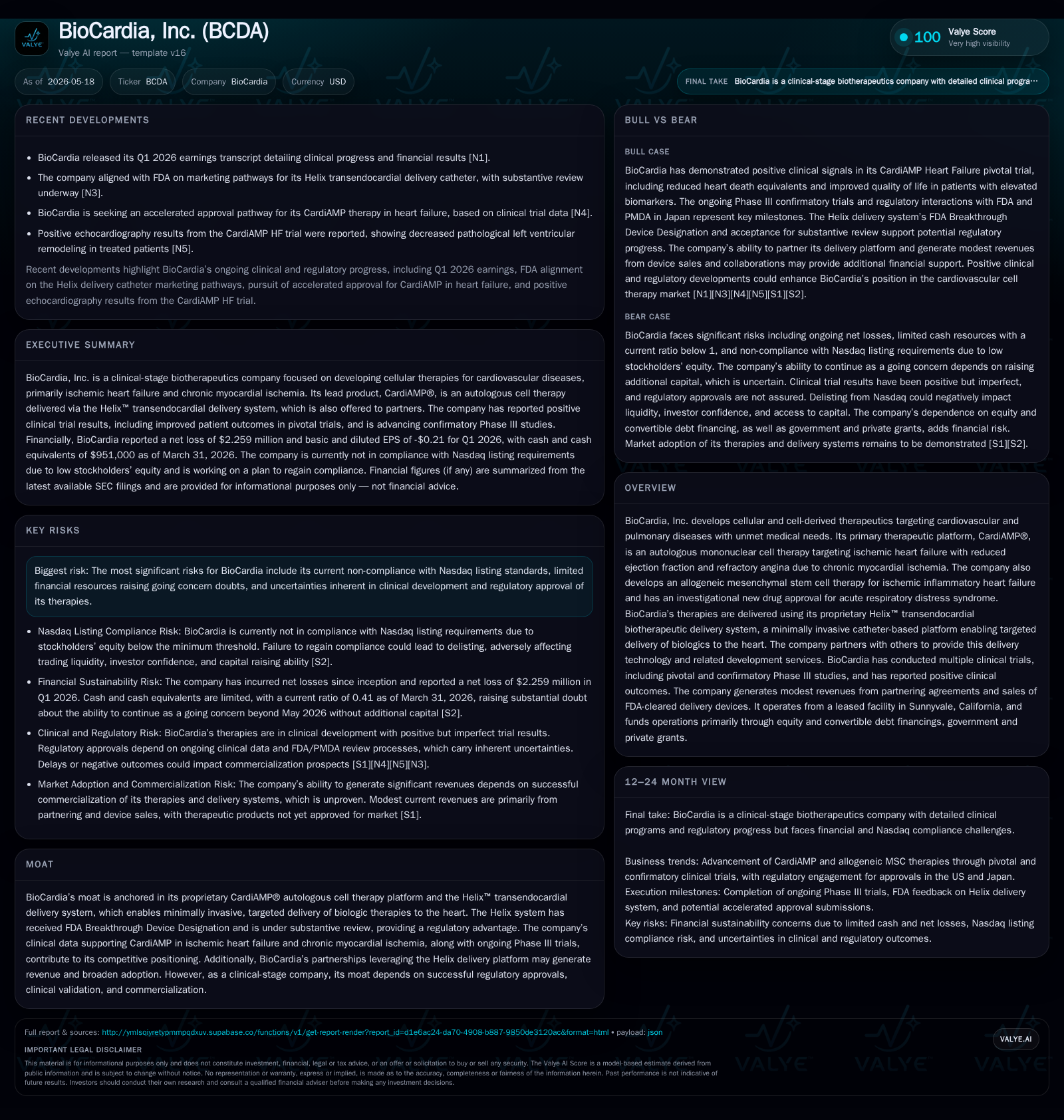
BioCardia, Inc. disclosed in its Q1 2026 10-Q that it remains non-compliant with Nasdaq's minimum stockholders' equity rule, registering only $895,000 against a $2.5 million threshold, triggering a submission deadline for a remediation plan by May 25, 2026. This financial strain coexists with ongoing advancements in its CardiAMP® cell therapy and the Helix™ delivery system, including FDA discussions on marketing pathways and clinical trial initiations. The company's business model hinges on clinical-stage partnerships and innovative biotherapeutic delivery platforms, which confer potential regulatory and competitive advantages but are contingent on regulatory approvals and further capital infusion. Moving forward, BioCardia’s near-term outlook depends heavily on Nasdaq’s acceptance of its compliance plan, progress in Phase III trials, and its ability to secure additional funding amid a low cash runway.
Q1 2026 Operating Update: Nasdaq Compliance Challenges Take Center Stage
BioCardia's most recent quarterly filing dated May 15, 2026 [S2] discloses a critical regulatory compliance issue: the company's stockholders’ equity as of December 31, 2025 was approximately $895,000 — significantly below Nasdaq Capital Market's minimum requirement of $2.5 million. This shortfall triggered a notice from Nasdaq on April 10, 2026 demanding submission of a detailed plan to regain compliance by May 25, 2026. Non-acceptance of this plan risks delisting [S2], which would severely restrict liquidity for shareholders and complicate any prospective fundraising efforts.
Trading currently continues under symbol BCDA without immediate delisting effect; however, the filing emphasizes the substantial risk to BioCardia’s capital access and partner or lender confidence should equity deficiencies persist [S2][S3]. A Nasdaq delisting could also trigger defaults under financing arrangements or contracts given loss of listing status is generally viewed unfavorably in capital markets.
This precarious equity backdrop frames all operational activity and heightens the urgency for BioCardia to demonstrate tangible progress in its core programs or secure fresh capital injections shortly.
Business Model and Product Efficacy: The CardiAMP Platform and Helix Delivery System
BioCardia operates as a clinical-stage biotherapeutics company focused on developing cellular therapies targeting cardiovascular diseases with unmet medical needs [S1]. Its core therapeutic candidate is CardiAMP®, an autologous mononuclear cell therapy designed for patients suffering ischemic heart failure with reduced ejection fraction as well as refractory angina caused by chronic myocardial ischemia.
Unlike traditional pharmaceutical models where revenues primarily come from marketed product sales or royalties post-commercialization, BioCardia's revenue streams remain early-stage and largely reliant on partnership agreements licensing use of its proprietary Helix™ transendocardial biotherapeutic delivery system. This minimally invasive catheter technology facilitates targeted injection of biologics directly into heart tissue during procedures [S1]. Revenue recognition thus depends on collaborative development milestones rather than steady product sales.
The FDA granted the Helix system Breakthrough Device Designation status—an explicit regulatory advantage enabling expedited review pathways and increased agency interaction. This designation underscores the potential differentiation provided by combining a novel delivery device with proprietary cell therapy platforms.
The business model emphasizes leveraging this integrated offering—both therapeutic candidates and platform delivery technology—to attract strategic collaborators who can expand adoption while supplementing internal development funding.
Competitive Positioning in Regenerative Cardiotherapy: Moat and Market Context
BioCardia sits within the nascent but growing field of regenerative medicine targeting cardiovascular pathologies. Its moat derives from two interlinked pillars:
- The proprietary autologous cell therapy CardiAMP®, which contrasts with off-the-shelf stem-cell or gene therapies by focusing on patient-derived mononuclear cells tailored to address ischemic myocardial damage.
- The Helix™ minimally invasive delivery platform uniquely enables precise transendocardial biological administration—a technical challenge often limiting efficacy for regenerative interventions.
Peer competitors tend either to focus exclusively on cellular therapeutics without integrated delivery or offer systemic biologic agents not designed for targeted myocardial injection. Clinical-stage validation through ongoing Phase III trials (e.g., CardiAMP Heart Failure II) bolsters competitive positioning although regulatory commercialization remains pending.
This bi-directional synergy between product composition and specialized delivery introduces switching costs that may bind healthcare providers once adopted due to training requirements and procedural integration.
However, as a clinical-stage entity without approved commercial products today, BioCardia relies heavily on successful trial outcomes and regulatory milestones to fortify this moat against emerging competitors or alternative technologies.
Growth Drivers: Clinical Trials, Regulatory Milestones, and Platform Partnerships
Several near- to medium-term growth drivers emerge from recent corporate developments:
- Initiation of CardiAMP Heart Failure II Phase III Trial enrollment marks a critical progression towards pivotal clinical evidence necessary for future market authorization [S1].
- Regulatory engagement in Japan aims at expanding geographic regulatory footprint beyond the U.S., enhancing global commercial prospects [S1].
- Marketing pathway alignment for Helix™ device with FDA, including pursuit of device-specific clearance that facilitates broader use of its delivery system independent of partnered therapeutics [N3].
- Seeking accelerated approval pathways for CardiAMP in heart failure under existing FDA frameworks may shorten time-to-market if supported by surrogate endpoints or intermediate clinical data [N4].
- Partnership expansion leveraging Helix platform offers potential upfront fees or milestone payments plus royalty streams post-commercialization while driving broader procedural adoption among cardiovascular specialists.
These growth vectors are intrinsically linked to observable KPIs such as trial enrollment rates, regulatory submission statuses, FDA responses on Breakthrough Device applications, and partner pipeline commitments.
Risk Factors: Financial Constraints, Regulatory Uncertainty, and Market Access
Three categories dominate BioCardia’s risk profile:
- Financial vulnerability: Latest filings show cash reserves approximating $951K as of March 31, 2026 paired with current liabilities roughly $2.78 million yields a current ratio around 0.41—signaling poor short-term liquidity requiring prompt external financing [F1]. Accumulated deficit exceeds $168 million per prior disclosures [S1]. The company explicitly acknowledges substantial doubt about going concern given cash runway constraints possibly ending near May-June 2026 absent new influxes [S1][S2].
- Nasdaq delisting threat: The equity deficiency notice places urgent pressure on management to submit an acceptable remediation plan by late May; failure could degrade share marketability and worsen capital acquisition costs [S2].
- Clinical/regulatory uncertainty: Success depends fundamentally on positive Phase III outcomes and satisfying evolving FDA marketing clearance thresholds; any setbacks could delay approval timelines or diminish commercial viability leading to downward pressure on partnerships or investments.
These risks compound each other synergistically—inadequate funding could stall clinical progress at precisely the moment regulatory dialogue intensifies while adverse trial data may exacerbate investor reticence amid delicate Nasdaq compliance status.
Near-Term Catalysts and What to Monitor
Looking ahead into the coming months,
- Nasdaq compliance plan submission deadline (May 25, 2026) stands as an immediate critical milestone determining listing continuity status.
- FDA decisions regarding marketing authorization pathways for Helix transendocardial delivery catheter provide clarity on independent commercial viability of BioCardia’s proprietary device platform outside direct drug approvals [N3].
- Clinical enrollment metrics from CardiAMP Phase III Heart Failure II trial, especially site activations and patient recruitment pace indicating feasibility and timeliness toward pivotal data readouts.
- Updates on accelerated approval efforts including FDA feedback may signal speedier commercialization trajectories than classical New Drug Application (NDA) timelines would permit [N4].
- Potential announcements around equity raises or strategic collaborations designed to shore up capital reserves are key indicators of financial sustainability prospects.
Focused tracking of these operational events will provide actionable gauges towards assessing BioCardia’s trajectory from developmental entity looming over liquidity risk toward potentially emerging commercial-stage success.
Financial Synopsis: Cash Position, Liabilities, and Going Concern Considerations
As of March 31, 2026, BioCardia reported cash and equivalents totaling approximately $951,000 juxtaposed against current liabilities close to $2.78 million resulting in a troubling current ratio near 0.41—a clear sign of strained liquidity relative to short-term obligations [F1]. Total debt stands minimal at around $284K based on older metrics without disclosure of significant new borrowings [F1].
The company recorded operating losses historically exceeding $8 million annually reflecting heavy investment into R&D activities related primarily to CardiAMP trials and Helix system advancement [S1][F1]. Such net losses alongside accrued deficits cumulatively reaching above $168M magnify reliance upon external financing sources.
Management has candidly disclosed material doubt about its ability to continue as a going concern beyond May-June 2026 without successfully raising additional funds—highlighting risk that any disruption in capital markets access might precipitate operational curtailments or worse [S1][S2]. The confluence of investor sentiment regarding clinical progress combined with Nasdaq compliance pressures frames funding challenges tightly.
Maintaining financial solvency while progressing complex biotech pipelines remains BioCardia's existential hurdle moving forward.
This analysis is based exclusively on publicly available filings from BioCardia as of May 18, 2026. It does not constitute investment advice but aims to provide a rigorous operational overview anchored in recent SEC disclosures.
Disclaimer: This is research-only, informational analysis and not investment advice. It may include AI-generated interpretation and general industry context. Always verify important details using primary sources.

Comments