
FatPipe Inc Builds Integrated SD-WAN and Cybersecurity Platform with Growing Channel Presence
Fiscal year 2026 results emphasize FatPipe’s integrated software stack advancement, expanded sales capacity, and international channel development.
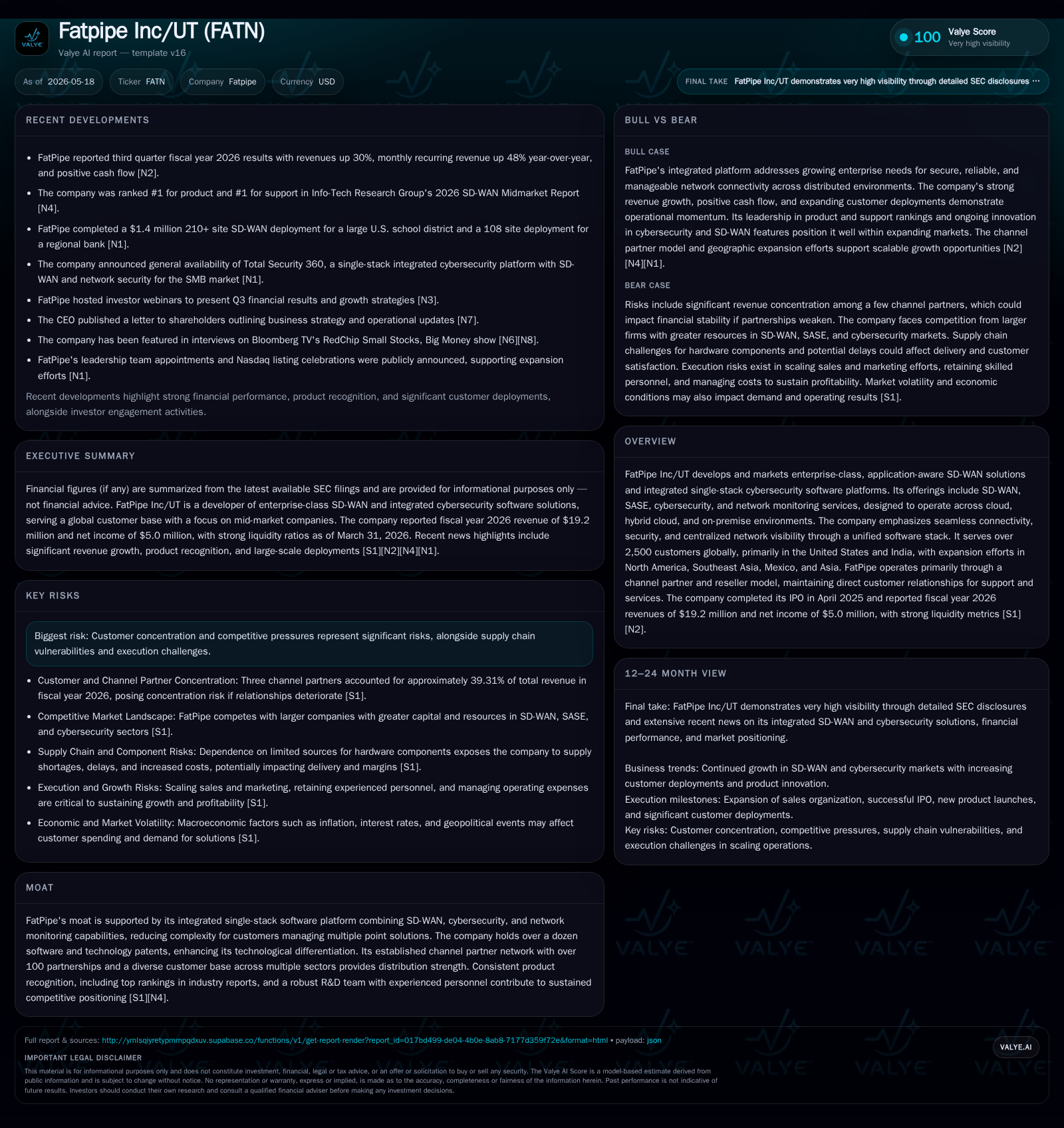
FatPipe reported fiscal year 2026 revenues of $19.2 million and net income near $5.0 million, validating its post-IPO growth trajectory. The company’s unified single-stack platform that combines SD-WAN, cybersecurity, and network monitoring differentiates it in a competitive market dominated by diverse players. Growth is driven by doubled sales headcount, expanding channel partnerships exceeding 100 globally, and geographic diversification into Southeast Asia and Mexico. Key risks include substantial concentration among top channel partners, supply chain uncertainties, and fierce competition from larger vendors offering point solutions or integrated alternatives.
Latest Operational and Financial Update: What Changed with FY26 Results
On May 18, 2026, FatPipe disclosed its fiscal year and fourth quarter financials ending March 31. Revenues rose to approximately $19.2 million with net income just shy of $5 million, underscoring effective commercialization of its integrated networking software platform shortly after its April 2025 Nasdaq debut [S3][F1]. Management highlighted doubling of sales personnel as a transformative catalyst underpinning sales pipeline growth and an expanded set of customer opportunities processed in FY26 [S1]. These developments mark important proof points in FatPipe’s effort to establish itself as a unified secure networking solutions provider amidst a complex competitive landscape.
Unified Software Platform: Business Model and Product Differentiation
FatPipe’s core offering is a tightly integrated single-stack software platform combining SD-WAN (software-defined wide-area networking), SASE (secure access service edge), cybersecurity functions, and network monitoring services delivered primarily via subscription licensing [S1][S19]. This architecture leverages over a dozen patents protecting proprietary traffic management features like dynamic failover routing across multiple data lines—ensuring uninterrupted applications sessions during link failures—and policy enforcement capabilities that operate seamlessly across cloud, hybrid-cloud, and on-premises environments.
The business model revolves around selling these distinct yet interoperable modules either as bundled suites or standalone licenses tailored to client network configurations. Subscribers pay ongoing fees tied to volume of usage or license tiers rather than one-off hardware purchases. This recurring revenue approach delivers durable margin profiles as customers benefit from reduced operational complexity versus stitching together disparate point products that often lack centralized visibility or coordinated threat response.
Competitive Environment: Channel-Driven Market Position and Industry Context
FatPipe's primary distribution runs through an extensive global channel partner ecosystem comprising more than 100 resellers spanning multiple sectors including education, healthcare, finance, manufacturing, and government [S6][S19]. This scale facilitates diverse end-user acquisition without over-reliance on direct sales but also concentrates revenue risk: three partners accounted for nearly 40% of FY26 revenues—a decline from prior years but still significant [S6][S19].
Geographically the company is anchored in the U.S. and India while actively expanding into Southeast Asia (excluding China) and Mexico through localization strategies including geography-specific license bundles responding to regional pricing sensitivities [S6]. Competition arises from larger incumbents with deeper pockets capable of aggressive pricing or broader portfolios but often lacking FatPipe's integrated stack approach or strong mid-market focus.
Customer retention benefits from direct post-sale support combined with partner-led sales fuel a switching-cost dynamic anchored by platform integration complexity.
Growth Catalysts: Sales Expansion, Geographic Footprint, and R&D Investment
Post-IPO FatPipe doubled its sales organization headcount supporting domestic plus international commercial accounts with territory managers training partners extensively on product technology—key to increasing effective pipeline throughput across geographies [S1][S6][S23]. This expanded coverage correlates directly with broader opportunity funnel metrics communicated by management.
Expansion into high-growth IT markets such as Southeast Asia—where digital transformation accelerates secure cloud migration—and Mexico reflect Geo-specific bundling efforts intended to lower barriers for channel adoption while adapting pricing models for local enterprise budgets [S6]
Meanwhile the R&D team continues to be a cornerstone with many members boasting over 15 years tenure; ongoing investments fund enhancements including new SD-WAN security features plus next-generation network monitoring systems—all within the unified single-stack framework aiming to solidify market differentiation [S1][S27].
Potential Risks: Customer Concentration, Supply Chain Constraints, and Market Pressures
Despite encouraging growth indicators several critical risks loom. Revenue concentration among top channel partners poses vulnerability as disruptions or insolvency in these entities could disproportionately impact sales flow given ~39% dependence in FY26 [S10][S24]. Supply chain issues remain salient risks owing to limited sources for key network server components critical for software delivery timelines—potentially inflating costs or stalling installations under current global supply constraints [S10][S24].
Competition also intensifies from both well-established vendors offering modular point solutions attractive to certain buyer segments and emerging providers integrating functions into broader cloud ecosystems which could erode FatPipe’s market share if innovation stalls or pricing power weakens. Economic downturns or IT budget tightening may slow refresh cycles further pressuring revenue growth visibility [S10][S26]. Execution risks relating to converting expanded pipeline opportunities into sustained bookings also warrant close attention given lengthier sales cycles typical for enterprise software deployments.
Investor Focus: Upcoming Milestones and Execution Watchpoints
Key performance indicators identified for tracking progress include average deal size expansion originating from upgraded cybersecurity modules; successful onboarding of new resellers particularly across Southeast Asia/Mexico; timely delivery of planned product updates enhancing SD-WAN security compliance layers; customer retention rates post license bundle deployments; and pipeline conversion ratios as sales teams mature post-organization scaling [N1][S3]
Regular quarterly disclosures expected ahead will shed light on how fatigue among competitors or macro uncertainties interplay with FatPipe’s momentum driven by strategic investments in people and technology.
Financial Snapshot: Liquidity, Profitability, and Capital Structure Considerations
FatPipe ended Q4 FY26 with approximately $19.2 million revenue translating to operating income around $3.59 million alongside net income near $5 million—a positive margin profile supportive of sustained reinvestment capacity post-IPO maturation phase [F1][S3]. Total debt stands at roughly $4.62 million balanced against current assets exceeding $16.4 million yielding a robust current ratio of approximately 3.85 indicating healthy near-term liquidity management [F1].
Net debt after subtracting cash reserves sits modestly at about $1.7 million which suggests manageable leverage levels allowing continued capital allocation towards R&D and geographic/channel development without excessive financial strain [F1][S5]
This analysis synthesizes facts disclosed by FatPipe Inc/UT through SEC filings as of May 18, 2026. All forward-looking observations reflect documented company plans or stated outlooks without speculative forecasting. Readers should consider publicly available regulatory disclosures alongside broader industry context when evaluating corporate health or strategic positioning.
Disclaimer: This is research-only, informational analysis and not investment advice. It may include AI-generated interpretation and general industry context. Always verify important details using primary sources.

Comments