
Indaptus Therapeutics Pauses Clinical Enrollment and Faces Strategic Transition Amid Financial Constraints
Indaptus Therapeutics discontinues enrollment in its key clinical trial, restructures executive leadership, and navigates capital challenges amid a strategic pivot.
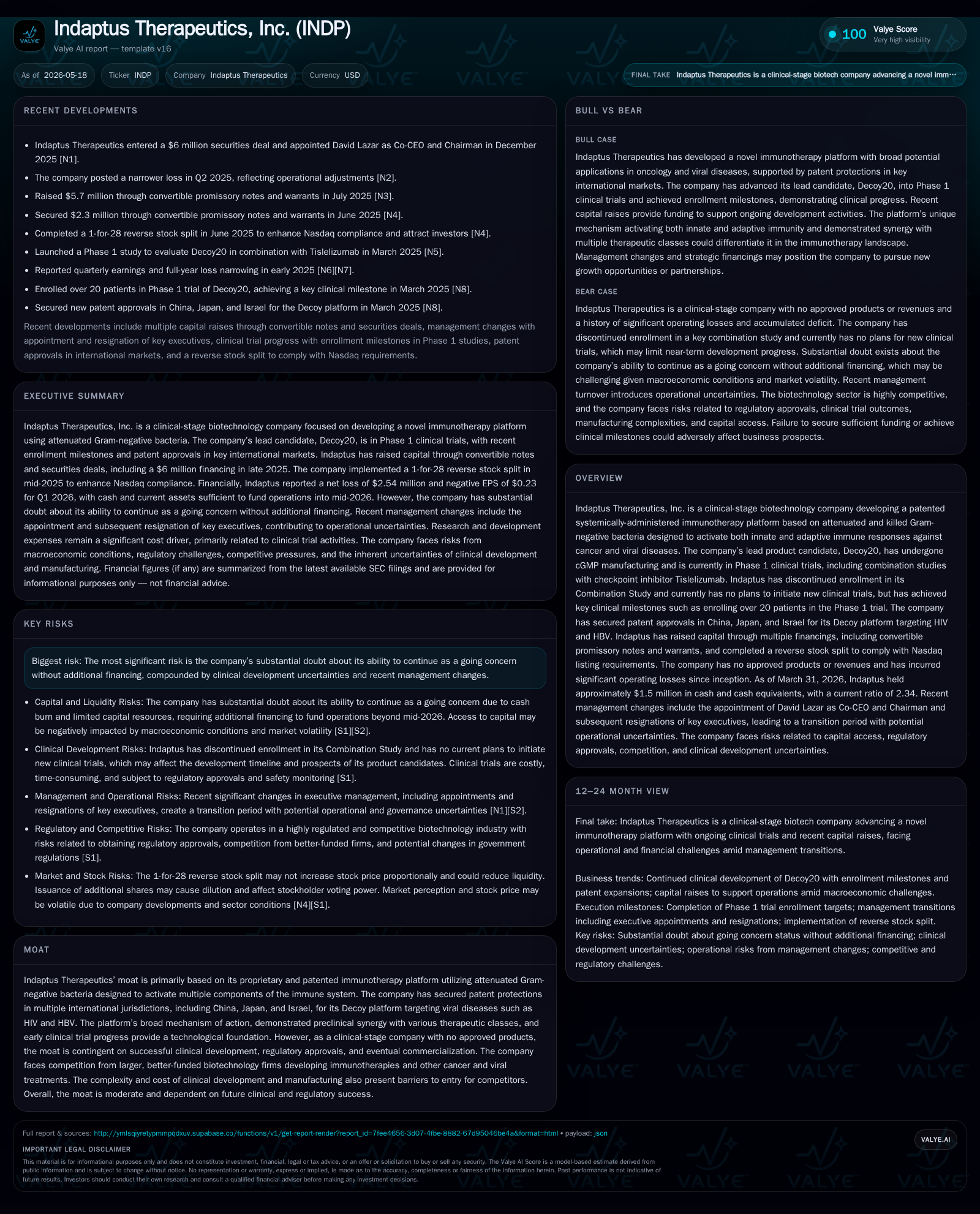
In its latest quarterly filing, Indaptus Therapeutics announced the halt of patient enrollment in its Phase 1 Combination Study involving Decoy20 and checkpoint inhibitor Tislelizumab, with no current plans for new clinical trials. Concurrent executive management changes underscore organizational transition. The company’s immunotherapy platform, based on attenuated Gram-negative bacteria and protected by patents in multiple international jurisdictions, remains early-stage. Financial constraints and operational uncertainties present significant execution risks as Indaptus explores potential strategic transactions to sustain development and growth.
Recent Operational Update and Strategic Transition
In its May 2026 quarterly filing, Indaptus Therapeutics disclosed that it has discontinued patient enrollment in its Combination Study evaluating Decoy20 alongside checkpoint inhibitor Tislelizumab. No participants remain in the study, and importantly, there are currently no plans to initiate new clinical trials in the near term [S2][S1]. This pause signals a strategic shift resulting in anticipated reductions in research and development expenditures.
Compounding operational complexity are recent executive management changes marked by the resignations of David E. Lazar and Jeffrey Meckler following security transfers related to convertible preferred stock holdings. The company anticipates potential further adjustments as it reassesses corporate priorities and resource allocation during this transition period [S2]. These developments introduce uncertainty regarding organizational stability and governance continuity.
This operating update underscores a phase where Indaptus pivots from active clinical expansion toward managing constrained resources while exploring alternative growth pathways or strategic transactions.
Business Model and Immunotherapy Platform
Indaptus operates as a clinical-stage biotechnology company developing an immunotherapy platform based on systemically administered attenuated Gram-negative bacteria designed to stimulate both innate and adaptive immune responses against cancerous tumors and viral infections [S1].
Its lead candidate, Decoy20, is manufactured under cGMP conditions and is undergoing Phase 1 evaluation with monotherapy arms as well as combination regimens with checkpoint inhibitors like Tislelizumab. The platform aims to harness broad immune activation beyond tumor-specific approaches common in oncology.
Intellectual property protection is central to Indaptus’ strategy. The company holds granted patents covering its Decoy technology across international markets including China, Japan, and Israel. These patents encompass viral disease targets such as HIV and hepatitis B virus (HBV), suggesting potential applications beyond oncology indications.
Commercial prospects rely on advancing product candidates through regulatory pathways towards approval. Currently lacking approved products or revenue streams, value derives primarily from patent assets, clinical data progression, and potential partnership opportunities.
Competitive Landscape
The immunotherapy sector is highly competitive with numerous established players developing immune-modulating treatments ranging from checkpoint inhibitors by large pharmaceutical companies to innovative cell therapies by specialized biotechs. Indaptus differentiates itself via its unique attenuated bacterial vector platform intended to engage multiple immune pathways.
However, the company faces competitive disadvantages due to its early clinical stage status combined with limited financial resources compared to well-capitalized peers. Although it maintains patent exclusivity in select international territories—providing barriers to direct competition—the commercial moat remains contingent upon successful regulatory advancement which remains distant.
Capital constraints limit trial enrollment speed, manufacturing scale-up capabilities, regulatory expertise deployment, and eventual commercialization reach relative to competitors with deeper funding pools. Regulatory compliance costs add further operational complexity given stringent healthcare laws governing clinical development.
Growth Drivers
Key growth drivers include potential resumption of clinical development programs post-pause or successful partnerships infusing capital and operational capabilities. Preclinical evidence demonstrating synergy between Decoy20 and checkpoint inhibitors supports combinational therapy opportunities aligned with prevailing immuno-oncology trends.
The geographically targeted patents offer avenues for licensing or collaborations particularly within Asia-Pacific regions burdened by high HBV prevalence rates—potentially generating niche revenue streams independent of Western markets.
Additionally, pursuing a Post-Investment Transaction such as an acquisition or merger represents a strategic pivot aimed at pipeline diversification or bolstering through inorganic growth opportunities [S1]. However, success depends heavily on external market conditions including investor interest amid volatile financial environments.
Risks and Challenges
Indaptus faces significant risks including substantial doubt about its ability to continue as a going concern without additional funding support explicitly noted in filings [S1]. Cash reserves stood at approximately $1.5 million as of March 31, 2026 against current liabilities below $933 thousand (current ratio 2.34), which is insufficient for sustaining ongoing operations absent new financing [F1][S2].
Convertible preferred stock presents dilution risk whereby full conversion could transfer controlling voting power to preferred shareholders such as Mr. Lazar or his transferees [S1]. Management turnover may further disrupt organizational momentum during this critical phase.
Clinical development uncertainties remain elevated given halted patient recruitment; reactivation depends on resolving financing gaps plus reestablishing investigator confidence regarding safety and efficacy profiles. Macroeconomic factors like inflation have intensified challenges in accessing capital markets impacting smaller biotech firms disproportionately [S1]. Regulatory demands impose additional cost burdens potentially extending timelines.
Upcoming Milestones and Market Watchpoints
Near-term focus areas include announcements on management stabilization efforts, progress toward securing financing or consummating strategic transactions that could provide operational runway extension or pipeline enhancement [S3][S2].
Reinitiation of clinical studies or initiation of new protocols would be critical validation steps supporting platform viability. Data releases from prior Phase 1 cohorts could also provide insight into therapeutic potential despite enrollment pauses.
Monitoring equity offerings or debt financings will be important given liquidity constraints. Corporate governance developments such as board composition changes or recruitment of experienced R&D leadership may influence investor confidence.
Financial Snapshot Summary
As reported in recent filings,[F1] cash and cash equivalents totaled approximately $1.5 million at March 31, 2026 versus current liabilities under $933 thousand resulting in a current ratio of about 2.34. While indicating short-term liquidity cushion, these levels are inadequate for sustained operations without additional capital infusion.[F1][S2]
Research and development expenses are expected to decline following enrollment cessation reflecting cost rationalization; however general administrative expenses persist reflecting ongoing public company obligations alongside transactional costs linked to financing activities.[S2][S3] Net losses continue reflecting operating deficits without revenue generation restricting internal funding capacity.
Overall financial position remains fragile underscoring urgency for securing adequate capital while managing expenditures until strategic direction clarity emerges.
Disclaimer: This analysis synthesizes SEC disclosures with industry context for informational purposes only; it does not constitute investment advice.
Disclaimer: This is research-only, informational analysis and not investment advice. It may include AI-generated interpretation and general industry context. Always verify important details using primary sources.

Comments