
Aeluma, Inc. Demonstrates Strong Balance Sheet Amid Sharp Quarterly Loss
The latest 10-Q reveals robust liquidity and narrowing losses as Aeluma prepares to capitalize on emerging frontier markets amid regulatory and funding uncertainties.
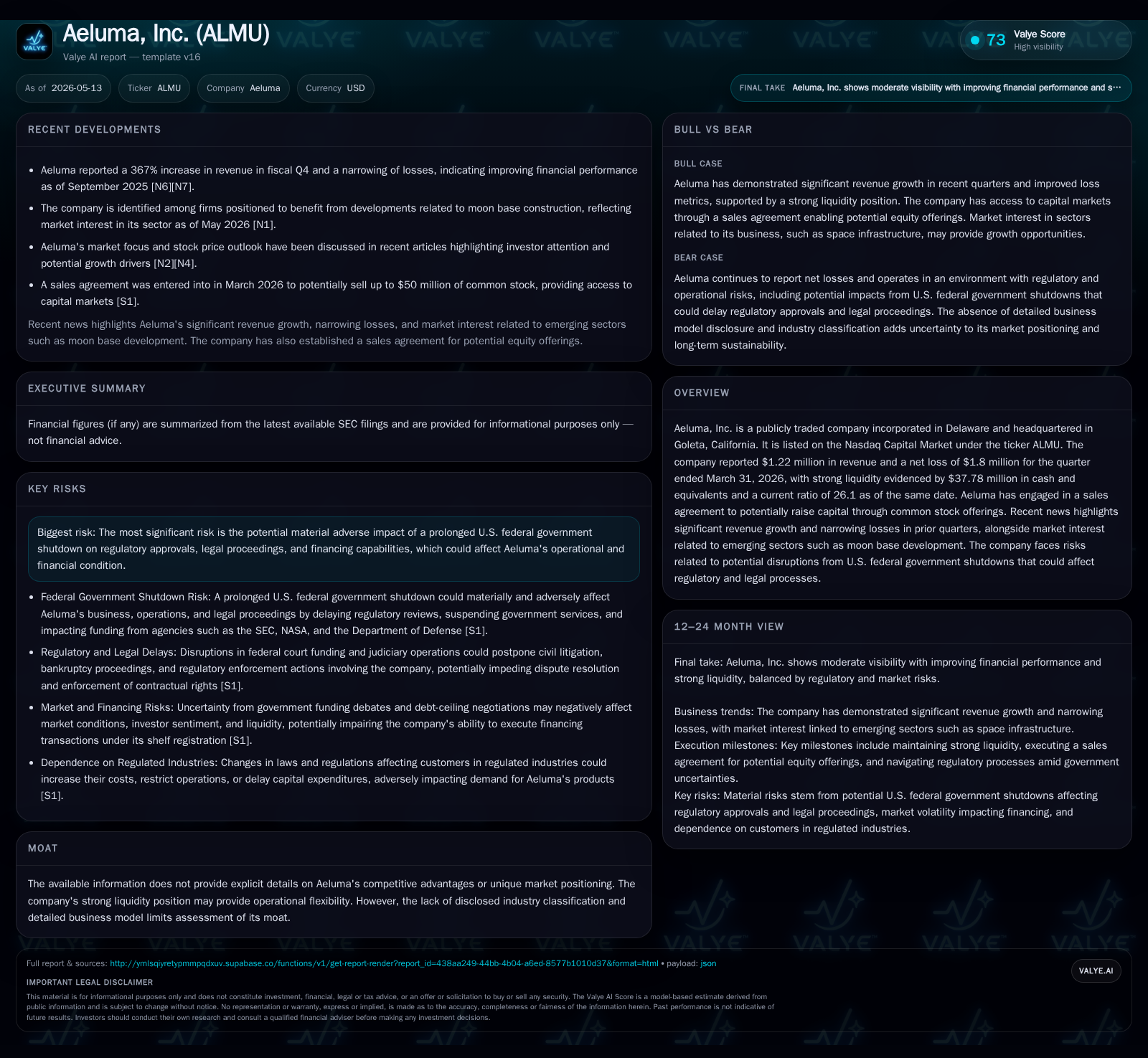
In its 2026 Q3 report, Aeluma posted $1.22 million revenue alongside an improved net loss of $1.8 million while maintaining an exceptionally strong cash position of $37.78 million and a current ratio exceeding 26x. The company’s strategic footing in emerging sectors such as space infrastructure development positions it well for growth, supported by an at-the-market $50 million stock sales agreement enhancing financing flexibility. However, ongoing risks from potential U.S. federal government shutdowns pose tangible operational and capital markets challenges that could delay regulatory processes and curtail fundraising activities.
Latest Quarterly Results and Operational Highlights
Aeluma’s Q3 financial disclosure filed May 13, 2026 ([S2], [S3]) provides a critical update on recent performance metrics. The company recorded $1.22 million in revenue for the three months ended March 31, 2026, accompanied by a net loss of $1.8 million. This represents a meaningful improvement in loss magnitude compared with prior periods reported by the company. Most striking is the liquidity profile: cash and equivalents stood at $37.78 million with current assets totaling approximately $40.17 million against current liabilities near $1.54 million — yielding an exceptionally high current ratio of 26.1x ([F1]). This liquidity cushion grants Aeluma considerable financial flexibility to weather near-term operational headwinds or pursue growth initiatives without urgent refinancing pressure.
Complementing the solid balance sheet is Aeluma’s March 2026 entry into a $50 million at-the-market (ATM) equity sales agreement ([S9]). While no shares have been sold yet under this arrangement, it positions the company with a ready mechanism to access capital opportunistically via common stock issuance through designated broker-dealers. The timing of this sales agreement suggests management intent to fuel expansion or R&D efforts as new business opportunities materialize.
These financial contours establish an important backdrop: Aeluma is balancing top-line growth and loss mitigation while maintaining ample liquidity—a feat not always achievable in early-stage ventures targeting frontier technology markets.
Aeluma’s Business Model and Market Positioning
Aeluma operates within an undefined but evidently high-tech domain entwined with burgeoning sectors like lunar infrastructure development ([N1], [N2]). Although the company's precise industry classification is undisclosed in filings ([S2], [S3]) or public docs, news references emphasize its involvement in niche markets supporting moon base construction—possibly supplying specialized components or technology systems crucial for extraterrestrial habitats.
Revenue generation presumably derives from customer purchases driven by hardware or solution deployment linked to space exploration projects overseen by U.S. governmental or affiliated agencies such as NASA or DoD. These customers’ purchasing behavior likely follows contract cycles tied to multi-year capital expenditure programs with rigorous qualification standards—an inference supported indirectly by references to regulatory agency involvement ([S6], [S7]).
From a product/service quality standpoint, operating within sensitive aerospace applications infers stringent compliance with safety and reliability standards. Moreover, developing novel solutions for space infrastructure might afford Aeluma pricing power rooted in customization and technological differentiation compared with commoditized suppliers.
Customer stickiness may derive from long development timelines and switching costs associated with certifying alternative vendors under government procurement rules—although such dynamics remain speculative absent explicit disclosure.
Competitive Environment and Industry Dynamics
The emerging segment of lunar bases and associated space infrastructure involves a small but competitive set of players targeting government contracts requiring exhaustive regulatory clearances ([N1], [S6], [S7]). Competition is characterized less by volume-based manufacturing scale and more by technology innovation depth and compliance proficiency.
Supply chain constraints—including specialized materials sourcing—and protracted regulatory reviews by federal bodies impose barriers that shape industry structure toward highly regulated microcap enterprises like Aeluma.
Pricing power appears conditionally durable given high switching costs but inherently linked to public budget cycles subject to political flux—a dual-edged sword offering opportunity paired with volatility risk ([S6], [S7]). Moreover, firms operate under scrutiny from export controls, environmental laws, trade policies, and evolving data privacy regulations impacting customer investment decisions.
Key Growth Drivers Shaping Future Demand
Growth trajectories are tightly coupled with measurable KPIs such as securing new government contracts (e.g., for lunar habitats or other space platforms), progress on demonstrated capabilities enabling commercial viability in frontier markets, and successful fundraises through the ATM program ([N2], [S9]).
Reports highlighting “laser-focused” market aspirations suggest management prioritizes achieving revenue milestones linked directly to deployments or pilot projects rather than speculative expansion.
Since government funding decisions often precede contract awards by several quarters, monitoring announcements from NASA or DoD serves as early demand indicators.
Additional drivers include potential diversification beyond moon base projects into adjacent aerospace technologies or terrestrial applications leveraging core competencies developed for space missions — consistent with strategic moves seen among peers.
Risks Related to Government Shutdowns and Market Volatility
Multiple filings contain explicit cautionary language around federal government shutdown scenarios materially impairing operations ([S6], [S7]). Such shutdowns risk furloughing essential regulators at the SEC, U.S. Patent Office, NASA, DoD, hindering timely approval of filings or contract processing.
Judiciary slowdowns would affect civil litigation or enforcement proceedings that could stall dispute resolution important for contractual certainty.
Capital market disruptions induced by shutdown uncertainty could depress investor confidence reducing share liquidity—a substantial threat for a small-cap entity reliant on at-the-market offerings for incremental capital infusion.
This confluence of regulatory uncertainty and funding instability situates Aeluma within a sector acutely sensitive to macro-political conditions beyond corporate control.
Upcoming Catalysts and Execution Milestones
Key forward-looking events include anticipated government contract awards essential for validating business model scalability; successful execution of capital raises under the ATM facility providing runway extension; and progress reported on contracts linked explicitly to emerging lunar infrastructure segments highlighted in recent Nasdaq analyses ([N1], [N2], [S9]).
Monitoring quarterly results post Q3 will be critical for tracking revenue growth momentum relative to prior improvements. Additionally, any announced delays or accelerations in regulatory approvals tied to federal funding status will serve as bellwethers impacting operational cadence.
Investor focus should also consider secondary market trading volume trends influencing financing cost efficiency given microcap trading sensitivities detailed in risk disclosures.
Current Financial Health and Liquidity Snapshot
Latest financial snapshot
| Metric | Value | Period |
|---|---|---|
| Cash & equivalents | $38mm | |
| 2026-03-31 | ||
| Current assets | $40mm | |
| 2026-03-31 | ||
| Current liabilities | $1539000 | |
| 2026-03-31 | ||
| Current ratio | 26.1x | |
| 2026-03-31 |
Source: SEC companyfacts cache [F1].
Aeluma's liquidity stands out starkly against its modest revenue base—cash dominance over liabilities provides cushion rare among emerging growth companies dependent on governmental clientele ([F1]). Reported total debt is negligible relative to cash reserves (~$0.3 million) based on best available midpoint data ([F1]), reinforcing strong solvency metrics conducive to funding R&D or scaling activities without immediate dilution pressures.
This financial strength may underpin strategic patience awaiting larger contract awards while mitigating downside risk amid uncertain external funding climates.
Disclaimer: This analysis is based solely on information available from SEC filings dated May 13, 2026 ([S2],[S3],[S6],[S7],[S9]) supplemented by recent Nasdaq news articles ([N1],[N2]) and does not constitute investment advice or recommendations.
Disclaimer: This is research-only, informational analysis and not investment advice. It may include AI-generated interpretation and general industry context. Always verify important details using primary sources.

Comments