
Boxlight Corp Faces Nasdaq Equity Compliance Challenges Amid Operating Losses and Liquidity Constraints
Strong product portfolio and global reach contrast with financial stress and compliance risks in Boxlight's latest quarter.
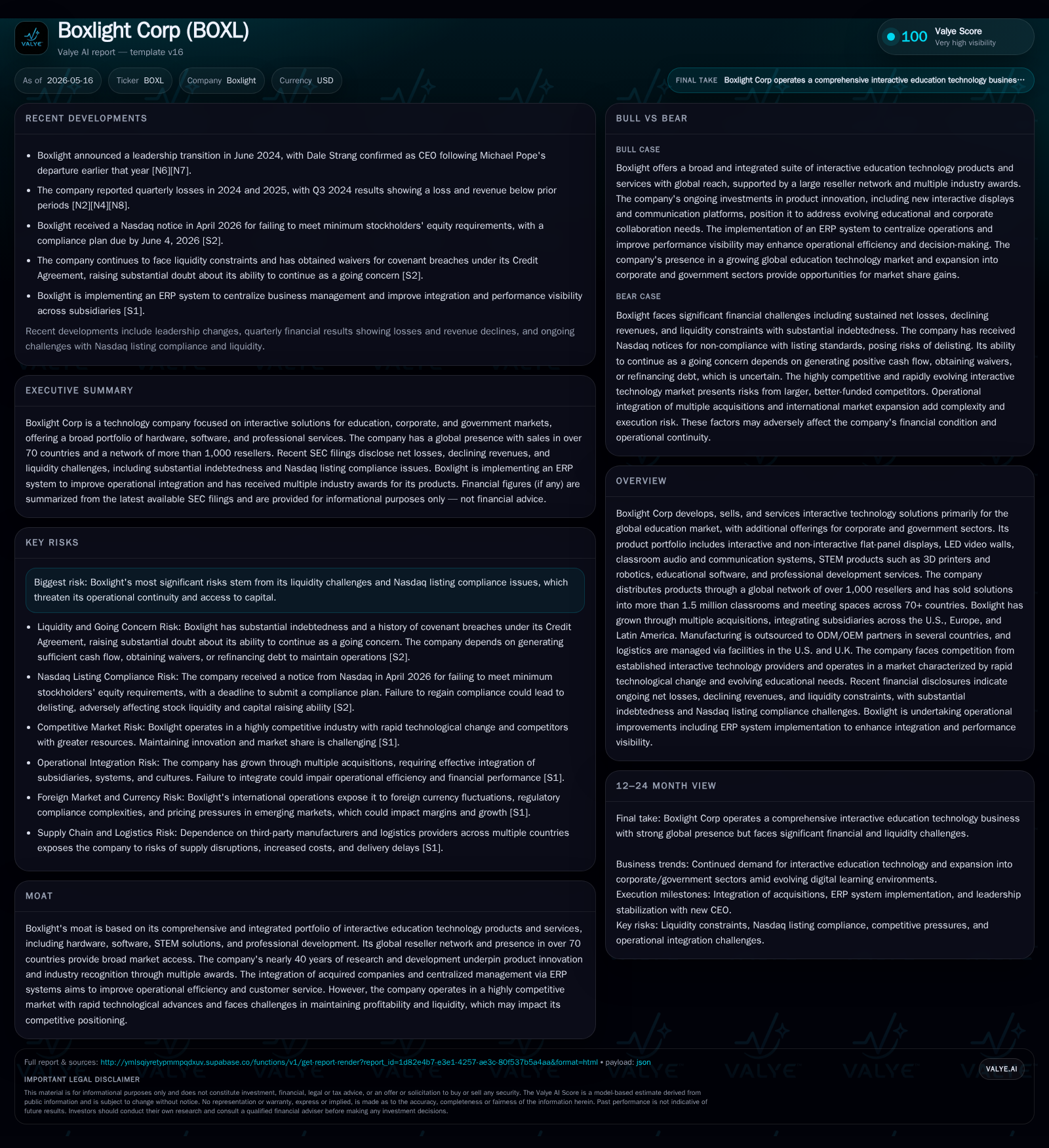
Boxlight Corp’s latest quarterly filing reveals ongoing liquidity strains, Nasdaq listing compliance risks, and covenant breaches despite operational persistence in interactive education technology. The company’s integrated hardware, software, and professional development offerings serve over 1.5 million classrooms globally. However, sustained losses, significant secured indebtedness near $32 million, and stockholders’ equity below Nasdaq thresholds create uncertain growth prospects. Boxlight's path forward hinges on its ability to regain equity compliance, refinance debt, and leverage global reseller networks amid competitive pressures.
Recent Operating Update: Q1 2026 Highlights
Boxlight Corporation’s latest quarterly report filed on May 15, 2026 [S2] signals critical operating developments. The company formally received a Nasdaq letter notifying it that its stockholders’ equity of approximately $1.26 million as of December 31, 2025 falls below the required minimum equity threshold of $2.5 million for continued listing [S2]. This initiates a compliance clock requiring Boxlight to submit a plan by June 4, 2026 to regain compliance or face potential delisting proceedings [S2]. The market impact could severely restrict capital access and shareholder liquidity.
Financially, Boxlight has about $32.2 million in total secured debt under an existing credit agreement [F1]. This debt is subject to covenants the company has recently violated—including balanced adjusted EBITDA minimums and borrowing base requirements—but the lenders have granted limited waivers for these defaults through at least April 30, 2026 [S11]. However, the company's historical operating losses alongside continuing liquidity constraints have spawned "substantial doubt" about its ability to continue as a going concern without additional relief or refinancing [S11].
Simultaneously filed on May 15 was an 8-K including a press release announcing Q1 results [S3][S23], emphasizing the company's proactive efforts to develop a plan for Nasdaq compliance and manage debt obligations.
Business Model Overview
Boxlight operates as a developer and seller of interactive technology solutions aimed predominantly at the global education sector but also extending into corporate and governmental markets [S1]. The core revenue driver is the sale of interactive flat-panel displays—both interactive and non-interactive—LED video walls, classroom audio systems, media players, cameras, and peripherals. These hardware products integrate tightly with proprietary educational software suites covering whole-class learning management, assessment tools, and collaboration features.
Beyond hardware/software sales, Boxlight distributes STEM education products including portable science labs, robotics kits integrated with curriculum content such as those from acquired entities like MyStemKits Inc. and Modern Robotics Inc. These offerings address growing demand for hands-on learning in science and technology disciplines.
The company complements its product sales with professional training services geared primarily toward U.S. educational customers—enhancing adoption rates through capacity building among educators [S1].
Revenue mechanics pivot on a multi-faceted channel approach: selling through more than 1,000 global reseller partners who operate locally within over 70 countries [S1]. This reseller ecosystem enables Boxlight to penetrate diverse regional markets effectively while outsourcing manufacturing to ODM/OEM partners primarily in Taiwan and China [S1]. Logistics hubs in Georgia (U.S.) and London manage distribution efficiency.
Strategically, Boxlight aims to be a one-stop comprehensive vendor providing integrated solutions—from hardware through software to training—thus creating higher switching costs and increasing customer lifetime value in education settings.
Industry Structure & Competitive Position
The interactive education technology industry is marked by rapid innovation cycles coupled with intense competition from well-capitalized firms including SMART Technologies (a subsidiary of Foxconn), Promethean (a division of NetDragon), ViewSonic, Newline Interactive, Samsung’s education display products line, Panasonic, and ClearTouch [S25]. Many competitors offer overlapping portfolios ranging from interactive displays to digital whiteboards and ecosystem software.
Boxlight differentiates itself through its breadth of offering—the integration of core display hardware with complementary peripheral devices (audio systems) plus embedded software platforms specifically focused on pedagogy-enhancing collaborative learning tools. Its awards recognition in recent years underscores its technology leadership claims [S1].
Acquisitions such as Sahara (EMEA-focused AV tech), Qwizdom (software for participation/feedback), MyStemKits (3D printing/STEM kits), and Modern Robotics broaden not only product lines but also geographic reach—a key advantage over some competitors less diversified internationally [S20][S27].
Its reseller network facilitates local customization and support capabilities which are critical given the complexity of educational procurement processes often dictated by institutional budgets and public funding cycles.
Growth Drivers
- Increasing EdTech Penetration: Growing government investments in K-12 digital classrooms globally coupled with accelerated adoption driven by hybrid/remote learning needs underpin structural demand growth.
- STEM Education Emphasis: Rising policy focus on science/technology literacy fuels demand for robotics kits and interactive STEM curricula where Boxlight has carved niches via acquisitions.
- Product Innovation & Integration: Continued R&D spending (~40 years legacy) yields upgraded hardware/software bundles supporting cloud-based learning environments which appeal to IT departments managing device interoperability challenges [S1].
- Geographical Expansion: Consolidating international acquisitions enables cross-selling opportunities outside the U.S., particularly across Europe/EMEA via Sahara’s footprint.
- Professional Services Upsell: Training programs enhance usage depth boosting renewals/penetration within existing customer bases.
- Replacement Cycles: Many school districts face aging interactive whiteboards leading to replacement waves favoring more affordable yet feature-rich devices like those offered by Boxlight.
Risks & Growth Constraints
- Liquidity & Credit Risk: Persistent covenant breaches under credit agreements combined with variable interest rate exposure heighten risk; failure to meet refinancing or waiver conditions could precipitate default or forced restructuring [S11][S16][S18].
- Nasdaq Listing Risk: Noncompliance threatens delisting which would hurt access to capital markets for growth investments or working capital [S2][S15].
- Competitive Pressures: Larger rivals may leverage economies of scale or deeper pockets for quicker technological innovation or aggressive pricing impacting Boxlight's market share.
- Supply Chain Dependencies: Outsourced manufacturing in Asia subjects production timing/pricing to geopolitical risks like tariffs or supply disruptions impacting delivery schedules [S1].
- Market Saturation & Funding Cuts: Public education budgets fluctuate based on economic/political climates which may constrain purchasing power or delay adoption cycles particularly in U.S. markets.
- Integration Execution Risks: The complexity of merging multiple acquired businesses into centralized ERP-managed operations poses operational challenges that could affect service levels or cost structures if not well managed.
What to Watch Next
Investors should focus on whether Boxlight submits an acceptable Nasdaq compliance plan by June 4 deadline that can plausibly restore minimum equity levels through earnings improvement or financing activities [S2]. Quarterly reporting on adjusted EBITDA progress will signal operational cash flow improvements needed to satisfy new credit covenants introduced in late 2025 amendments [S15]. Monitoring available capital buffer as indicated by quarterly cash balances around $6.9 million against near-term debt maturities will be critical [F1]. Progress integrating international subsidiaries for maximizing cross-selling efficiencies will emerge over coming quarters as a longer-term growth catalyst.
New product launches exploiting AI or virtual reality capabilities mentioned as industry trends could expand TAM if executed well; announcements here would warrant attention given competitive dynamics documented [S1]. Additionally, developments in trade/tariffs impacting external suppliers or logistics partners remain systemic risk vectors worth monitoring.
Financial Profile Snapshot (as of March 31, 2026)
Latest financial snapshot
| Metric | Value | Period |
|---|---|---|
| Cash & equivalents | $6.9mm | |
| 2026-03-31 | ||
| Total debt | $32.2mm | |
| 2026-03-31 | ||
| Net debt | $25.4mm | |
| 2026-03-31 | ||
| Current assets | $65.5mm | |
| 2026-03-31 | ||
| Current liabilities | $40.2mm | |
| 2026-03-31 | ||
| Current ratio | 1.63x | |
| 2026-03-31 |
Source: SEC companyfacts cache [F1].
This leveraged balance-sheet profile underlines liquidity pressures despite reasonable current ratio metrics primarily driven by working capital structure rather than profitability due to operating losses reported last fiscal year (-$23.8 million net loss) [F1][S11].
Disclaimer: This analysis is intended solely for informational purposes based on publicly available filings as of May 16, 2026. It does not constitute investment advice or recommendations regarding the purchase or sale of securities.
Disclaimer: This is research-only, informational analysis and not investment advice. It may include AI-generated interpretation and general industry context. Always verify important details using primary sources.

Comments