
Liminatus Pharma Faces Nasdaq Compliance Hurdles While Pursuing Capital Raises and Treasury Innovations
The company’s latest quarter highlights ongoing liquidity constraints and efforts to regain Nasdaq listing compliance alongside strategic treasury initiatives.
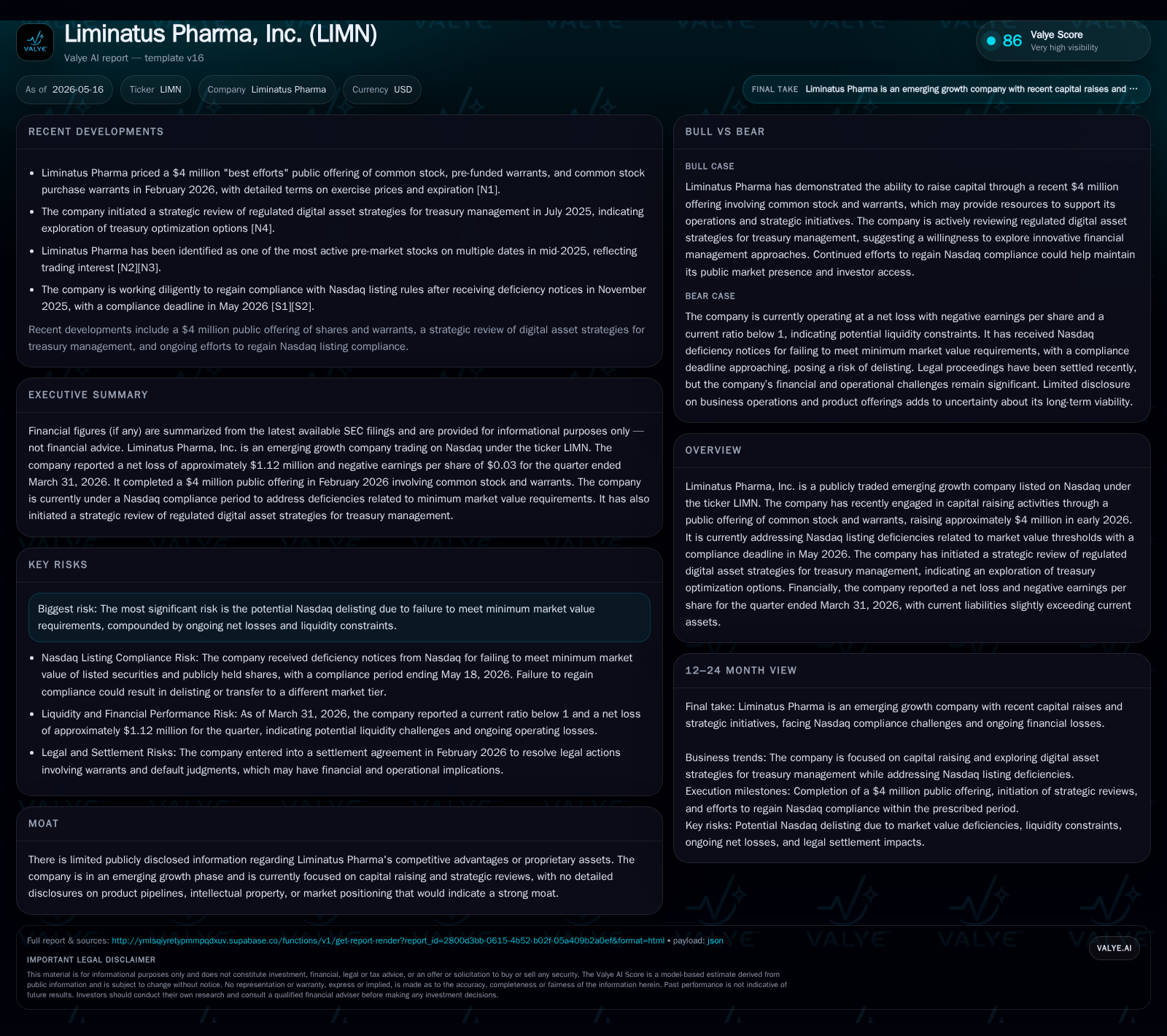
Liminatus Pharma, Inc. reported a net loss for Q1 2026 with current liabilities slightly exceeding current assets, underscoring ongoing liquidity challenges. The company is actively addressing Nasdaq listing deficiencies tied to minimum market value thresholds, with a compliance deadline by May 2026, adding pressure on near-term operational and capital strategies. Recent capital raises have bolstered cash positions, while management explores regulated digital asset strategies as part of treasury optimization. However, a lack of disclosed proprietary products or market positioning leaves Liminatus in an uncertain competitive stance within the pharmaceutical sector. The company’s path forward hinges on successful compliance, capital access, and clarity on product development progress.
Recent Operating Update: March 31, 2026 Quarter
Liminatus Pharma's latest quarterly filing (10-Q dated May 15, 2026) reveals a financially strained operating environment characterized by a net loss and a current ratio below unity (0.96), indicating that current liabilities ($2.89 million) marginally exceed current assets ($2.78 million) [F1][S2]. This signals tight liquidity despite recent capital infusion efforts.
Earlier in February 2026, the company successfully raised approximately $4 million through a public offering including common stock and warrants at around $0.29 per unit [S7]. These proceeds aim to support clinical trials, R&D, sales and marketing initiatives, as well as general corporate purposes but imply dilution pressures given the volume of shares issued.
A notable corporate action in early March involved amending the bylaws to reduce the quorum for stockholder meetings from a majority to one-third of outstanding voting power [S27]. This change could reflect attempts to streamline shareholder meeting processes amid fluctuating investor engagement.
Concurrently, Liminatus is navigating compliance deadlines imposed by Nasdaq related to market value standards. Specifically, notices indicated non-compliance with minimum market value of listed securities (MVLS) and publicly held shares (MVPHS) rules [S20]. The company faces a May 18, 2026 deadline to regain compliance or face delisting proceedings. Efforts to remedy this include pursuing additional capital raises and potential reverse stock splits [S9][S20].
Business Model Overview
Liminatus Pharma operates as an emerging growth biopharmaceutical entity primarily focused on clinical development activities. The company's revenue model appears contingent on progressing product candidates through clinical trials toward commercialization stages; however, current disclosures lack detailed data on any marketed products or late-stage candidates [S1]. Revenue generation is thus either minimal or non-existent at this point.
Capital inflows arise from equity offerings including common stock sales and derivative instruments such as warrants used both as financing tools and incentives within placement agency agreements [S7]. Such structuring reflects common biotech early-stage financing mechanisms designed to temporarily bridge developmental expenses.
Cash burn understandably dominates operating cash flows given research-intensive activities with negative net income reported historically [F1]. Strategic treasury management efforts indicate exploration beyond traditional financing paths—specifically, the examination of regulated digital asset avenues points to experimentation aimed at enhancing liquidity or capital efficiency without reliance solely on equity markets.
Industry Structure and Competitive Positioning
The pharmaceutical industry is highly competitive with established incumbents typically benefitting from extensive intellectual property portfolios, regulatory approvals, manufacturing scale, and commercialization capabilities. In contrast, Liminatus currently exhibits limited visibility into proprietary technology or differentiated pipeline candidates based on public filings.
Without disclosed lead products or significant clinical milestones in its filings, the company's competitive moat appears weak or nascent at best—a common challenge for early-stage biotech players reliant heavily on investor funding cycles. This lack of evident structural advantage increases vulnerability amid patent cliffs faced by larger peers who might engage in acquisitions for technology aggregation.
The novelty of employing digital asset strategies within treasury functions is rare among pharma peers but represents an unconventional attempt at seeking innovative financial flexibility—though its direct operational benefit to drug development remains speculative until proven.
Growth Drivers
Sustainable growth for Liminatus would be anchored on several key levers:
- Capital Availability: Successful completion of equity financings ensures funding continuity for clinical progress. Recent transactions illustrate ability but also highlight dependency on external markets.
- Regulatory Milestones: Advancing product candidates through clinical trials toward FDA or other global approvals would materially enhance valuation prospects.
- Strategic Financial Management: Optimization of treasury via regulated digital assets might yield incremental funding efficiencies or risk diversification.
- Operational Streamlining: Amendments lowering quorum thresholds may facilitate agility in decision-making processes.
Current drivers remain predominantly finance-centric pending clearer R&D progress disclosures.
Risks and Constraints
Several risk factors impose significant constraints:
- Nasdaq Listing Risk: Failure to meet market value standards threatens delisting impacting liquidity and investor confidence [S20].
- Liquidity Shortfalls: Current ratio below 1 coupled with ongoing losses demands prompt capital solutions.
- Competitive Deficit: Absence of disclosed proprietary assets or commercial products limits immediate revenue streams.
- Market Dilution Risk: Continued reliance on equity raises could erode shareholder value over time.
- Regulatory Uncertainty: Pharma development timelines carry inherent variability delaying any potential revenue inflection points.
- Legal Overhangs: Settlement agreements resolving warrant litigation indicate adverse contingencies though managed [S21].
What To Watch Next
Key near-term markers to assess include:
- Outcome of Nasdaq compliance efforts by May 18, 2026—confirmation of regained compliance or progression toward delisting process [S20].
- Execution of further financing events to shore up working capital base post-February raise [S7].
- Updates regarding pipeline advancements through clinical milestones (if any disclosure emerges).
- Potential adoption or rollout status of digital asset treasury initiatives which may signal novel liquidity strategies.
- Engagement levels by shareholders following governance rule changes affecting meeting quorum dynamics [S27].
Financial Profile Summary (Q1 2026)
Latest financial snapshot
| Metric | Value | Period |
|---|---|---|
| Total debt | $1442500 | |
| 2026-03-31 | ||
| Net debt | $1442500 | |
| 2026-03-31 | ||
| Current assets | $3mm | |
| 2026-03-31 | ||
| Current liabilities | $3mm | |
| 2026-03-31 | ||
| Current ratio | 0.96x | |
| 2026-03-31 |
Source: SEC companyfacts cache [F1].
The balance sheet snapshot reveals modest leverage predominantly from short-term obligations outpacing liquid assets marginally—a scenario demanding continued fundraising effort to sustain operations.
Disclaimer: This analysis is provided solely for informational purposes without offering investment advice or recommendations. Readers should conduct their own due diligence before making any investment decisions involving Liminatus Pharma or related securities.
Disclaimer: This is research-only, informational analysis and not investment advice. It may include AI-generated interpretation and general industry context. Always verify important details using primary sources.

Comments