
Lunai Bioworks Strengthens CNS Drug Discovery with $20M IP Acquisition
Lunai Bioworks amplifies its AI-driven neurological therapeutics platform through a major patent portfolio acquisition and key quarterly developments amid liquidity challenges.
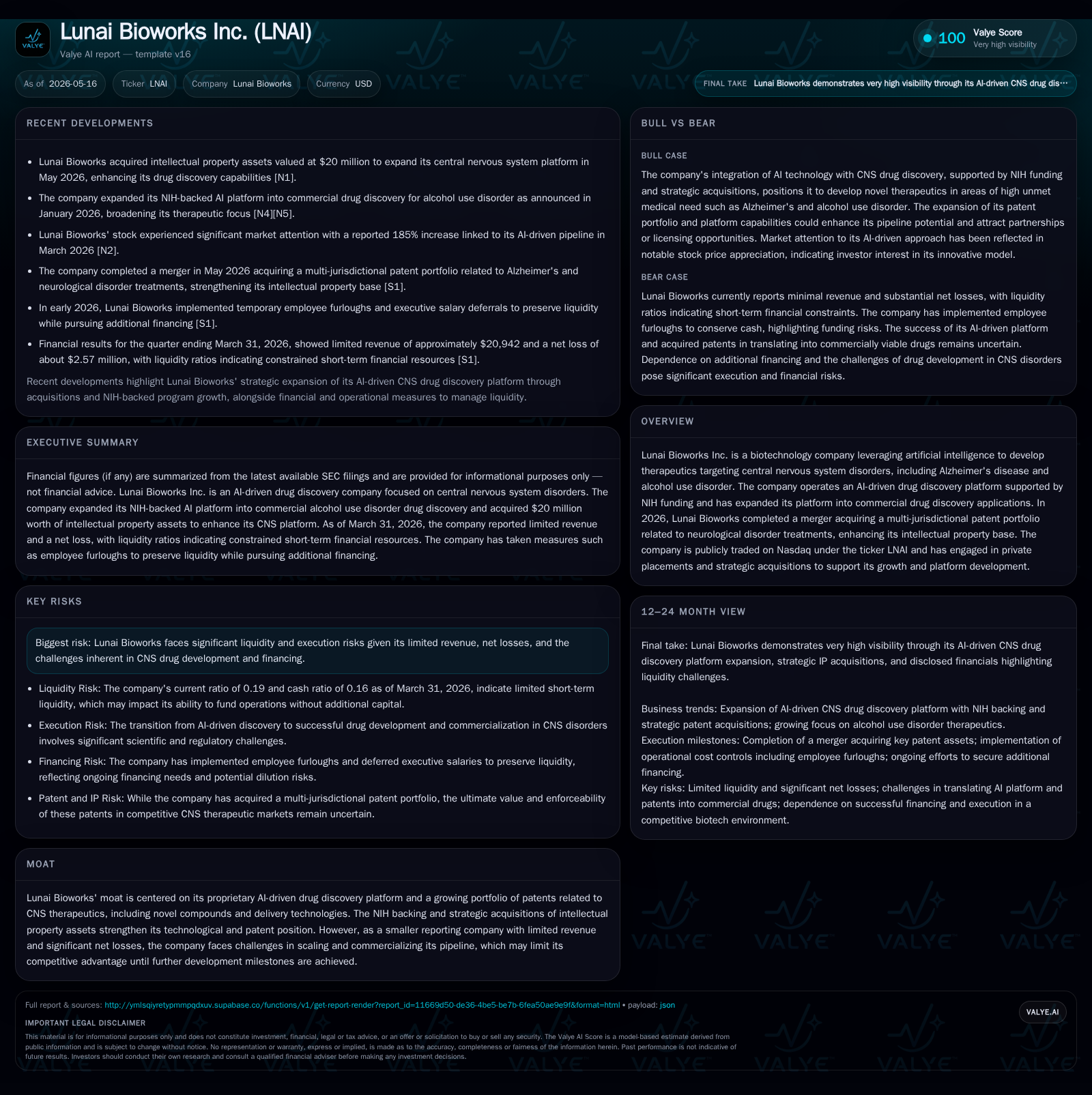
In Q1 2026, Lunai Bioworks completed a transformative merger acquiring a $20 million multi-jurisdictional patent portfolio that markedly enhances its proprietary position in central nervous system (CNS) therapeutic development. The acquisition, alongside ongoing AI-driven drug discovery programs for Alzheimer's and alcohol use disorder, underscores the company’s strategic pivot toward expanding its intellectual property (IP) base and commercial applications. However, significant liquidity constraints evidenced by a low current ratio and ongoing net losses highlight execution risks as Lunai seeks to capitalize on its growing CNS pipeline. Upcoming stockholder votes on equity restructuring and further capital raises are critical near-term milestones to monitor.
Recent Operating Update: Patent Acquisition and Quarterly Developments
Lunai Bioworks’ most recent Q1 2026 filing dated May 15 [S2] and prior event filings [S3] reveal pivotal progress in its strategic positioning within CNS therapeutics. On May 1, 2026, Lunai completed a merger to acquire a multi-jurisdictional patent portfolio valued at $20 million through issuance of Series B Convertible Preferred Stock [S5]. This patent acquisition encompasses novel compounds and delivery technologies targeting neurological disorders such as Alzheimer's disease, enhancing Lunai's intellectual property base significantly beyond its existing AI-powered drug discovery framework.
The Series B Preferred Stock issued carries a fixed conversion price of $1.50 per share with a stated value aggregating to $20 million allocated primarily between Oncotelic Inc. and Pelerin Therapeutics Inc. [S5]. Concurrently, the company secured stockholder approval for a reverse stock split in a range from 1-for-3 up to 1-for-30 shares [S3], aimed explicitly at meeting Nasdaq's minimum bid price compliance standards — a reflection of ongoing challenges related to share price volatility and liquidity.
These developments mark an important inflection point: the infusion of valuable patents tied directly into Lunai’s proprietary AI-enabled CNS drug discovery programs presents both an extension of their moat and a tactical lever for future financing strategies anchored in asset value rather than solely R&D milestones.
Business Model and AI-Driven CNS Therapeutics Platform
Lunai Bioworks operates at the intersection of biotechnology and artificial intelligence focusing specifically on discovering therapeutics for central nervous system disorders such as Alzheimer's disease and alcohol use disorder. Its core revenue model—though currently pre-revenue—anticipates deriving value from proprietary drug candidates developed via its AI-driven platform complemented by licensing arrangements or collaboration agreements once candidates mature.
The company's AI technology accelerates early-stage therapeutic identification by integrating complex biological data sets to model disease pathways and compound efficacy more efficiently than traditional experimental approaches. Enhancement through NIH funding endorsement offers credibility which aids in securing partnerships or grant funding critical for smaller biotechs facing capital-intensive development phases.
The recent patent acquisition strategically widens the scope of Lunai’s platform by incorporating compounds designed to cross the blood-brain barrier with activation mechanisms localized within the brain to minimize systemic exposure [S9], an essential differentiation given the significant delivery challenges endemic to CNS therapeutics. Such proprietary IP elevates switching costs by embedding unique capabilities not easily replicated by competitors without similar patent protections.
Competitive Landscape and Industry Positioning
The neurodegenerative disease space remains one of biotechnology's most challenging frontiers due to high R&D costs, prolonged clinical timelines, regulatory complexities, and historically low success rates. In this environment, Lunai competes with other biotech firms leveraging AI but also faces entrenched pharmaceutical incumbents investing heavily in CNS drugs.
Its competitive moat chiefly rests on:
- The newly acquired multi-jurisdictional patent portfolio protecting both compound innovations and drug delivery methodologies.
- A validated artificial intelligence platform supported by NIH grants that could catalyze more cost-effective early discovery compared to traditional trial-and-error methods.
- Ability to develop combination therapeutics aligning with evolving treatment paradigms requiring synergy across multiple neural pathways.
However, this market remains capital intensive with complex regulatory hurdles specific to CNS indication approvals. Thus, sustained competitive advantage depends heavily on successful clinical progression coupled with robust IP enforcement amidst evolving patent landscapes.
Growth Drivers: Intellectual Property and Platform Expansion
The primary growth vectors for Lunai include advancing its expanded pipeline enabled by recent acquisitions, exploiting patented blood-brain barrier crossing technologies acquired through an agreement valued at $20 million payment in Series B stock [S9], as well as leveraging its AI platform across commercial discovery projects beyond internal candidate development.
Near-term operational KPIs pertinent for growth assessment include:
- Progression of therapeutic candidates into key preclinical or early clinical phases utilizing newly acquired patents adapted for more effective CNS delivery.
- Securing collaborations or licensing deals that monetize the expanded IP portfolio or use the AI discovery platform as a service.
- Successful realization of milestone payments or additional capital raises underpinned by asset valuation.
Further NIH support continues providing non-dilutive funding assistance crucial during these expensive R&D stages.
Risks and Constraints: Execution, Liquidity, and Development Challenges
Lunai faces several material risks fundamentally shaped by its financial structure and sector-specific dynamics:
- Liquidity Risk: With cash & equivalents standing at approximately $3.15 million against current liabilities nearing $19.28 million as of March 31, 2026 ([F1]), its current ratio is critically low at around 0.19 indicating strained near-term liquidity [F1]. This imbalance poses considerable operational continuity risk without timely capital injections.
- Financing Risk: The reliance on Series B Convertible Preferred Stock issuance — while strategic for asset consolidation — introduces dilution risk upon conversion tied to future stock price performance and shareholder approval outcomes [S3].
- Development Risk: CNS therapeutics traditionally endure high attrition owing to complex biology, lengthy trials, stringent regulatory scrutiny compounded here by the experimental nature of some acquired technologies.
- Regulatory & Listing Risk: Approval-dependent reverse stock split governance reflects fragility in share price adherence to Nasdaq rules; failure to implement could lead to delisting threats affecting investor confidence substantially [S3].
- IP Validity Risk: While patents form Lunai’s moat, their enforceability remains subject to legal proceedings which may impact exclusive rights or require costly litigation defenses.
Upcoming Catalysts and Key Milestones to Monitor
Several imminent governance events will serve as critical inflection points:
- Stockholder Vote Results: Final approval outcomes on the proposed reverse stock split (May 8 meeting) [S3] directly influence Nasdaq compliance status with immediate market impact potential.
- Series B Preferred Stock Conversion Rights: Subsequent filings indicating exercise or conversion terms execution timelines can signal shifts in ownership structure affecting share supply.
- Clinical Progress Updates: Announcements regarding candidate advancements leveraging new IP assets will validate platform expansion strategies.
- Partnership or Licensing Deals: Any material collaborations tapping into the combined AI-patent CNS pipeline offer growth visibility beyond internal development constraints.
- Capital Raise Activities: Monitoring indications of fresh equity offerings or debt raises following low liquidity disclosures will highlight runway adequacy for executing developmental goals.
Financial Snapshot: Current Liquidity and Balance Sheet Overview
Latest financial snapshot
| Metric | Value | Period |
|---|---|---|
| Cash & equivalents | $3mm | |
| 2026-03-31 | ||
| Current assets | $4mm | |
| 2026-03-31 | ||
| Current liabilities | $19mm | |
| 2026-03-31 | ||
| Current ratio | 0.19x | |
| 2026-03-31 |
Source: SEC companyfacts cache [F1].
| Metric | Value |
|---|---|
| Cash & Equivalents | $3.15M |
| Current Assets | $3.73M |
| Current Liabilities | $19.28M |
| Current Ratio | 0.19 |
As of Q1 2026 reporting [F1], Lunai maintains minimal cash reserves relative to sizable short-term liabilities reflecting acute liquidity constraints typical for clinical-stage biotechs without commercial revenue streams. Total debt is modest (~$0.54M), but this does little to alleviate overall solvency pressures given operational cash burn exceeding inflows. The financial structure emphasizes dependence on equity-linked financing instruments such as the strategically issued Series B Preferred Stock associated with the patent merger [S5]. This financial snapshot reinforces considerable execution risks tied directly to asset monetization success or further capital access capability while highlighting finite operational runway absent external funding events.
This analysis leverages detailed disclosures from Lunai Bioworks' latest quarterly filings supplemented by strategic event updates surrounding its recent intellectual property acquisition that materially reshape its therapeutic pipeline prospects within complex CNS disorder domains. While advancing an innovative AI-driven approach strengthened through targeted patent consolidations offers promise in overcoming longstanding challenges in neurotherapeutics development, tight liquidity alongside significant developmental uncertainties necessitates careful monitoring of forthcoming corporate governance resolutions and operational milestones moving forward.
This report is for informational purposes only, presenting an analytical perspective based on publicly available SEC filings and company disclosures without offering investment advice.
Disclaimer: This is research-only, informational analysis and not investment advice. It may include AI-generated interpretation and general industry context. Always verify important details using primary sources.

Comments