
Healthy Choice Wellness Focuses on Store Expansion and Margin Improvement Despite Liquidity Challenges
Latest quarterly results underline HCWC’s commitment to growth through acquisitions, operational efficiency, and differentiated natural product offerings.
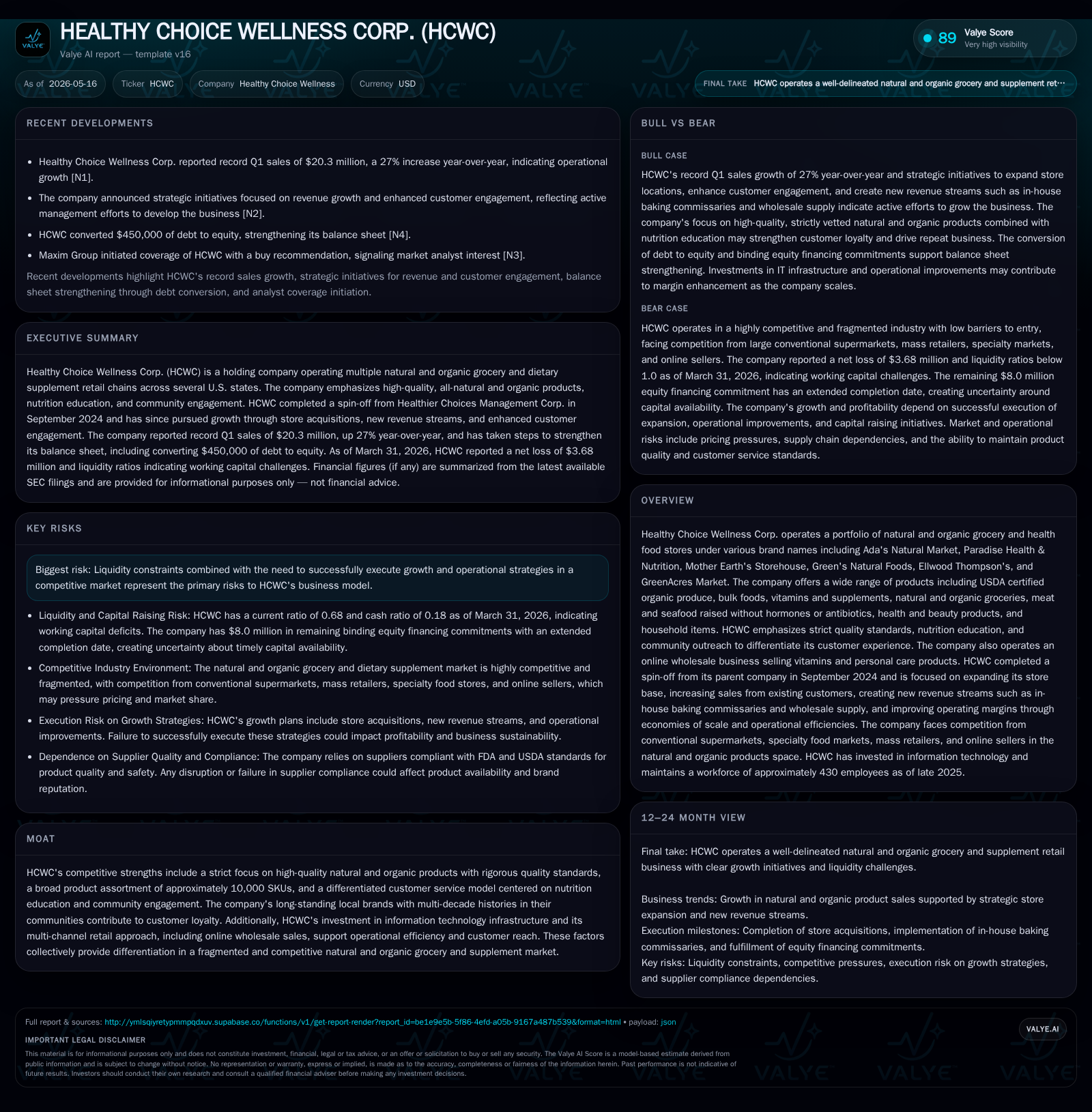
Healthy Choice Wellness Corp. (HCWC) reported ongoing efforts to expand its footprint across natural and organic grocery and wellness sectors in the latest quarter ending March 2026. The company continues facing liquidity constraints but is managing these via equity raises, cost optimization, and store portfolio enhancements. Its business model leverages locally-rooted brands and a multi-channel approach combining retail stores and wholesale online sales. Growth is planned through store acquisitions, expanding customer base with targeted education programs, and introducing new revenue streams like in-house baking commissaries. HCWC's competitive position rests on strict quality controls, nutrition-focused customer service, and broad product assortments in a fragmented market with low barriers to entry.
Recent Operating Update
The latest quarterly filing for the period ending March 31, 2026 ([S2]) confirms Healthy Choice Wellness Corp.'s continued strategic emphasis on expanding its physical retail footprint while improving operational efficiencies. The company did not report significant changes in risk factors compared to prior periods ([S27]), but its operating narrative highlights ongoing initiatives to leverage fixed costs through scale as new stores are added.
HCWC continues to implement its revamped VIP membership loyalty program introduced in August 2024 ([S11]), which replaced the previous points-accumulation system with immediate discounts at the point of sale. This change simplifies revenue recognition by reducing contract liabilities associated with deferred loyalty points.
Business Model
Healthy Choice Wellness operates as a holding company for a multi-brand portfolio of natural and organic grocery stores and wellness product retailers spread primarily across the eastern and central United States ([S13]). Its subsidiaries operate under six major banners: Ada's Natural Market, Paradise Health & Nutrition (3 stores), Mother Earth’s Storehouse (1 store), Green’s Natural Foods (8 stores), Ellwood Thompson’s (1 store), and GreenAcres Market (5 stores) ([S1][S13]).
The business model centers on offering high-quality natural and organic food products including USDA certified organic produce, bulk foods, vitamins/supplements, hormone/antibiotic-free meat and seafood, health & beauty products, as well as natural household items ([S1]). HCWC stresses strict adherence to quality standards by excluding foods with artificial additives such as colors or preservatives ([S18]), differentiating itself from many competitors who offer less stringent selections.
Employees receive robust training focused on nutrition education so they can provide knowledgeable customer service—one of HCWC’s key differentiators aimed at fostering customer loyalty through empowered consumer choices ([S18][S25]). Nutrition education is delivered across multiple channels: in-store coaching, newsletters, cooking classes, and community outreach programs.
In addition to brick-and-mortar retail operations, the company operates an online wholesale platform selling vitamins and personal care products through its wholly owned subsidiary Healthy U Wholesale ([S5]). This multi-channel approach allows HCWC to diversify revenue sources.
Industry Structure and Competitive Position
The natural and organic grocery market is large but highly fragmented with low barriers to entry ([S25]). Competitors range broadly from conventional supermarket chains like Publix or Winn-Dixie to specialty retailers such as Whole Foods or Trader Joe’s; it also faces competition from mass merchandisers like Walmart/Target, drugstores carrying supplements, farmers’ markets, online retailers, and multi-level marketers.
HCWC's competitive moat relies on:
- Local brand legacy: Several of its banners have operated for decades within their communities—important intangible assets promoting customer affinity ([N/A analysis from firm context]).
- Rigorous product selection criteria preventing sale of lower-quality or synthetic-laden goods ([S18]).
- Employee focus on nutrition education enhancing shopper experience uniquely ([S18]).
- A broad SKU assortment (~10,000 SKUs) sourced from approximately 1,000 suppliers including notable distributors like Kehe Distributors LLC ([S19]), enabling rich product diversity.
- Investment in IT infrastructure enhancing inventory management and operational reporting supports scalable growth ([S18]).
Nonetheless, intense competition exists with mounting pressure on pricing due to discounters entering more organic categories. Total debt stood near $6.46 million versus cash at $2.35 million implying net debt around $4.1 million [F1]. This strained liquidity requires vigilant cost management alongside securing committed equity financings scheduled through April 2027 totaling roughly $8 million in Series A Preferred Stock capital commitments—though timing delays in drawing these funds increase uncertainty about sufficiency for operating needs beyond one-year horizon ([S6][S7]).
Execution risks linked to integrating acquired stores seamlessly while maintaining quality standards also loom large given rapid geographic breadth expansion plans ([N/A analysis linked to fragmented operations complexity]). Maintaining supplier relationships amidst competitive pressures for premium natural products could impact availability or cost structures if alternatives are limited or less favorable ([S19]). The competitive environment demands continuous product innovation alongside price discipline due to encroachment by larger supermarket chains offering organic ranges ([S25]).
What To Watch Next
- Quarterly updates on acquisitions closed or new store openings will indicate pace of physical expansion progress.
- Metrics around loyalty membership enrollment growth vs prior point-based system redemption rates may shed light on customer engagement success.
- Operating margin trends reflecting realized fixed-cost leverage gains especially across administrative expenses as more stores scale up.
- Execution milestones tied to commissary bakery launch outcomes including wholesale client additions.
- Drawdowns of committed preferred stock capital—and any amendments delaying these commitments—will strongly shape balance sheet flexibility timing.
- Inventory turns/supply chain updates given importance of freshness preservation in refrigerated private label products.
Financial Profile Summary
Latest financial snapshot
| Metric | Value | Period |
|---|---|---|
| Cash & equivalents | $2.35mm | |
| 2026-03-31 | ||
| Total debt | $6.46mm | |
| 2026-03-31 | ||
| Net debt | $4.11mm | |
| 2026-03-31 | ||
| Current assets | $8.81mm | |
| 2026-03-31 | ||
| Current liabilities | $12.95mm | |
| 2026-03-31 | ||
| Current ratio | 0.68x | |
| 2026-03-31 |
Source: SEC companyfacts cache [F1].
As per the Q1 2026 SEC filing data [F1]: Operating income remained negative as per previous full-year figures (-$2.48M ended Dec '25) with net losses around -$3.93M for that year [F1]. These underscore ongoing challenges in achieving profitability amid growth investment phases.
Management’s ongoing plans emphasize cost reductions recommended by operational consultants alongside steady equity raises while expanding the physical footprint aiming over time to increase sales volume sufficiently enough to absorb overheads more efficiently ([S4],[S7],[S15]).
Disclaimer
This analysis is provided strictly for informational purposes based on publicly available SEC filings up to May 16, 2026. It does not constitute investment advice or a recommendation regarding securities of Healthy Choice Wellness Corp.
Disclaimer: This is research-only, informational analysis and not investment advice. It may include AI-generated interpretation and general industry context. Always verify important details using primary sources.

Comments