
Israel Acquisitions Corp Faces Critical Deadline in Business Combination Amid Liquidity and Listing Challenges
ISRLF extends business combination agreement termination date to May 31, 2026, as liquidity pressures escalate with delisting completed and Sponsor support crucial.
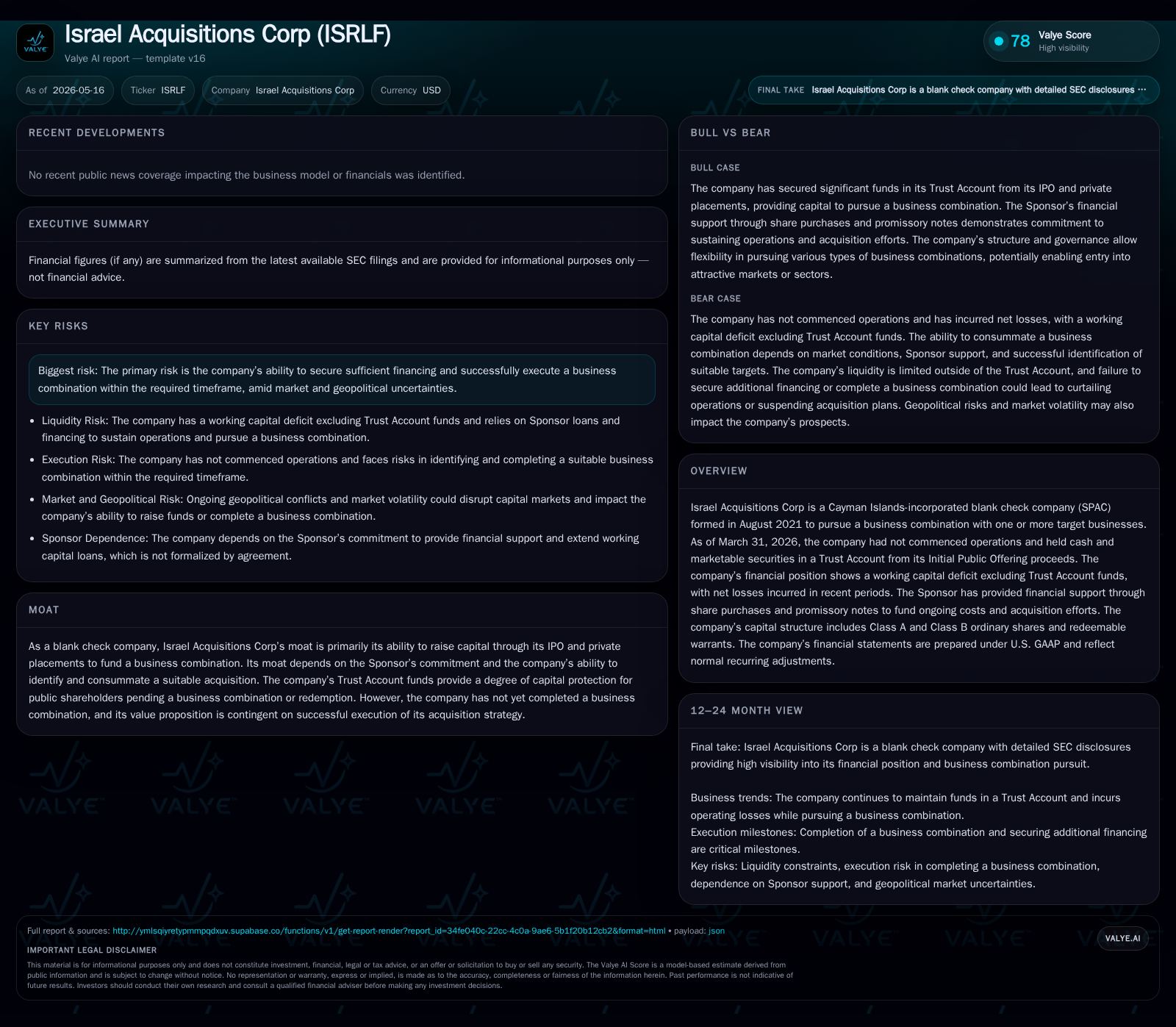
Israel Acquisitions Corp (ISRLF) operates as a blank check SPAC holding IPO proceeds in trust, yet the company faces mounting operational challenges without having completed a business combination. Recent amendments extend the window to consummate its merger with Gadfin Ltd. to May 31, 2026, but liquidity remains severely constrained with minimal operating cash and working capital deficits, compounded by Nasdaq delisting in late 2025. The firm depends heavily on Sponsor financial support to maintain viability while seeking a suitable target amid geopolitical uncertainties affecting deal execution.
Recent Operating Update
The latest quarterly filing dated May 15, 2026 ([S2]) reveals that Israel Acquisitions Corp and its targeted merger partner Gadfin Ltd., along with Gadfin Regev Holdings Ltd., agreed to extend the termination date of their Business Combination Agreement (BCA) to May 31, 2026. This fifth amendment provides an additional two weeks beyond the original termination date of May 15 but maintains all other termination rights intact. Both parties retain rights to terminate if material breaches or misrepresentations occur or if a superior proposal surfaces prior to shareholder approval.
Crucially, the company has not consummated any business combination as of quarter-end March 31, 2026. It holds proceeds from its initial public offering (IPO) primarily in a Trust Account rather than generating operating revenue, consistent with its SPAC blank check structure.[S2][S3]
Liquidity remains a critical constraint. As of March 31, the firm had only $32,586 in its operating bank account against current liabilities of $8.28 million (excluding trust assets), creating a working capital deficit near $2.84 million when discounting Trust Account funds.[F1] The total debt reported was over $2.12 million due mainly to promissory notes and related-party loans from the Sponsor,[F1][S2] signaling heavy reliance on affiliated financing to cover ongoing costs.
Added pressure stems from Nasdaq’s delisting decision effective January 2026 following failure to regain compliance with minimum market value of listed securities rules during late 2025.[S4][S21][S25] Since then, ISRLF securities trade on the OTC Pink Market. This materially impacts liquidity options and investor access.
Management acknowledges substantial doubt about continued operation beyond one year unless additional funding or deal closure occurs.[S2][S6]
Business Model Analysis
Israel Acquisitions Corp is a Cayman Islands-incorporated special purpose acquisition company formed in August 2021.[S1] Its sole business objective is to identify and complete one or more mergers or acquisitions (business combinations) using proceeds raised from an IPO primarily held in escrow as cash and marketable securities within a trust account.[S1][F1]
Revenue generation is nonexistent prior to consummating its first business combination. Instead, income arises from investment gains on trust account holdings and interest/dividends on cash equivalents.[S28] Costs are incurred mainly through administrative expenses and transaction pursuit expenditures funded through sponsor loans or equity injections.[S2]
The company’s moat effectively lies in its access to IPO capital upfront and sponsor commitment providing working capital loans to sustain deal pursuit amid market volatility.[N/A Speculation] Without completion of a business combination within designated timeframes (extended most recently to May 31, 2026), liquidation procedures would be triggered returning funds less expenses back to shareholders.[S2]
The share capital consists of Class A ordinary shares issued in the IPO and private placement shares owned by sponsors (Class B), together with associated redeemable warrants exercisable at $11.50 per share.[S3][F1] Shareholders’ economics depend heavily on deal terms negotiated post-merger initiation and are subject to dilution risks inherent in warrant exercises or additional financings.
Industry Structure and Competitive Position
ISRLF competes within the increasingly complex SPAC ecosystem characterized by numerous vehicles pursuing diverse targets globally. The SPAC space faces intensified regulatory scrutiny post-JOBS Act expansions permitting emerging growth companies like ISRLF favorable accounting transitions.[S2]
Competition hinges on access to quality acquisition targets, speed and efficiency in deal execution, and securing sufficient investor appetite for post-combination equity offerings. ISRLF's position is somewhat challenging given its extended timeline without closing combined with declining market capitalization leading to delisting—factors which blunt investor confidence relative to larger or more active peers.
Furthermore, geopolitical factors involving conflicts impacting Israel region introduce cross-border deal risks that complicate valuations, due diligence logistics, and investor perception dynamics - often tilting favor toward SPACs targeting domestic or stable sectors.
Growth Drivers
Despite operating as a shell pre-transaction entity, ISRLF’s main growth vector involves successfully completing its initial business combination. The extension granted until May 31 aims explicitly at facilitating closure on Gadfin Ltd., a presumably strategic Israeli target although specifics remain confidential outside filings.[S2][S3]
Post-combination growth relies on:
- Accessing additional financing or equity markets leveraged by increased visibility from target’s operational profile.
- Expanding investor base once publicly combined entity delivers operational results.
- Capitalizing on underlying industry tailwinds specific to acquired businesses’ sector (not disclosed).
- Maintaining sponsor support for bridge financing if needed.
Monitoring backlog agreements or commitments by Gadfin or any Superior Proposal developments will indicate deal viability moving forward.
Risks / Watchpoints / Growth Constraints
Major risk factors revolve around:
- The extremely narrow remaining timeframe for completing a transaction before forced liquidation triggers.
- Severe liquidity constraints evidenced by minimal operating cash reserves versus sizeable current liabilities excluding Trust Account funds.[F1]
- Dependence on related-party loans and sponsor goodwill representing single points of failure if withdrawn.
- Market access limitations post-Nasdaq delisting reducing investor confidence and tradability.[S4][S21]
- Geopolitical tensions between Israel-Hamas conflict zone potentially delaying transaction negotiations or deterring participant engagement.
- No revenues yet; entire valuation contingent upon successful combo execution creating binary outcome risks.
- Potential dilutive impacts should further financings be required amid low internal funds.
- Regulatory risks tied to evolving SEC guidelines governing emerging growth companies’ disclosures.
Any material deviation from negotiated terms with Gadfin or emergence of competitive superior proposals could abruptly alter prospects either positively (via termination fees) or negatively (deal collapse). Management’s capacity for swift contingency planning remains critical.[S2]
What To Watch Next
Key upcoming milestones include:
- Whether ISRLF completes the business combination with Gadfin Ltd. by the extended deadline of May 31, 2026.[S2]
- Disclosures concerning any Superior Proposals that may trigger termination rights aligned with corresponding fees.
- Continuation or augmentation of Sponsor working capital loans ensuring operations through closing period.
- Regulatory updates as company remains categorized an emerging growth company opting into extended transition periods affecting accounting standards adoption.[S2]
- Market reaction post-deadline regarding potential liquidation or successful transition from SPAC shell status into operating company entity.
- Updates related to geopolitical developments influencing potential cross-border M&A activity sentiment affecting Israeli companies like Gadfin.
Financial Profile Summary
Latest financial snapshot
| Metric | Value | Period |
|---|---|---|
| Cash & equivalents | $32586 | |
| 2026-03-31 | ||
| Total debt | $2mm | |
| 2026-03-31 | ||
| Net debt | $2mm | |
| 2026-03-31 | ||
| Current assets | $6mm | |
| 2026-03-31 | ||
| Current liabilities | $8mm | |
| 2026-03-31 | ||
| Current ratio | 0.77x | |
| 2026-03-31 |
Source: SEC companyfacts cache [F1].
Israel Acquisitions Corp’s financial condition as of March 31, 2026 reflects typical pre-business-combination SPAC dynamics but under intensifying stress:
The working capital deficit excluding trust assets reflects near-term liquidity insufficiency requiring continuous Sponsor financial injections through related-party promissory notes to fund operations pending transaction closure.[F1][S2]
While trust account balances are substantial historically (~$146 million gross after IPO netting expenses initially), reported amounts have declined reflecting prior use for underwriting commissions plus expenses across quarters leading up to this filing,[S28] suggesting significant erosion without replenishment outside planned acquisitions.
This precarious position underscores elevated going concern risk flagged repeatedly by management pending transaction consummation or liquidation provisions activation.[S2][S6]
Disclaimer: This analysis is based strictly on publicly filed SEC documents as of May 16, 2026. It does not provide investment advice or recommendations but offers an informed overview grounded solely on disclosed data and pertinent industry context.
Disclaimer: This is research-only, informational analysis and not investment advice. It may include AI-generated interpretation and general industry context. Always verify important details using primary sources.

Comments